


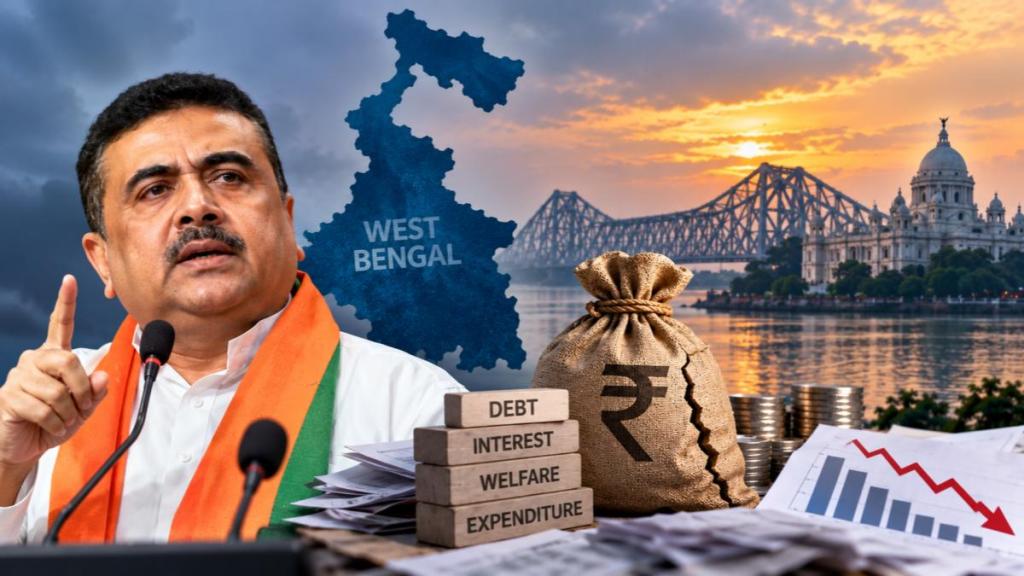

West Bengal Chief Minister Suvendu Adhikari on Monday said years of “fiscal mismanagement” had left the state “practically bankrupt” and that his government would need at least a year to pull it out of financial distress.
The description is politically loaded, but it points to a real problem. West Bengal has a large debt burden, a high interest bill and limited room to spend after paying salaries, pensions and subsidies.
But “bankrupt” is not a technical description of the state’s position. West Bengal continues to collect taxes, receive money from the Centre and borrow from the market. Its economy is growing and its fiscal deficit is budgeted to remain within the limit recommended for states.
Speaking to the press, Adhikari blamed revenue leakage, theft and the previous government’s failure to join several Central schemes for the financial strain. He said the BJP government had now joined all such schemes and that more funds would flow into the state.
The chief minister said the state expects to earn nearly 18% more revenue in 2026-27. That increase will be important because the government is expanding welfare even as it tries to repair its finances.
High debt and a heavy interest bill
West Bengal’s latest budget, presented in June, aims to improve its financial position. According to PRS Legislative Research’s analysis of the 2026-27 state budget, the fiscal deficit is estimated at Rs 62,421 crore i.e. 2.9% of gross state domestic product (GSDP). This is below the 3% ceiling recommended by the 16th Finance Commission and lower than the revised 3.4% recorded in 2025-26.
The revenue deficit is expected to fall from 2.1% of GSDP in 2025-26 to 1% (Rs 21,984 crore). This deficit arises when regular income cannot cover day-to-day spending. A smaller gap would reduce such borrowing.
The targets, however, are ambitious. Revenue receipts are expected to rise 31% to Rs 3.20 lakh crore. Capital outlay, which covers public assets and infrastructure, is projected to jump 55% to Rs 40,930 crore.
Debt stock remains biggest concern
The Comptroller and Auditor General’s report on West Bengal’s finances put the state’s outstanding liabilities at Rs 7.02 lakh crore (38.66% of GSDP), at the end of March 2025. This was slightly above the state’s own target of 38%.
However, the ratio has fallen from 42.6% in the pandemic year of 2020-21 and is budgeted to decline further to 38% this year. A 16th Finance Commission study said Bengal’s debt problem had built up across governments, rather than during one recent period.
West Bengal has budgeted Rs 53,034 crore for interest and Rs 54,607 crore for debt repayment. Salaries, pensions and interest will absorb Rs 1.62 lakh crore i.e. 51% of projected revenue receipts. The CAG said fixed expenses and subsidies used up nearly 74% of receipts in 2024-25, leaving only 26% for other needs.
The auditor found that 41% of revenue expenditure was financed through net borrowing. Capital spending fell 25% to Rs 21,622 crore, 1.19% of GSDP.
Welfare promises add to the pressure
This helps explain why the government has not immediately doubled payments for elderly and specially-abled beneficiaries, as the BJP had promised. Adhikari said another increase would be considered when finances improve.
The pension adds to an already large welfare bill. The budget provides Rs 36,000 crore for Annapurna Bhandar, the cash-transfer programme for eligible women — about 11% of projected revenue receipts.
Adhikari said 1.48 crore women received money under it in August. That scale means even small changes in benefit levels can have a sizeable effect on annual expenditure.
Revenue growth will decide the recovery
The government’s revenue target will be the first major test of Adhikari’s one-year recovery claim. Bengal’s own tax revenue is pegged to rise 17% to Rs 1.31 lakh crore in 2026-27, broadly in line with his statement that revenue would increase by nearly 18%. State GST, the largest source of the state’s own taxes, is projected to grow 14% to Rs 61,535 crore.
Citing Reserve Bank of India data, PRS said its own-tax revenue was 5.4% of GSDP in 2024-25, below the 6.3% state average. Non-tax revenue was 0.2% of GSDP, against an average of 1%.
The Finance Commission study linked this weakness to slower organised-sector growth and inefficient tax collection. Lasting improvement will also require more formal businesses, investment and income growth.
The other part of the plan is more Central funding. Grants are budgeted to rise from Rs 22,069 crore in 2025-26 to Rs 71,393 crore as Bengal joins more Central schemes. Together with its share in Central taxes, transfers from New Delhi would provide about 57% of projected revenue receipts.
This could ease the pressure, but is not guaranteed. Central grants in 2025-26 were revised 41% below budget. Releases depend on scheme rules, matching funds, project progress and timely accounts.
The CAG said utilisation certificates covering Rs 1.36 lakh crore were still pending in March 2025. It also found Rs 8,296.51 crore unused in accounts handling Central schemes.
West Bengal therefore faces serious financial stress, but the data do not point to literal bankruptcy. The budget projects a Rs 21.48-lakh-crore economy, with strengths in agriculture, engineering, steel, petrochemicals, tea, jute and logistics, according to the India Brand Equity Foundation.
The one-year test is straightforward: can the government raise revenue as promised, use Central funds, borrow less for routine expenses and protect capital spending? If the targets are missed, debt, welfare commitments and interest payments will continue to leave Bengal with little room to manoeuvre.