


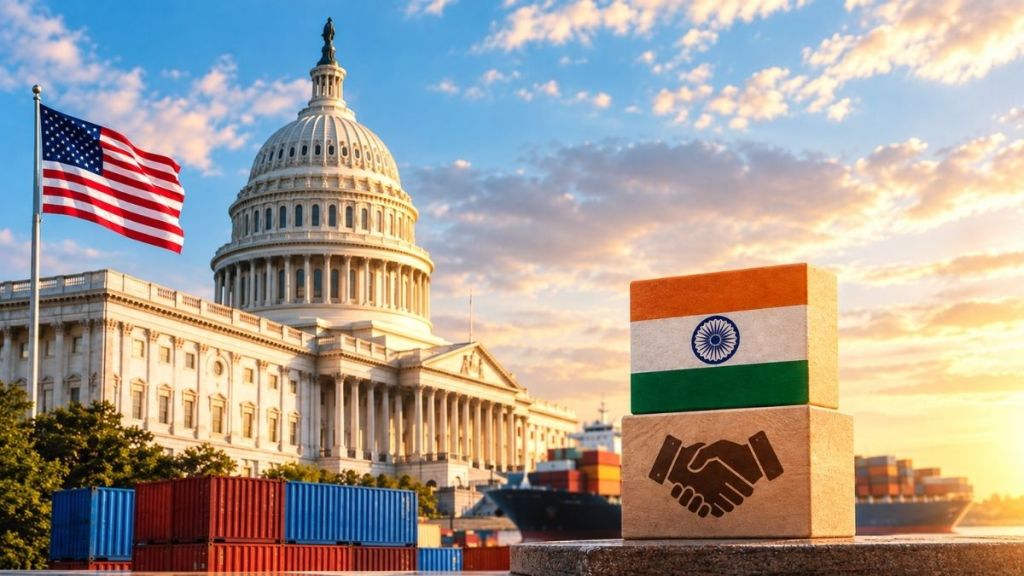

The United States may design a tariff architecture that will give India preferential market access vis-à-vis its key competitors under a bilateral trade deal (BTA) in the works.
“There is a requirement that any deal has to give you certain kind of preferential access on each other’s part. From the Indian side, because we are operating on MFN (most favoured nation) tariffs, it is easier to do so. From their (US) side, they are operating on executive tariffs. So they are building an architecture which will create those differentials and create a preferential market access,” Commerce Secretary Rajesh Agrawal said Wednesday.
Though New Delhi stated multiple times in recent weeks that competitive tariff advantage for the country’s exporters was a must for clinching an interim BTA with the US, this is the first time a senior government functionary has indicated that Washington is indeed working on this.
Talking to the media on the sidelines of the Global Fintech Summit in Mumbai, the secretary said the deal has more or less been finalised but both sides are discussing a few remaining items before it is signed at an appropriate time.
Bangladesh, Vietnam, Indonesia and Malaysia are among India’s key Asian competitors in the US market.
The new US architecture is in the form of tariffs under Section 301 of the Trade Act, Section 232 of the Trade Expansion Act and other measures. These were necessitated as the US Supreme Court invalidated reciprocal tariffs that differed for each trade partner and formed the basis of negotiations on trade deals.
In February, India and the US announced the framework for the first phase of the pact, but changes in the tariff landscape after the US Supreme Court invalidated reciprocal tariffs have led to further negotiations between the two countries.
To take the negotiations forward, Commerce and Industry Minister Piyush Goyal would visit the US in late September to attend the G-20 Trade Ministerial in Milwaukee and hold bilateral talks with USTR Jamieson Greer, with trade pact issues to figure in the discussions.
Despite the delay in the deal our trade with the US has been growing. In 2025-26 despite wild swings in US tariffs on India, India’s exports to the US grew a flat 0.92% year-on-year to $87.3 billion. In April-July exports to the US are up 3% to $ 34.4 billion.
On the increase in freight rates and some disruptions in the availability of containers due to the West Asia war and possible support to exporters to deal with it, Agrawal said all countries are facing this issue and these costs are being passed on to buyers.
“However, having said that, we are working with the exporters. First, our objective is to see that they have enough access to ships and containers so that their cargos are not stuck. Then the second option is to create how much we can ensure that their costs are competitive, the cargo times are minimal,” he added.
Earlier in his address the commerce secretary said services exports have been growing by 8 to 10% year after year and with this pace they will grow beyond the goods exports also. For future growth in services exports diversification is required. At present 50% of services exports are from IT and IT enabled Service (ITeS) and 30% from professional services.
“Financial services trade globally is also growing very fast. Today it is more than $670 billion.
But India’s contribution to that trade export is only around $8 billion. We are around 1.2, 1.3% of the global trade. And that is where I think Fintech can actually make the change,” Agrawal said..
Now it’s time to see whether we can use the unique experience (in Fintech) to take these services across the world. If you look at the cross-border payments market, which is today at $180 to $190 billion, that is projected to go up to $360 billion by 2032. The cards and payment market is around $1 trillion and expected to go to $1.5 trillion by 2028-29.
So there is a real growth in these sectors by 9-10% year after year. India has also some of the experiences where we have built fintech solutions at population scale, at scale which is second to none, he added.