


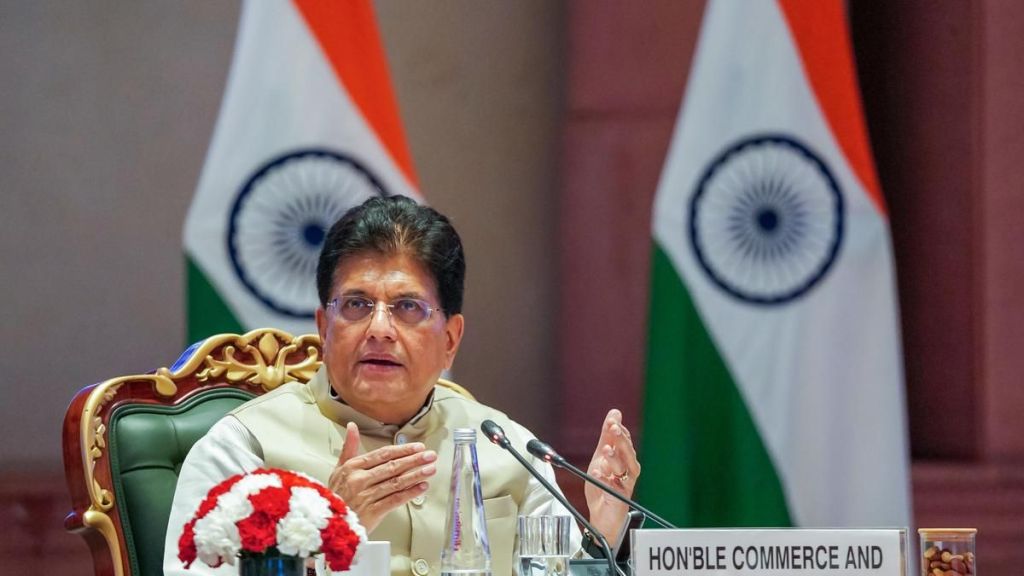

In a major boost to domestic manufacturing, Commerce and Industry Minister Piyush Goyal on Monday offered full government financial backing to establish state-of-the-art testing laboratories for medical equipment and machinery.
Addressing the Pharma MachTech and LabNext Expo 2026, organized by EEPC India, Goyal urged the industry to build a robust local component ecosystem centered on uncompromised quality and global benchmarking.
“We must develop a critical component ecosystem by strengthening our domestic capabilities with high quality. We must create a shared testing infrastructure where these equipment can be tested, benchmarked to the best in the world, certified, and demonstrated to global customers,” Goyal said.
Highlighting the government’s commitment through the Bureau of Indian Standards (BIS), Goyal emphasized that funds would not be a constraint for quality control infrastructure. “From BIS, we are willing to support 100% cost of the best testing equipment for your equipment… 100% of the government will fund the acquisition of testing equipment… demand from us, there is no proposal from you. And we will set up the most modern labs,” he added.
Beyond infrastructure, the minister urged the medtech sector to accelerate innovation by forging international technology partnerships, establishing joint foreign R&D facilities, and importing cutting-edge global technologies. He also called for localized design centers and an expanded startup incubation network for medtech, consumables, and medical machinery.
To position India as an international innovation hub, Goyal stressed the need to strengthen intellectual property frameworks, including design protections, copyrights, and patent laws, leveraging the nation’s substantial cost advantages.
Speaking earlier at the inaugural ceremony of Sanjeevani 2026 during the Bharat Health Global Expo 2026 in New Delhi, Goyal urged the sector to transition India from being the “pharmacy of the world” to the premier “medical destination of the world.”
Pointing to healthcare costs that remain 60% to 80% lower than in developed nations alongside advanced technological capabilities, Goyal set an ambitious target for Medical Value Tourism. While 3.5 million foreign patients visited India over the past seven years, he noted that the country has the doctors, capacity, and ecosystem required to scale that figure to 10 million patients annually.
Goyal also called on health-tech firms and insurers to streamline patient care and speed up reimbursements, while insisting that high-quality care must extend equally to domestic patients. “India must ensure that every Indian patient receives the same high-quality healthcare as anyone coming from across the world,” he added.