


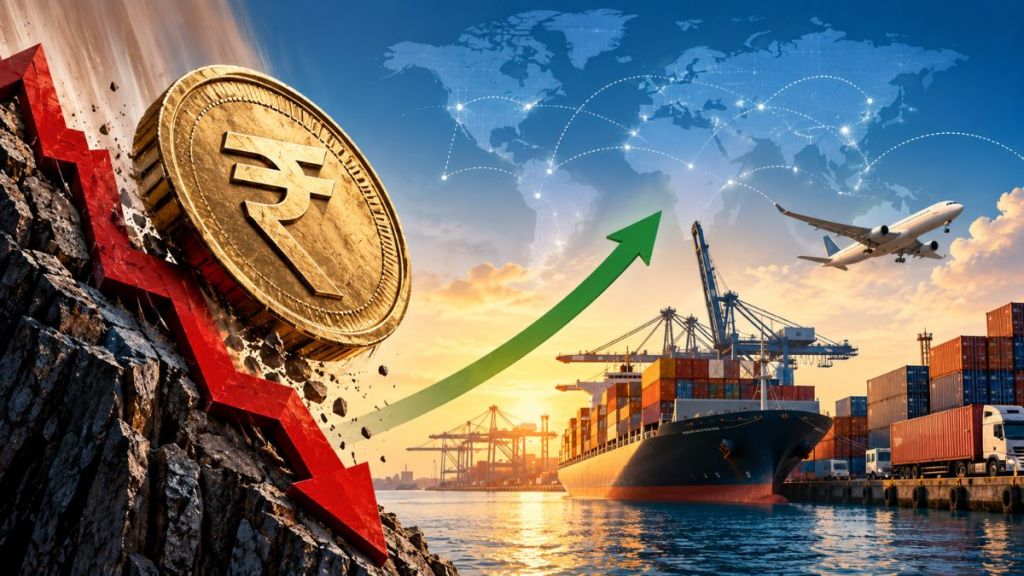

India’s real effective exchange rate (REER) has remained below the 100-mark for 13 consecutive months, indicating that the rupee has become relatively undervalued against the currencies of India’s major trading partners.
A REER index value of 100 serves as the neutral baseline. If the rupee is over that it is overvalued and below that it is undervalued against a basket of 40 currencies tracked by the Reserve Bank of India, which shows its purchasing power against other currencies of trading partners.
According to Bank of Baroda, the trend could improve the price competitiveness of domestic goods in international markets. However, it does not automatically translate into faster export growth, as global demand, productivity, trade policies and other economic factors also influence exports.
What is REER, why does it matter?
Before delving deep into the impact of a weak REER, let’s first understand how REER works, and why it’s important to track this metric. There are two parameters of tracking the movement in the effective exchange rate, the nominal effective exchange rate (NEER) tracks the rupee against a basket of trading-partner currencies, while the real effective exchange rate (REER) adjusts this measure for inflation differences.
Nominal depreciation of rupee, Foreign portfolio investor (FPI) outflows, Higher crude oil prices, Geopolitical tensions and volatility in global financial markets along with inflation have weighed on the rupee leading to the decline of REER.
Weaker rupee can boost exports
An undervalued currency can improve export competitiveness by making a country’s goods relatively cheaper in international markets.
However, the relationship between REER and export growth is not always straightforward. A weaker currency does not automatically translate into higher exports, as overseas demand, productivity, global economic conditions and trade policies also influence performance.
India’s experience during 2018-19 illustrates this. Between December 2018 and February 2019, when the REER remained below 100, export growth averaged 3.4%, below the long-term average.
The more recent trend has been stronger. Merchandise exports grew by an average of around 7.8% during the 12-month period examined in the report, broadly in line with the long-term average of approximately 8%.
More importantly, merchandise exports grew 18.8% during April-August 2026, while non-oil exports increased by 14.4%.
The report cautions that this improvement cannot be attributed solely to the weaker rupee. Global demand, macroeconomic conditions, terms of trade and government initiatives, including production-linked incentive schemes, have also supported exports.
What lies ahead for the rupee’s competitiveness?
India’s NEER and REER have both declined significantly over the past year, with the rupee’s nominal depreciation emerging as the primary driver. Inflation differentials, capital flows and narrowing interest-rate differentials have also influenced the movement.
The sustained decline in REER could support India’s export competitiveness by making domestic goods relatively cheaper for overseas buyers. The strong growth in merchandise and non-oil exports during April-August 2026 provides some evidence of improving export performance, although the contribution of currency movements remains difficult to isolate.
The broader trend suggests that several Asian economies are gaining a relative price-competitiveness advantage over advanced economies. For India, the key question is whether the weaker REER can translate into sustained export growth amid geopolitical uncertainty, volatile commodity prices and changing global trade policies.