


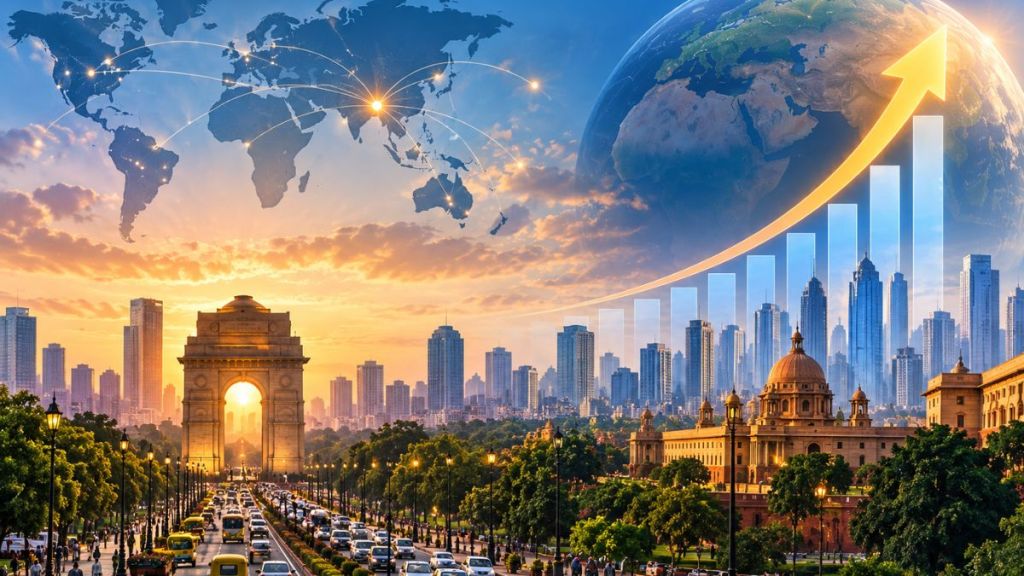

Delhi is not among the world’s 100 highest-ranked cities today. However, by 2050, it could be one of the cities that reshapes the global economy. As per Oxford Economics’ Global Cities Index 2026, some of the cities that appear relatively unremarkable on today’s global league tables could become the engines of tomorrow’s growth.
The city of Delhi is a major example for the same. It is projected to add $1.8 trillion in nominal GDP between 2025 and 2050, placing it among the ten cities expected to record the largest absolute additions to economic output anywhere in the world, alongside New York, Shanghai, Los Angeles, London and Tokyo.
Delhi, however, is only the beginning. From Bengaluru’s transformation into a global technology hub to the rise of Coimbatore, Surat and dozens of smaller Indian cities, the Oxford Economics report sketches out a country undergoing a remarkable urban transformation. The map of economic power is beginning to move and India is right in the middle of it.
Delhi: The giant hiding in plain sight
Look at Delhi today and the contradiction is difficult to miss. The city ranks 268th overall in Oxford Economics’ index of 1,000 cities worldwide. Its weaknesses are familiar. According to the report, strained infrastructure, poor environmental conditions and a quality of life that has struggled to keep pace with the city’s extraordinary expansion have impacted its overall ranking.
Look beneath those numbers and a very different Delhi emerges. On human capital, the city ranks 13th in the world. Delhi has something many of the world’s established economic powerhouses increasingly struggle to find. That is, a vast pool of educated and skilled workers capable of powering higher-value industries.
The city is, in effect, a giant reservoir of economic potential surrounded by infrastructure that is still catching up. This tension may define India’s urban story over the next quarter-century.
Oxford Economics expects Delhi to add $1.8 trillion to its nominal GDP between 2025 and 2050. Shanghai and Beijing are similarly positioned for enormous increases, despite all three cities currently sitting outside the global top 100 overall.
By 2050, the combined share of global city GDP generated by China and India is projected to overtake Europe’s. The economic centre of gravity is moving east. Bengaluru is no longer India’s future. It is its present. If Delhi represents scale, Bengaluru represents velocity.
For decades, India’s technology capital was described in the language of possibility. It was India’s Silicon Valley, the next global tech hub, the city that could become the country’s gateway to the digital economy.
Much of that future has already arrived. Oxford Economics report explainss Bengaluru as one of five rising cities to watch across the Asia-Pacific region, alongside Kuala Lumpur, Ho Chi Minh City, Shenzhen and Tashkent. The transformation has been extraordinary.
Over the past 25 years, Bengaluru’s population has more than doubled to over 14 million. Its GDP has grown at close to 10% a year on average since 2000, with several years of double-digit expansion.
The city is now expected to rank among the world’s fastest-growing urban economies. It is projected to be the 10th-fastest-expanding city economy among the 1,000 cities in the index over the next five years, and the fifth-fastest-growing city overall through 2030.
Its 2025 numbers give a sense of the scale already reached. Bengaluru has a GDP of around $314 billion, a population of 14.5 million and GDP per capita of roughly $9,200. The more important question is what comes next. The city is moving beyond the outsourcing and software-services model that made it famous.
Research and development, deep tech, artificial intelligence, these are the next battlegrounds. Google and Microsoft are among the thousands of foreign corporations with a presence in the city. Karnataka’s new IT policy for 2025-30 is designed to keep attracting technology, business process outsourcing and infrastructure investment.
Bengaluru is no longer merely a place where the world gets its software built. It increasingly wants to be a place where the world invents what comes next. There is a catch. The city is growing faster than its infrastructure.
Traffic congestion, stretched public transport, housing shortages and poor air quality are increasingly the price of Bengaluru’s success. Lower-income residents are being pushed into slums and hostels as housing supply struggles to keep pace. Its economic ascent has been spectacular. Its urban systems are still trying to catch up.
The rise of the Indian city is bigger than Bengaluru
The most important revelation in the Oxford Economics report is that India’s urban transformation cannot be reduced to a story about Delhi, Mumbai and Bengaluru.
The growth is spreading. Indian cities are increasingly moving into high-productivity sectors such as advanced manufacturing, technology, financial services and business services. These sectors historically powered many of the world’s richest urban economies.
Oxford Economics expects several Indian cities to become major centres of financial and business services by 2050. Bengaluru, in particular, is expected to emerge as a genuine global technology hub.
India is also projected to have four cities among the world’s top 100 for financial and business services value added by 2050, a significant increase from two decades ago.
It is a profound change. For much of the modern economic era, the world’s most valuable urban economies were concentrated in North America, Western Europe and a handful of Asian powerhouses. Now another generation of cities is coming through. Then there is the consumer boom. There is another number in the report that may ultimately matter just as much as GDP.
Case of households
Oxford Economics expects the number of high-income households globally to nearly double by 2050. Almost two in five of the new high-income households are expected to come from India and China.
Across Asian cities alone, more than 54 million high-income households are projected to be added over the next 25 years. By 2050, those households could account for roughly a third of the world’s total, approximately as many as the United States is expected to have.
India’s urban transformation is therefore not simply about producing more. It is about creating millions of new consumers. People who will buy homes, cars, financial products, travel, education, healthcare, entertainment and technology. The world’s next great consumer markets are being built in cities.
The 91-city story
The easiest way to understand the scale of India’s transformation is simply to count the cities. Ninety-one Indian cities feature among Oxford Economics’ 1,000 ranked cities worldwide. The familiar giants are there: Delhi, Mumbai, Bengaluru, Chennai, Kolkata and Hyderabad. Oxford Economics places these six in its Developing Megacities archetype. These are urban areas with populations above 10 million where infrastructure has often struggled to keep pace with extraordinary population growth.
The more interesting story lies beyond the giants
- Coimbatore
- Surat
- Jaipur
- Nagpur
- Vadodara
- Visakhapatnam
These cities sit within the report’s Emerging Standouts category. They are cities in the developing world that are outperforming their own national economies and attracting people through faster productivity growth and higher incomes. India’s urban story is becoming less about a handful of giant metropolitan centres and more about an entire network of cities moving up the economic ladder. The next Bengaluru may not look like Bengaluru today.It may be a city that is barely on the global radar.
Thrissur: A smaller city with a bigger story
Then there are cities such as Thrissur. The Kerala city may be better known for its temples, festivals and cultural identity than for its place on a global economic map. Oxford Economics has put it there. Thrissur ranks 477th among 1,000 cities globally.
Its strongest score is in economics, where it ranks 334th. Its human capital ranking is 611, quality of life 584, environment 468 and governance 415. The numbers reveal a familiar pattern. The economic engine is moving faster than the systems around it.
Thrissur’s position in the index is a reminder that India’s urban transformation is not happening only in cities that dominate international headlines. Smaller urban centres are also accumulating economic weight, even when their infrastructure, human capital and quality-of-life indicators have yet to catch up. This gap may be one of the defining challenges of India’s next phase of growth.
The price of speed
There is a temptation, when looking at projections stretching to 2050, to see only the upside. The numbers make that easy. Trillions of dollars in new GDP. Millions of new high-income households. Technology hubs expanding into artificial intelligence and deep tech.
Indian cities moving closer to the economic scale of their Western counterparts. Oxford Economics’ report contains another story running beneath the optimism. Growth creates pressure. Delhi’s environmental problems are already reflected in its rankings. Bengaluru’s roads, housing market and public transport are struggling under the weight of its success.
Across India’s developing megacities, population growth has repeatedly outpaced the ability of urban infrastructure to respond. India’s next chapter is therefore more complicated than a simple growth story. The question is no longer whether Indian cities can grow.They clearly can. The harder question is whether they can build fast enough to live well while they grow.
The map is being redrawn
For centuries, the world’s economic map was dominated by a relatively small collection of cities:
London
New York
Paris
Tokyo
Then came Shanghai, Shenzhen, Singapore and a new generation of Asian economic centres. Delhi is projected to add trillions of dollars to its economy. Bengaluru is racing towards the front ranks of the global technology economy. Dozens of Indian cities are building the foundations of their own ascent.
The major thing about India’s urban future may not be that one or two cities become global giants. It may be that an entire country becomes a network of them. By 2050, the world’s economic map could look very different from the one we know today.
Somewhere inside that new map will be a much larger India, represented not by one Delhi or one Bengaluru, but by dozens of cities moving, unevenly and sometimes chaotically, towards the same horizon.