




‘AI will take your job’ has been the conventional narrative surrounding the rising use of artificial intelligence. However, emerging reports suggest AI is not replacing jobs; it is reshaping them. The technology is driving hiring trends, restructuring roles towards less specialised activities, and, more importantly, setting wage premiums for workers who possess AI-fluent skills.
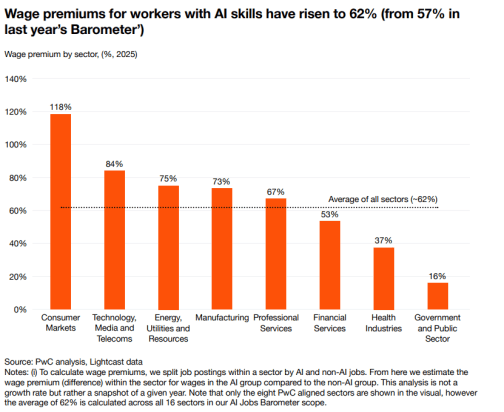
According to PwC’s 2026 Global AI Jobs Barometer report, this wage premium has risen sharply and now stands at 62%, up from 57% in last year’s report. Economists and analysts call this the AI-wage premium, meaning the extra pay for workers with specialised AI skills.
Source: 2026 Global AI Jobs Barometer
This AI-wage premium reflects the pay gap between two similar job postings in the same sector: one requiring AI-related skills, such as prompt engineering or machine learning, and another that does not. The PwC report noted that wage growth in AI-exposed companies has risen much faster than in those with the least exposure.
As companies prioritise AI investments and employers seek AI specialists, it becomes important for jobseekers to have the right AI foundation so as to leverage this premium.
How AI Reshapes ‘Professionalised’ vs ‘Democratised’ Job Roles
According to Shantanu Rooj, Founder and CEO of TeamLease Edtech, the AI-wage premium is emerging as companies seek to deploy talent that can scale up business impact. Citing EdTech’s Career Outlook Report HY2 2026, he said that companies are not just paying this premium for AI knowledge but for getting a workforce that can deploy AI to improve productivity, automate workflows and make better decisions.
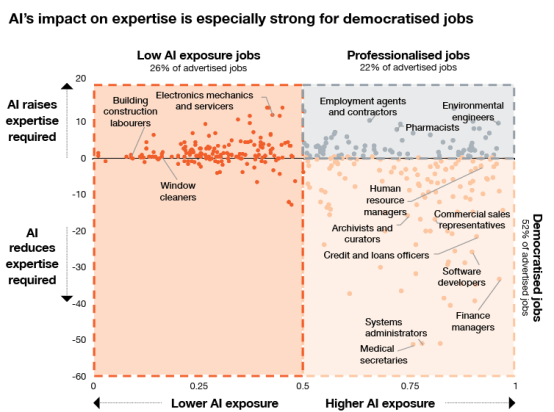
For example, AI can help an employment recruiter with tasks like scanning CVs, which in turn can help them focus on more demanding operations like negotiating contracts. PwC addressed these as ‘Professionalised Jobs’, which are reshaped by AI to demand more expertise.
Source: 2026 Global AI Jobs Barometer
It added that average salaries in these professionalised roles have grown 42% faster than those in democratised roles, which are jobs shaped by AI to require less expertise. “AI is becoming a multiplier for professionals across industries,” added Rooj.
Scarcity of skilled talent in India
Elaborating on the same, Vamsi Karavadi, Partner at Deloitte India, stated that the AI wage premium in India is primarily driven by the scarcity of skilled talent. “Productivity gains are still emerging as organisations scale AI use cases, but we expect measurable business impact to become a stronger driver over time,” he added.
TeamLease EdTech, in its report, noted that employers in India are moving beyond hiring only for technical knowledge and are preferring candidates who use AI to drive efficiency rather than simply holding AI certifications.
Citing examples, Rooj explained that in the financial field, professionals should understand applications like risk analytics, fraud detection, and automated reporting. PwC had stated the wage premium in this field at 53%.
According to Rooj, in the manufacturing sector, where PwC reported a 73% wage premium in 2025, job seekers should focus on predictive maintenance and industrial automation.
What is the wage premium in India?
Analysts explained that no exact number can be given for a premium, as it depends on the job requirements and experience. However, Karavadi puts the country’s wage premium within the range of 20-40%, with digital-first organisations paying the most.
“The stronger premiums are currently visible in technology, data, engineering and analytics roles, but the opportunity is expanding into BFSI, healthcare, manufacturing, retail and other sectors where professionals can apply AI to improve business outcomes. The future premium will increasingly be captured by AI-enabled professionals rather than AI specialists alone,” the edtech’s CEO explained.
He added that these sectors are already exploring AI-led transformation, which in turn is increasing workforce demand for professionals who command domain expertise. However, Rooj notes that organisations relying heavily on repetitive tasks are vulnerable to pressure as AI changes the nature of entry-level jobs.
Similarly, Karavadi explained that technology services and Global Capability Centres (GCCs) are under pressure to deliver efficient work, making talent competition fluent in AI skills particularly intense.
“Our research indicates that the future workforce will not be divided into AI jobs and non-AI jobs; rather, most roles will increasingly require some level of AI fluency,” said Rooj.
Mid-Career vs Entry-Level: Where India’s Sharpest Pay Hikes can come through
Both Karavadi and Rooj said mid-career professionals command the sharpest AI-related salary premium in India, as they carry enough experience to combine domain expertise with strong business judgement. This helps them to translate AI capabilities into useful outcomes, they add.
But the entry-level market in India is shifting too. Rooj pointed out that graduates going into AI engineering, machine learning, data science, or related roles can typically command packages in the Rs 6-12 lakh per annum range, adding that stronger profiles and premium employers may even offer higher than this.
This is roughly double the Rs 3-6 lakh per annum compensation of entry-level jobs without AI or digital skills pay.
Karavadi added that even where AI fluency is just one part of a role, it can lift the starting pay by around 15-20%, though the role itself, not the AI skill alone, still decides most of the salary.
Measurable business outcome using AI crucial
The PwC report elaborated on how learning to command AI as a tool and partner is where the opportunity lies. ‘You won’t lose your job to AI, but rather to someone who knows how to use AI,’ the report highlighted.
Employees should consider moving towards professionalised roles with lower AI exposure while developing human-intensive capabilities such as empathy, judgement, creativity and leadership. This is increasingly important as new responsibilities added to AI-exposed roles since 2022 are 2.5 times more likely to rely on these skills, the report added.
According to Karavadi, building AI-enabled products and applying GenAI to real business problems is important, but ultimately, professionals who demonstrate AI efficiency will reap the benefits.
“The strongest premium will increasingly go to those who can demonstrate measurable business outcomes rather than simply AI knowledge or certifications,” he added.
Conclusion: Employees need to control AI
In short, professionals have to learn to adapt to changing times. They need to command AI to tap into this premium. Employees need to explore using technology in a way that drives business growth, leaving them with room to concentrate on more concrete tasks. That, according to experts, is how professionals can earn more using AI.
This article provides general informational commentary on employment market trends and compensation data and does not constitute career, educational, or professional financial advice.
This disclaimer has been generated using AI to support user well-being and responsible content consumption.