


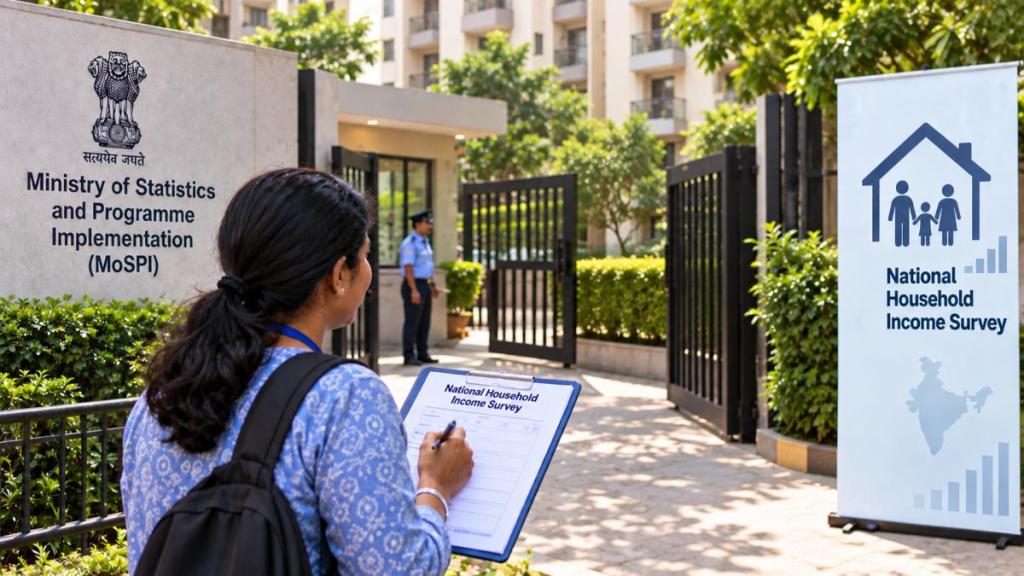

To ensure participation of rich households in the ongoing National Household Income Survey (NHIS), the Ministry of Statistics and Programme Implementation (MoSPI) is relaxing the timeline for respondents in gated societies to respond to the relevant questionnaire.
The ministry is also reaching out to local Resident Welfare Associations (RWAs) in advance and conducting outreach programmes on local and social media to ensure India’s first-ever comprehensive NHIS is a success, Ministry of Statistics and Programme Implementation Secretary Saurabh Garg told FE.
“We have also given households one more option this time. Many of them would like to fill the questionnaire at their leisure when they have time. So we are also giving that option to some households in these gated communities on a pilot basis,” Garg said.
The enumerators leave a printed questionnaire with the households, and contact them back after a “few days or whatever is the timeline that has been decided locally,” Garg said. “But this we are doing in very limited areas just to ensure that we get good response. But in general, we are having an excellent response,” he added.
The NHIS, which began in April and is expected to continue till March 2027, is the first-ever pan-India survey focused on measuring household income and living conditions. It is expected to fill a long-standing data gap in India’s socio-economic statistics system, and the results are to be used to revise CPI and GDP series in the future. The results of the income survey are expected by mid-2027.
The ministry has also provided extra training to enumerators to deal with rich households, among whom unresponsiveness to government surveys has risen over time.
Almost exactly two years ago, MoSPI held a brainstorming session in the national capital with RWAs on how to bring down the non-response rate for the survey, particularly by affluent households.
At the session, ministry officials said the urban non-response rate for the 2022-23 (August-July) Household Consumption Expenditure Survey had risen to 9.8% from 2.8% in the 75th round of the National Sample Survey, conducted in 2017-18 (July-June). For rural areas, this figure had risen to 4.1% from 1.5%.
Along with reaching out to local RWAs in advance, MoSPI is also informing local police stations about the survey visits. This is done “so that they (the police) are aware of this, and in case someone wants to call and check whether this (the survey) is genuine or not, so they can do that,” Garg said.