


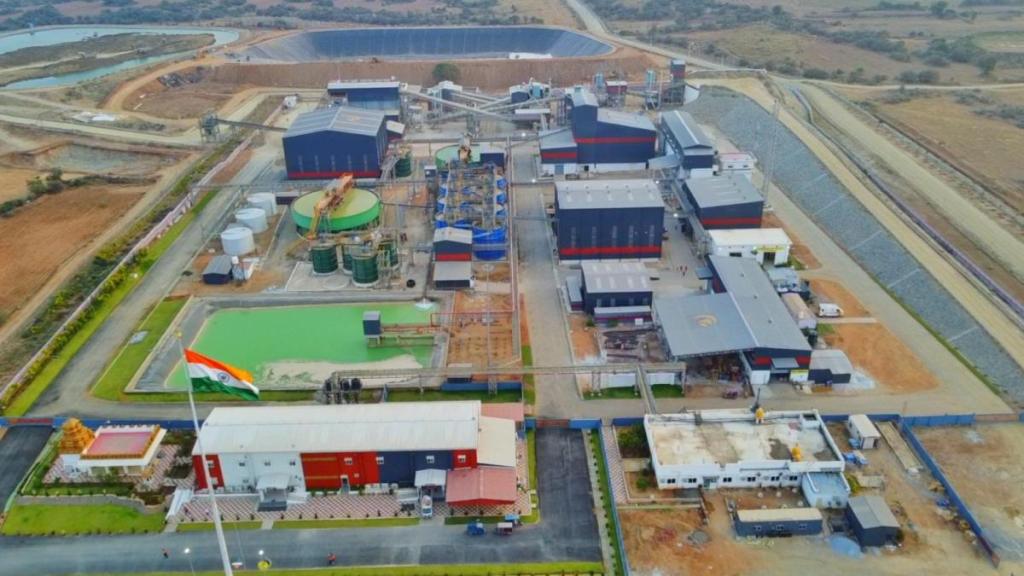

For the first time since Independence, a privately owned gold mine is commercially operational in India. Andhra Pradesh Chief Minister N Chandrababu Naidu on Wednesday inaugurated the gold mining and processing project at Jonnagiri in Kurnool district.
The project was built at a total investment of Rs 405 crore and is operated by Geomysore Services India Pvt Ltd (GMSI) in partnership with Deccan Gold Mines Limited. It spans nearly 598 hectares in Kurnool’s Tuggali mandal and is the only operational private primary gold mine in the country.
At the same event, Naidu laid the foundation stone for the second phase of the project.
What is a primary gold mine?
A primary gold mine is a hard‑rock operation that extracts gold directly from its original source in the earth, known as a lode deposit. In such mines, gold is locked inside solid rock, usually in quartz veins or mineralised zones formed deep underground by hot, mineral‑rich fluids.
Miners drill, blast and haul this ore to the surface, where it is crushed and processed using chemical and physical methods to separate the gold. Globally, primary lode mines account for most of the world’s gold output.
Village renamed, sector rebranded
Ahead of the inauguration, the Andhra Pradesh cabinet approved renaming Jonnagiri village as ‘Swarnagiri’. “This project opens a new chapter for Andhra Pradesh in the mining sector and is expected to contribute significantly to industrial growth and employment generation,” PTI quoted citing an official release by the state government.
Trial production at the mine began in May. Wednesday’s inauguration marks the formal transition to full commercial operations.
Addressing a public gathering, Naidu said the initiative aligns with his vision of transforming Andhra Pradesh into “Swarnandhra Pradesh” by 2047 as part of the Viksit Bharat mission.
VIDEO | Kurnool, Andhra Pradesh: Chief Minister N Chandrababu Naidu inaugurated the gold mining project at Jonnagiri in Kurnool district and announced that the village would be renamed "Swarnagiri," expressing hope that the project would usher in a "golden future" for local… pic.twitter.com/8XkeHjmL4D
— Press Trust of India (@PTI_News) June 24, 2026
Scale of the project
The state government allotted 1,500 acres for the project. Of that, mining has commenced on 600 acres in the first phase. Expansion to the remaining area is planned in stages.
According to a report by Telugu daily Andhra Jyothi, water supply for the operation has been arranged through the Handri Neeva Sujala Sravanthi scheme. Around 0.021 TMC of water (which converts to 59.46 crore litres) will be drawn through an 18-kilometre pipeline. Trial runs on this infrastructure have already been completed ahead of commercial operations.
According to news agencies, around 700 people will get employment through the mining project. Notably, nearly 80% of the workforce is expected to come from local communities, PTI further reported citing the release.
What the state stands to earn
The revenue arithmetic here is straightforward and the upside is significant.
At an annual production level of 400 kg of gold, the Andhra Pradesh government expects to earn around Rs 57 crore through royalties and statutory payments. If output climbs to 900 kg annually, that figure rises to Rs 144 crore.
The mine is targeting production of approximately 400 kg during the first full year of commercial operations (2026-27). Annual output is then projected to rise to around one tonne in the years ahead.
The second processing unit, whose foundation stone was laid alongside the first unit’s inauguration, is central to the scale-up plan. Once operational, the expanded facility could raise total annual gold production to nearly two tonnes.
The geology behind the opportunity
The Kurnool project is not an isolated geological find. The region sits within a broader mineralised belt (Chigurgunta-Bisanatham belt) that officials believe holds considerable additional potential.
According to the Ministry of Mines, in 2023, Chigurgunta-Bisanatham block holds estimated ore resources of more than 2.2 million tonnes with an average gold grade of over 5.6 grams per tonne. That block is currently being auctioned through the unified mining portal.
Several other sites in Anantapur district are also under active exploration namely Boksampalli, Ramagiri and Javakula. These fall within the Ramagiri and Veligallu greenstone belts, ancient geological formations that are directly comparable to Karnataka’s Kolar and Hutti belts in terms of their gold-bearing characteristics. Kolar was historically one of the world’s richest gold fields.
That comparison carries weight because if the Andhra formations yield results similar to their Karnataka counterparts, the Swarnagiri inauguration may prove to be the starting point of something considerably larger for the state.