


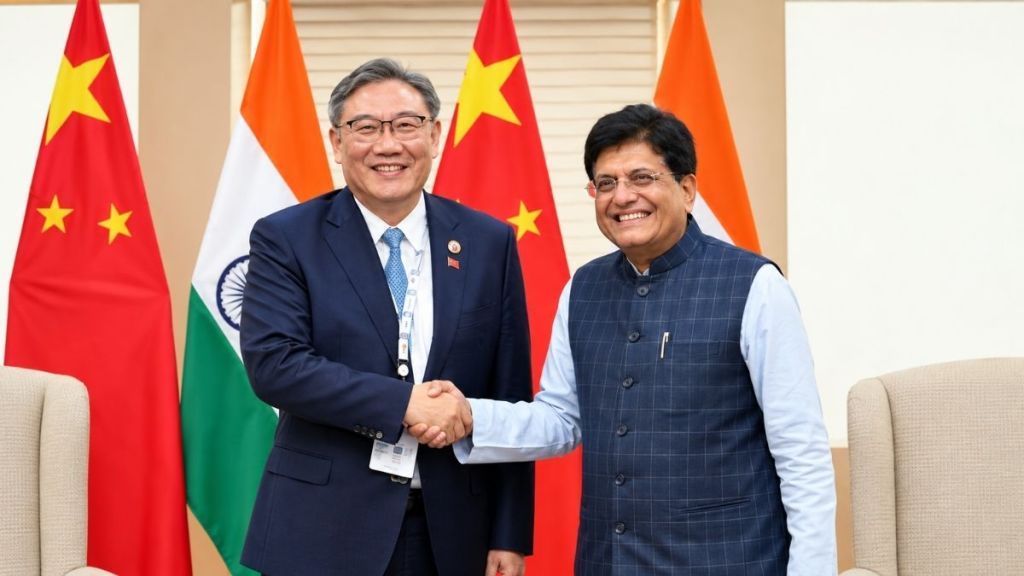

India and China have signalled a renewed push to stabilise economic ties, with Chinese Commerce Minister Wang Wentao meeting Commerce and Industry Minister Piyush Goyal in New Delhi over the weekend and stressing Beijing’s readiness to address bilateral trade and economic concerns.
“China stands ready to work with India” to implement the consensus reached by Prime Minister Narendra Modi and Chinese President Xi Jinping, a Chinese Embassy spokesperson said in a social media post on Monday after the meeting.
The post said the two sides should expand mutually beneficial economic and trade cooperation and “properly address each other’s economic and trade concerns in a balanced manner” to benefit businesses and people in both countries.
The meeting was held on Saturday, after Modi and Xi concluded their bilateral engagement on the sidelines of the BRICS Summit. The two leaders underlined the need to address concerns including the structural trade imbalance and supply-chain issues, and facilitate meaningful and predictable market access.
The ministerial meeting is significant as New Delhi seeks to convert the recent political thaw with Beijing into concrete progress on long-standing economic issues, particularly India’s widening trade deficit, market access for Indian exporters, supply-chain vulnerabilities and Chinese restrictions on critical minerals
India’s trade deficit with China rose to $112.1 billion in 2025-26 from $99.1 billion in the previous financial year. It stood at $73.3 billion in 2021-22. China accounted for 33.5% of India’s total merchandise trade deficit in 2025-26.
Much of the deficit was driven by India’s heavy dependence on China for industrial inputs, machinery, electronics components, chemicals, pharmaceutical intermediates and critical minerals. Emerging sectors of exports like electronics and automobiles are heavily dependent on inputs and components from China.
The dependence has also exposed supply-chain vulnerabilities. In 2025, China tightened controls on exports of rare-earth elements and permanent magnets. This made it difficult for Indian automobile and component manufacturers, which are heavily dependent on Chinese supplies, to secure magnets used in electric vehicles, hybrid vehicles and other automotive applications.
Indian companies have also faced difficulties in obtaining market access in China. New Delhi has repeatedly sought greater access for pharmaceuticals, agricultural products, food items and other goods, while Indian businesses have complained of regulatory, sanitary and other non-tariff barriers.
Investment has also remained constrained since the Covid-19 pandemic. India amended its Foreign Direct Investment policy in April 2020 to require government approval for investments from countries sharing a land border with India. The move brought Chinese investments under the government route amid concerns over opportunistic acquisitions and national security as company valuations fell during the Covid-19 outbreak.
New Delhi has since begun a calibrated relaxation of these restrictions. In March 2026, the government introduced changes permitting certain non-controlling investments of up to 10% by investors from land-bordering countries through the automatic route. It also created a time-bound approval mechanism for specified manufacturing investments, including in capital goods, electronic components and solar-cell inputs.