



India has joined a US-led initiative to tackle “structural excess capacity” in manufacturing, a move that could draw scrutiny given its own rapid expansion in sectors such as solar modules, steel and petrochemicals, some of which are already under the Trump administration’s trade lens.
The initiative seeks to address concerns that excess manufacturing capacity can distort global trade by fuelling overproduction, depressing prices and displacing domestic industries through state-subsidised dumping.
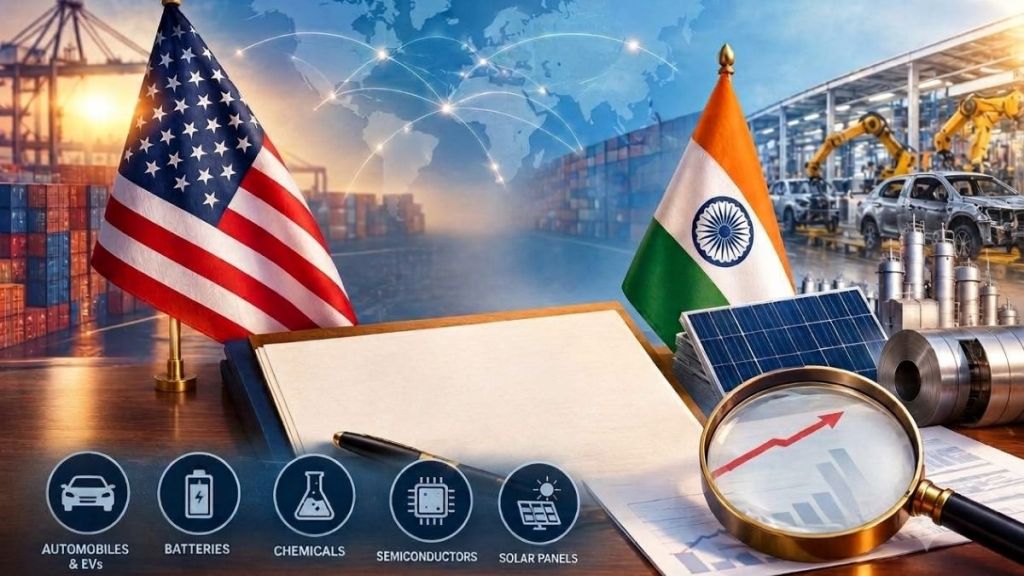
India is among 15 economies that have signed a joint ministerial statement unveiled by the US Trade Representative (USTR) to address structural excess capacity and production. The initiative will initially cover automobiles and electric vehicles, batteries, chemicals, foundational semiconductors and solar panels, with participating economies setting up sectoral platforms to exchange information and explore coordinated action.
The move comes nearly seven months after USTR launched a Section 301 investigation into structural excess capacity across 16 economies, including India, the European Union, Japan, Mexico and South Korea. The five are now both subjects of the probe and signatories to the new initiative.
For India, the overlap is significant. USTR has raised concerns about expanding capacity and potential export-driven oversupply in solar modules, steel and petrochemicals, citing Indian solar-module capacity as nearly three times annual domestic demand. The deadline for its final Section 301 findings is March 11, 2027.
The joint statement calls for countries to eliminate structural excess capacity, including by ending non-market policies and practices that distort markets. It says excess capacity can lead to overproduction, price distortions, concentration of production and weaker competition.
The Global Trade Research Initiative (GTRI) founder Ajay Srivastava said India was now “joining Washington in tackling the very issue for which its own manufacturing is under American investigation”. He said the initiative raises a question of consistency for participating economies and that, for India, the test would be whether cooperation protects domestic manufacturing or gives Washington greater legitimacy to challenge its industrial expansion.
The statement does not name any country as the source of excess capacity or announce tariffs, quotas or sanctions. GTRI said China appears to be the principal implied focus, although China is not a signatory.
India’s participation does not provide an automatic reprieve from the Section 301 probe, with any US trade remedies following a separate process. But it gives New Delhi a forum to put forward data and arguments on its manufacturing capacity. Senior officials are to develop terms of reference and share non-confidential data before December.