


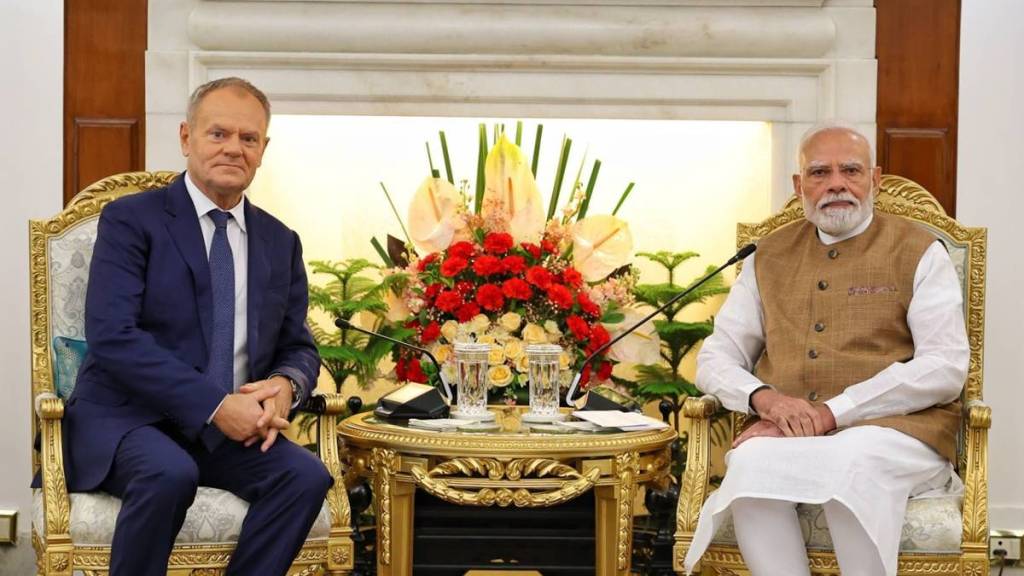

India and Poland have set a target of doubling bilateral trade by 2030, seeking to deepen economic engagement across manufacturing, critical minerals, clean energy and advanced technologies as the proposed India-European Union free trade agreement (FTA) promises to open up new opportunities for businesses on both sides.
The target was agreed upon by Prime Minister Narendra Modi and his Polish counterpart Donald Tusk during the latter’s visit to India, with both leaders underlining the complementary strengths of the two economies and the need to build resilient and diversified supply chains. Bilateral trade currently stands at $6.3 billion, while Indian investments in Poland are estimated at over $3 billion.
“We are sure that companies from both the countries would together develop trusted supply chains for the world and achieve the target of doubling the bilateral trade by 2030,” Modi said.
The visit comes at a critical juncture in India’s economic engagement with Europe, following the conclusion of the India-EU FTA. In their joint statement, the two leaders called for its early signing and ratification and timely implementation, saying it would unlock opportunities for trade and investment, strengthen critical value chains and open new markets. The agreement could provide a broader framework for expanding India-Poland commercial ties, while Poland’s position as a gateway to Central and Eastern Europe offers Indian companies an opportunity to widen their presence in the European market.
Modi invited Polish firms to expand their investments and operations in India, leveraging the country’s large market, skilled workforce and growing manufacturing and innovation ecosystem. Tusk, in turn, welcomed Indian investments in Poland and highlighted the country’s potential as a base for Indian businesses seeking to expand across Europe.
“Trade and investment and economic cooperation received considerable attention in the discussions,” Secretary (West) in the Ministry of External Affairs Sibi George said, pointing to emerging opportunities in electric vehicle batteries, renewable energy, advanced manufacturing and clean technologies.
The Polish prime minister is accompanied by a high-level delegation, including around 100 chief executives and industry representatives. The India-Poland Business Forum held during the visit is expected to facilitate partnerships in sectors such as industrial machinery, defence, pharmaceuticals, mining, critical minerals, & energy.
Proposed memorandums of understanding are also expected to cover areas such as railways, transport, engineering and mining.
The two countries also agreed to strengthen cooperation in agriculture by resuming the activities of their bilateral working group, with the aim of intensifying trade and sectoral collaboration.
The leaders agreed to encourage collaborative research in artificial intelligence, semiconductors and quantum technologies, alongside closer startup partnerships and greater engagement between businesses, research institutions and innovation ecosystems.
Critical minerals have emerged as another important area of cooperation, particularly amid efforts by major economies to diversify sourcing and reduce vulnerabilities in strategic supply chains. The joint statement highlighted opportunities in geology, mining and critical minerals, with a memorandum of understanding in the sector under negotiation. The leaders also emphasised cooperation in the circular economy, including battery recycling and rare-earth mineral refining.
Both sides stressed the importance of supporting medium and small enterprises, innovation-led growth and digital transformation.
The leaders highlighted cooperation between ports and in the shipping industry and underscored the importance of the India-Middle East-Europe Economic Corridor (IMEC) in improving connectivity.