


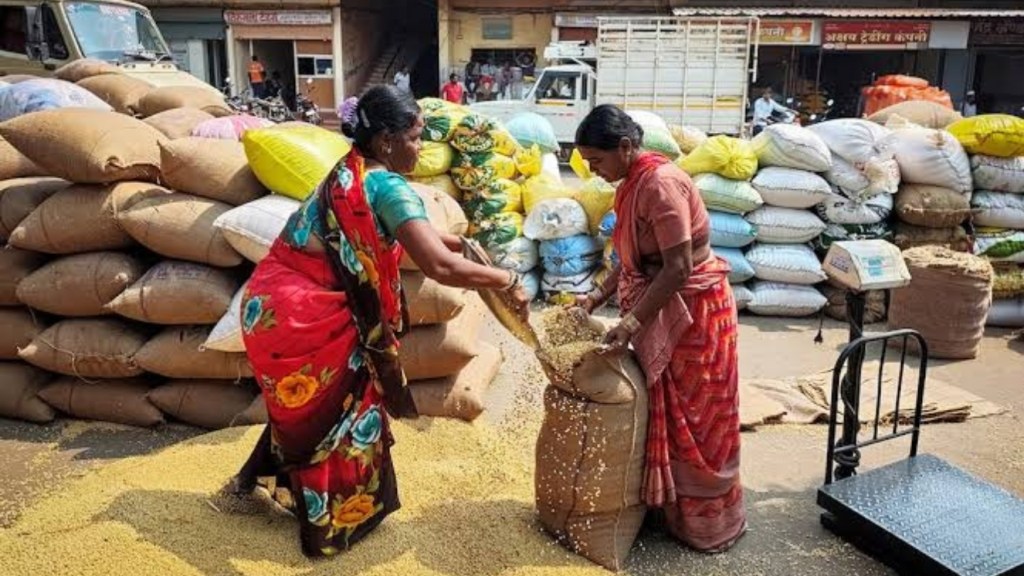

Despite lower kharif yields and a slow start to rabi sowing, which have raised concerns over rural consumption demand, the potential supply squeeze in key commodities has pushed up mandi prices, allowing farmers to earn higher realisations.
Mandi prices of kharif crops – paddy, pulses and oilseeds – are ruling significantly above the previous year’s level as well as the minimum support price (MSP), which may boost farmers’ income, traders and officials said.
They said that higher prices of agri-commodities may partly offset yield losses in those regions where crop has been hit due to inadequate monsoon. It may encourage farmers to expand acreage next season.
Market prices of soybean, a key kharif oilseed crop, are currently ruling around Rs 7000/quintal, a sharp rise of 55% over the previous year. This is against the minimum support price (MSP) of Rs 5708/quintal for the current season.
“The higher prices realised from soybean this season would encourage farmers to take up more area under oilseed variants next season, as in the last few years farmers did not realise remunerative prices,” D N Pathak, Executive Director, Soybean Processors Association of India, told FE. SOPA’s first estimate puts the country’s soybean production at 10.79 million tonne (MT) in Kharif 2026, down 2.1% on year.
In Bharatpur, Rajasthan, a major trading centre, farmers are currently selling mustard from the previous season at over Rs 7200/quintal, 10% more than the MSP of Rs 6613/quintal announced for the next marketing season. The government has announced an MSP of Rs 6200/quintal for 2026-27 marketing season and sowing activities are on.
“Last two years, farmers have been realising significantly higher prices because of elevated demand and a spike in global prices,” a Bharatpur-based trader said. India imports about 56% of its cooking oil consumption, as prices have been elevated due of geo-political factors and diversion of cooking oils for production of biofuel.
Trade sources said mandi prices of tur, a key kharif variant of pulses, are around Rs 10,500/quintal, atleast 50% higher than previous year as crop yield would be hit because of deficient monsoon especially in key growing regions of Maharashtra and Karnataka.
“With the arrivals peaking, farmers would continue to get elevated prices in the coming weeks,” Nitin Kalantri, CEO, Kalantry Food Products, a Latur, Maharashtra-based traders and processors of pulses, said.
Market price of Chana (gram), which accounts for 50% of the country’s pulses production, is currently around Rs 7400/quintal, 14% up on year while the current prices at Jaipur market, Rajasthan is around 26% more than the MSP.
“Chana prices trading above MSP are a welcome development for farmers, offering remunerative returns and a stronger incentive for rabi sowing.” In a year marked by moisture stress across several growing regions, chana’s relatively lower water requirement adds to its appeal,” Harsha Rai, Head, Mayur Global Corporation, leading pulses trading firm, told FE.
Current market prices of wheat in Delhi were around Rs 2850/quintal, 5% more than the previous year as the government has a huge surplus grain stock of over 45 MT.
Shweta Saini, Founder and CEO, Arcus Policy Research, said “higher mandi prices may partly offset production losses for some farmers, but do not necessarily translate into higher farm incomes when marketable surpluses are lower. For consumers, however, the outlook suggests that food inflation could remain elevated over the coming months, with the rabi harvest becoming critical to any sustained easing,”.
Saini said that the 2026 monsoon has been particularly challenging for Indian agriculture, not just because rainfall was nearly 13% below normal, but also because of its uneven distribution and high temperatures.