


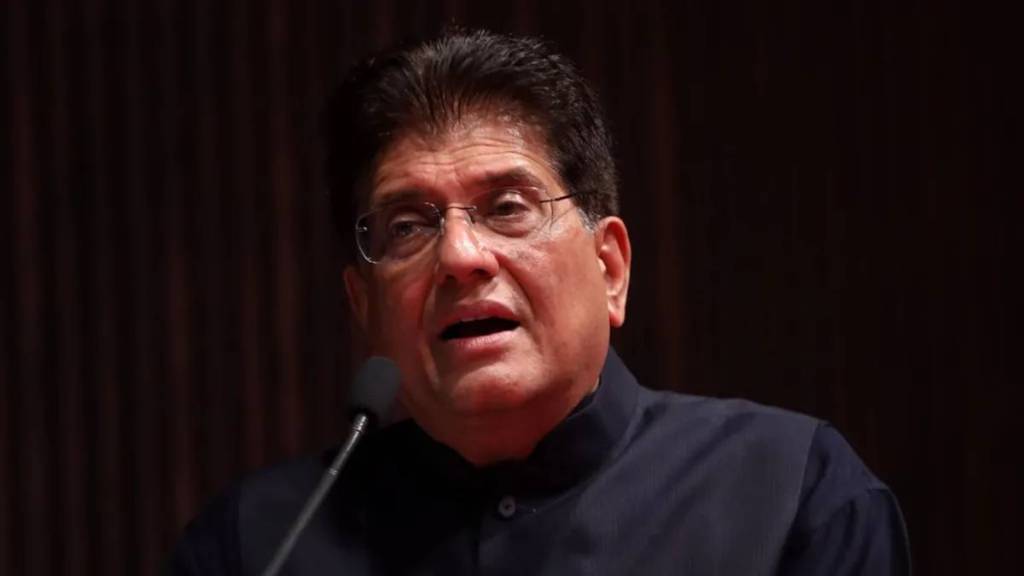

Commerce and Industry Minister Piyush Goyal will hold talks with US Trade Representative (USTR) Jamieson Greer later this week to push negotiations towards an interim India-US trade deal, as the two sides seek to advance the broader Bilateral Trade Agreement (BTA) in line with their February 7 joint statement.
Goyal will travel to the US from September 29 to October 5 and meet Greer on the sidelines of the G20 Trade Ministers’ Meeting in Milwaukee, Wisconsin. The G20 Trade Ministerial will be held on September 30 and October 1. The meeting comes as New Delhi and Washington work to resolve outstanding issues and finalise the interim component of the proposed BTA.
The February 7 joint statement had laid out the framework for negotiations, including work towards an interim trade agreement as part of the broader bilateral deal.
Goyal will also hold bilateral meetings with trade ministers from other G20 members. India will seek to expand opportunities for farmers, fishermen, women entrepreneurs, startups, MSMEs and other enterprises through these engagements, the commerce ministry said in a statement.
At the G20, India will advocate a rules-based, open, inclusive, transparent, equitable and non-discriminatory multilateral trading system, with the World Trade Organisation (WTO) at its core. It also stresses the need to preserve adequate policy space for developing countries.
As host of the G20 trade ministers’ gathering, representing nations that account for 85% of global GDP and up to 80% of world trade, the US is expected to push its key trade and economic priorities.
A key item on the US agenda is a proposal to “update” the WTO’s foundational Most-Favoured-Nation (MFN) principle. The MFN rule, a cornerstone of the global trading system, mandates unconditional and non-discriminatory treatment among trade partners.
The USTR is advocating a shift towards greater reciprocity, strategic alignment and conditional market access. In addition to MFN reform, the US plans to press member nations to address structural excess production capacities and eliminate forced labour from global supply chains.
Following investigations into major exporter economies, Washington has already levied duties of between 10% and 12% on 60 economies over forced labour concerns, while its probe into global excess capacity is ongoing. The G20 meeting will also include a session on excess steel capacity, as the US seeks to boost domestic manufacturing of the key industrial input.
The meeting is also expected to address the “weaponisation of trade in food”. For the US, a key concern is the vulnerability of its domestic agricultural sector during broader trade disputes. Washington has raised concerns over retaliatory tariffs imposed by foreign trading partners on US agricultural exports, including soybeans, pork and corn, whenever broad unilateral tariffs are imposed.
Goyal will also meet chief executives of leading US companies in manufacturing, consumer goods, agri-business, retail and technology in Milwaukee and Chicago. Through these meetings and business roundtables, he will highlight investment and manufacturing opportunities in India and encourage American companies to deepen partnerships with Indian businesses.