


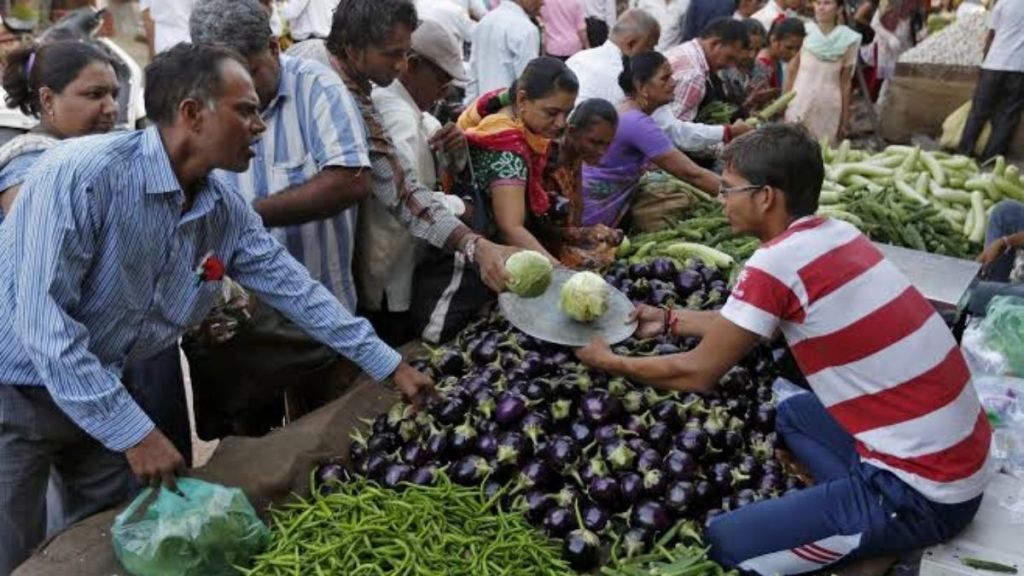

Food inflation, as measured by the recently revised consumer food price index, continued to move upwards to touch 5.95% in August, primarily because ginger, garlic, onion, sugar, chicken, and edible oils became costlier.
Sequentially, the all-India Consumer Food Price Index (CFPI) rose by 0.92% last month from the July level, slightly lower than the rise seen in July. Food inflation was 5.52% in July 2026, and it was in negative territory for seven months through December 2025.
Food inflation was 2.13% in January, 2026, when the new consumer price index (CPI) series with a base year of 2024 was introduced by the Ministry of Statistics and Programme Implementation (MoSPI).
Using both the current and previous CPI series (the latter with 2012 as the base year), food inflation in August was the steepest in 19 months.
Inflation in ginger (73.82%), onion (48.27%), garlic (43.6%), Sugar (24.2%), chicken (14.12%) and mustard oil (6.92%) reported steep hikes, according to the statistics ministry. The retail prices of vegetable oils in the category, according to MoSPI, rose to 8.8% in August year-on-year.
Inflation in rice last month was 5.88% compared to 3.3% in July, 2026. According to the agriculture ministry, paddy sowing this season has lagged 4% to 42.68 million hectare (Mha) in the ongoing kharif season compared to the previous year owing to deficient monsoon rains.
Despite the rise in food inflation, prices of tomato (-31.09%), potato (-13.14%), and lady finger (-5.41%) declined in August 2026 on a year-on-year basis. There was moderate inflation in wheat (0.86%) and chana (0.32%) last month year-on-year.
“We project food and beverage inflation to harden further, crossing the 7.0%-mark by October 2026, which would exert upward pressure on the headline inflation number,” Aditi Nayar, Chief Economist, ICRA said.
Overall, the area sown under the kharif crops—paddy, pulses, oilseeds, cotton, sugarcane and coarse cereals—stood lower at 109.49 Mha, 1.4% below the previous year’s level, according to the agriculture ministry.
However, experts say that erratic rainfall and skewed distribution across the country are expected to adversely impact kharif crops yield and likely push up prices of pulses and rice.
Meanwhile, lower-than-expected sugarcane yields and a shift towards ethanol production have tightened the domestic availability of sugar, thereby pushing up sugar prices. Apart from food prices, global energy prices remained volatile amid the conflict in the Middle East.
“Food prices shock due to prices being elevated because of the end-of-season phenomenon as well as international prices being high as in the case of edible oils,” Madan Sabnavis, Chief Economist, Bank of Baroda, said.
With a monsoon deficit of 14.7% against the benchmark till Monday, overall rainfall (June-September) is likely to be ‘deficient’—below 90% of the benchmark this season. This season’s rainfall is likely to be the lowest since 2009.
The statistics ministry stated that from the beginning of 2026, the base year for measuring CPI has been revised from 2012 to 2024 using the Household Consumption Expenditure Survey 2023-24. The weightage of CFPI in CPI has declined to about 36.73% from 45.86% in the new series.