


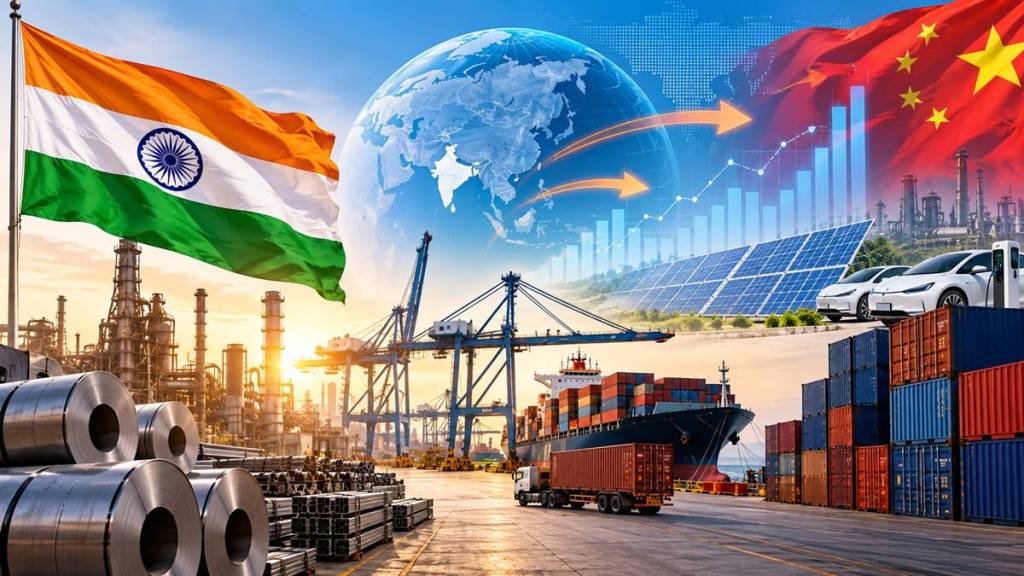

India has joined a US-led initiative on excess capacity even as its own manufacturing faces US investigation. Ajay Srivastava explains the potential risks to Indian exports and why India must safeguard its industrial growth.
l What is excess capacity, and why is it a concern?
IN TRADE DISCUSSIONS, “excess capacity” refers to concerns that state subsidies allow a country’s firms to produce and export large quantities at low prices, dominate global markets and hurt local industries and jobs in other countries.
Steel has been central to this dispute for decades. Concerns grew in 2015–2016, leading to the creation of the Global Forum on Steel Excess Capacity after the 2016 G20 Summit. In 2023–2024, the debate widened to electric vehicles, batteries, solar panels and foundational semiconductors.
l How is excess capacity assessed?
THE UNITED STATES and Europe look out for government support that encourages overproduction and harms their industries. Signs include cheap energy, land or loans; rising output despite weak demand; and firms continuing to produce despite losses and falling prices.
The US and Europe see China’s aggressive subsidies and industrial policies as major causes of excess capacity and pressure on manufacturing elsewhere. But China’s export strength also reflects investment in scale, innovation and efficient supply chains. Subsidies alone do not explain its dominance. The assessment must distinguish subsidy-driven overproduction from competitiveness based on scale, innovation and efficiency.
l What is China’s response to this?
CHINA REJECTS THE US and EU argument. It says capacity should be assessed against global demand, including future clean-energy needs, rather than domestic demand alone. China attributes its manufacturing success to technology, efficient supply chains, large-scale production and strong competition.
It says affordable Chinese products help the world shift to clean energy. It also accuses the US and Europe of double standards because they subsidise their own industries and have long produced for export.
l Which products are on the radar?
MAJOR PRODUCTS INCLUDE steel, aluminium, electric vehicles, solar equipment, batteries, foundational semiconductors, petrochemicals, other industrial chemicals, cement and glass. Countries have responded with anti-dumping duties, import quotas and carbon-border measures.
l What is the US probe against India about?
THE US STARTED excess-capacity probes against 16 economies including India, China, and the EU on March 11, 2026. Conducted by USTR under Section 301, these examine whether subsidies, government-backed expansion, market-access barriers and other policies have led to excess capacity that harms US commerce. Final findings are due by March 11, 2027. Possible outcomes include additional tariffs, import quotas, or other trade restrictions.
The US notice identifies possible excess capacity or export surpluses in India’s solar modules, petrochemicals, steel, textiles, health-related goods, construction materials and automotive products. It says solar-module capacity is nearly three times domestic demand and questions expanding steel and petrochemical capacity. India needs to show that its expansion serves domes-tic, export and future demand. Treating exports themselves as proof of excess capacity would undermine the basis of international trade. An adverse USTR finding could expose Indian exports to additional tariffs or other restrictions.
l What is the Oct 7 joint statement?
INDIA JOINED 14 other economies in a US-led initiative announced by USTR on October 7, 2026. It seeks joint action against government-supported over-production that distorts markets and threatens domestic industries. Its initial focus is automobiles and EVs, batteries, chemicals, foundational semiconductors and solar panels. The statement names no target country, although China appears to be the implied focus.
l Why does India’s participation raise concerns?
THE US IS apparently taking contradict-ory steps: investigating economies over alleged excess capacity while asking some of them to cooperate on the same issue. India, the EU, Japan, Mexico and South Korea are both signatories of the statement and subjects of the Section 301 probes. Washington is seeking their cooperation while retaining the option of restricting their exports. Joining the initiative does not end US scrutiny.
India should ensure that cooperation protects its manufacturers and does not imply acceptance of US allegations. It should seek clear criteria for identifying harmful excess capacity and defend its right to expand manufacturing for domestic and export markets. Export growth should not automatically be treated as evidence of surplus capacity. The same scrutiny should apply to US subsidies, industrial policies and trade practices as to those of other countries.
The writer is founder, GTRI
Disclaimer: The views expressed are the author’s own and do not reflect the official policy or position of Financial Express.