


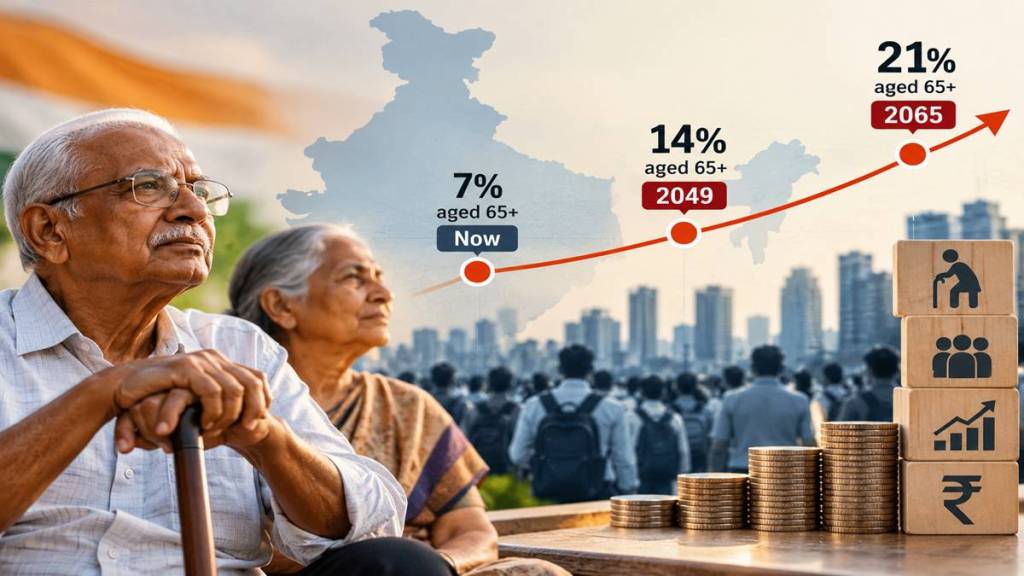

India, which has been banking on its demographic dividend to become a high-income economy by 2047, could be aging faster than it expected, says a report by Moody’s Ratings. By 2049, 14% of the population will be above 65 years. Banasree Purkayastha interprets the findings
l What the report says about India
INDIA’S AGE STRUCTURE is beginning to shift, setting the stage for a much older population later this century. Currently, only around 7% of the population is aged 65 years or above putting India in the “ageing” category. By 2049, 14% of the population will be 65 years or older, predicts a report by Moody’s Ratings. From 2049, the speed will pick up and in just 16 years, that is, by 2065, 21% of the population will cross that threshold. That’s the “super-aged” category.
Indonesia, which entered the “aging” category around the same time as India, in contrast, will take 29 years to transition into the “super-aged” category.
Countries with 7% of the population over 65 years are termed “ageing”, while countries with 14% and 21% of the population over 65 years are called “aged” and “super-aged”, respectively.
The implications extend far beyond demographics. Aging affects labour supply, consumption, public finances, wealth transfers and financial markets, warns Moody’s. Brazil and Turkiye are also on similar trajectories.
l Below replacement fertility rate is driving the rapid shift
FALLING FERTILITY IS behind this demographic transition. India’s Total Fertility Rate (TFR) had dropped to 1.9 children per woman – lower than the benchmark level of 2.1 needed to keep the population stable in the long run. TFR is the average number of children that a woman is expected to have in her lifetime. In the 2000s, India’s TFR was around 3.3 births per woman. Live births in India peaked at about 29 million in 2001 but have since fallen to below 23 million.Small differences in fertility rates can have profound long-term consequences. If fertility rates remain constant, a rate of 1.0 produces a generation roughly half the size of the previous one. These effects take decades to emerge but are difficult to reverse because smaller cohorts eventually become the next generation of parents.
l Growing old before getting rich
THE BIGGEST RISK of this rapid aging is that it leaves India with very little time to get wealthy before it goes grey.
The rapid drop in fertility is compressing what was once a multigenerational adjustment into a few decades. This will force the economy to confront rising pension, healthcare and long-term care costs at income levels well below those of the countries that aged before them, leaving less time and fewer resources to adapt. Countries such as France and Germany, with much smaller populations, took 30 years and 43 years to move from the “aged” to the “super-aged” category.
India has set itself the target to become a high-income, developed economy by 2047. It is relying on its demographic dividend – the economic potential when the working-age population (15-64 years) outnumbers the dependent population – to do the heavy-lifting. A rapidly aging society means this cohort’s productivity will have to be several notches higher than envisaged earlier to realise this dream.
l What are the policy solutions?
POPULATION AGING WILL reshape the economy and defy easy policy solutions. Two states — Andhra Pradesh and Tamil Nadu — have recently started giving incentives to couples to have more children. But reversing demographic aging has proved difficult around the world. Pronatalist policies – including one-off cash bonuses, recurring allowances, tax relief, housing and mortgage subsidies, childcare and parental leave provision, and fertility treatment or in-kind support – have generally failed to produce sustained increases in fertility, says the report.
Meanwhile, longer working lives, higher labour force participation, migration and technological advances can partly offset the economic effects of slower population growth. Raising the female participation rate and the retirement age can help expand labour supply and strengthen economic resilience. India’s female labour force participation rate is only 32%. In countries such as Japan, US or UK, it varies between 55% and 57%.
l Falling fertility now a global phenomenon
THE WORLD POPULATION itself is growing older faster. More than 70% of the world’s population now lives in countries at or below replacement fertility. Fertility rates across much of Latin America are now comparable to those of Europe and Japan, several East Asian countries have some of the lowest fertility rates ever recorded. The global fertility rate has declined from 4.9 children per woman in 1950 to around 2.2 today, only slightly above the replacement rate of 2.1. What makes this episode particularly significant is that many of the world’s largest economies are aging at the same time, says the Moody’s report. As a result, populations are aging and, in many countries, stagnating or declining. Age structures are therefore changing faster than at any other point in modern economic history.