


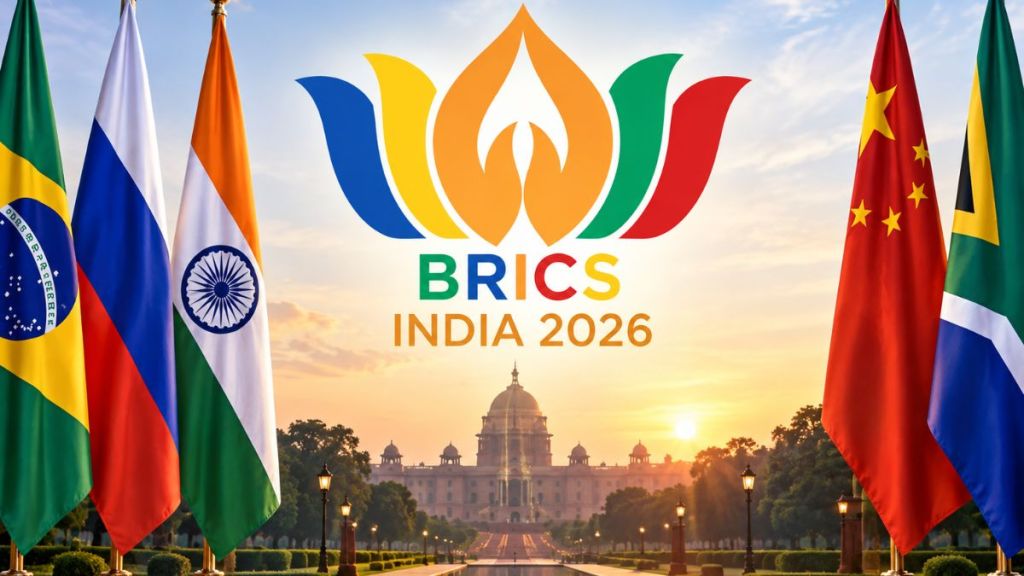

As New Delhi readies itself to host world leaders at the 18th BRICS Summit, attention now shifts to the enlarged coalition of emerging economies. As India chairs the summit for the fourth time, it comes at a significant point in the diplomacy of the Global South, write James J Nedumpara and Ridhish Rajvanshi.
What is BRICS? What is its goal?
The BRICS group was originally known as “BRIC”, a term coined by Goldman Sachs analysts to draw attention to four rapidly developing economies: Brazil, Russia, India, and China. South Africa then joined in 2010, expanding the group’s name to BRICS. Recent expansions have included Egypt, Ethiopia, Iran, Saudi Arabia, the United Arab Emirates, and Indonesia, together with an increasing number of partner countries.
BRICS performs as an informal, consensus-based grouping. Its main focus is on South-South cooperation, fair trade, sustainable development, and technological independence. It supports a multipolar international order and advocates structural changes in existing institutions such as the United Nations Security Council, the International Monetary Fund, and the World Bank. For many years the group has set up sectoral dialogues covering agriculture, health, medicine, anti-terrorism coordination, and science, and has managed to establish itself as a unified voice for developing economies on multilateral venues such as the G20. Its activities are based on three main pillars: political and security cooperation, economic and financial partnership, and cultural exchanges.
What has BRICS actually delivered?
One key institutional achievement of BRICS is the New Development Bank set up in 2014, which has disbursed tens of billions of dollars for infrastructure and projects promoting sustainable development. The bloc has kept the Contingent Reserve Arrangement to protect its member states from fluctuations in currency values; it has at the same time been gradually increasing trade settlements in national currencies in order to shield its members from external financial shocks. Over 20 years, BRICS has advanced the priorities of the Global South, for example by campaigning for reforms at the WTO, ensuring greater participation for developing countries in international rule-making, promoting cross-border payment interoperability, and advocating for adjustments to the quotas at international financial institutions.
What are the challenges it must navigate?
BRICS is not a single political entity. The member states have very different political systems, economic models, and foreign policy orientations.
Since there are 11 full members and 10 partner countries in the grouping, dealing with internal disagreements or ensuring alignments on wider geopolitical issues have been challenging.
What is the fundamental vision directing India’s role as Chair?
On January 13, 2026, India unveiled its official theme: “Building for Resilience, Innovation, Cooperation and Sustainability” (forming the acronym B-R-I-C-S), in order to guide New Delhi’s agenda. The role of India as Chair has been characterised by extensive and decentralised outreach. During the period of New Delhi’s leadership, more than 350 meetings and high-level engagements took place in over 25 Indian cities, linking international delegates directly with India’s regional economic and technological centres.
Throughout the year, the vision has been put into practice in a wide range of ministerial tracks, working groups and meetings of the heads of agencies covering energy, health, finance, digital technology and trade facilitation. In addition to institutional reform, the leaders meeting in New Delhi are concentrating on strengthening mutual cooperation within the BRICS while dealing with their common concerns regarding global and regional economic and security issues.
What should India & the BRICS leaders consider at the summit?
In New Delhi, the leaders will discuss ways of strengthening cooperation within the BRICS and deal with the significant regional and global challenges.
The main areas of focus are to set up frameworks which will protect member economies from global supply shocks, healthcare weaknesses, and disruptions in energy supplies, and to help shape the global discussions on critical minerals, digital connectivity, and AI governance. The grouping seeks to establish a BRICS Digital Public Infrastructure (DPI) Repository in order to promote technology transfer and open-source innovation.
Ultimately, India’s primary goal at the summit is to show that an enlarged BRICS grouping is able to navigate geopolitical turmoil and achieve tangible economic benefits. The New Delhi Summit will be able to produce significant, people-oriented results for the Member countries.
Nedumpara is head, Centre for Trade and Investment Law, while Rajvanshi is senior research fellow.
Disclaimer: The views expressed are the author’s own and do not reflect the official policy or position of Financial Express.