


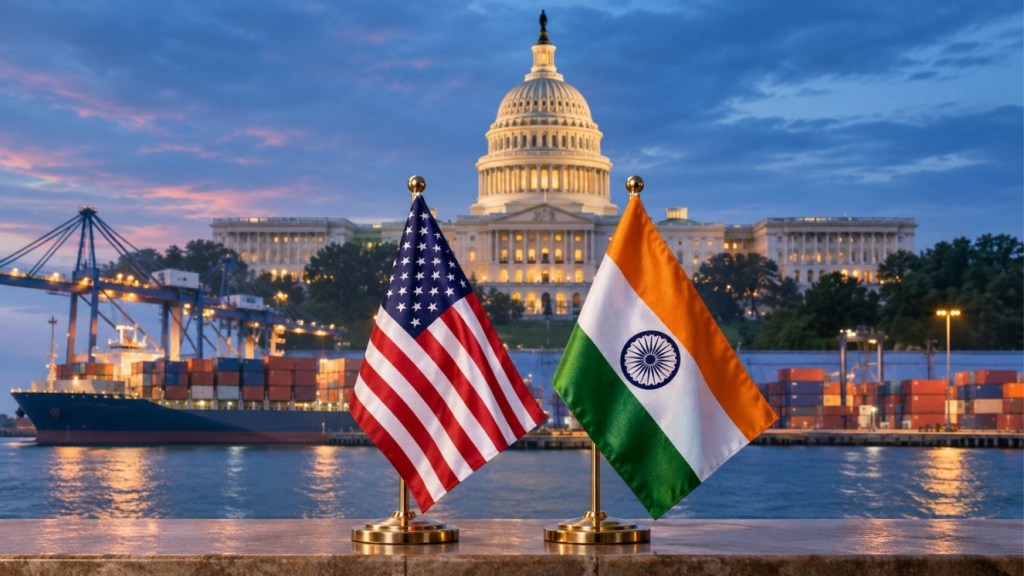

The Democratic Party’s takeover of both the US House of Representatives and Senate in the midterm elections is unlikely to have an impact on the proposed interim India-US trade deal, as the agreement being negotiated by the two countries is largely in the nature of an executive-negotiated framework rather than a conventional free trade agreement (FTA), official sources said on Thursday.
The interim deal does not require a vote in either chamber of the US Congress, they said, adding that negotiations would continue on the trajectory established after the two sides agreed on a framework in February this year. While the framework has laid down the broad contours of the agreement, the legal text is still being negotiated.
Most of the trade arrangements concluded by President Donald Trump with individual trading partners have taken the form of executive-negotiated framework agreements or political commitments. These can establish international commitments without requiring prior congressional approval, although their ability to alter US domestic law or override existing statutory requirements is limited.
The immediate hurdle to concluding the India-US agreement, however, is not the change in the US political balance but uncertainty over the tariff regime that Washington intends to put in place following the US Supreme Court’s February ruling striking down Trump’s country-specific reciprocal tariffs imposed under the International Emergency Economic Powers Act (IEEPA).
The administration is now relying on alternative statutory provisions, particularly Section 301 of the Trade Act of 1974, to rebuild its tariff architecture. The US has already concluded a Section 301 investigation into the failure of 60 economies to effectively prohibit imports of goods produced using forced labour. Under the resulting measures, India has been placed in the 10% additional tariff category, while duties on other investigated economies range from 10% to 12.5%, depending on their commitments and the applicable provisions.
A separate and potentially more consequential Section 301 investigation into structural excess capacity and production in manufacturing sectors is still underway. It covers 16 economies, including India, China, Vietnam, Thailand, Bangladesh, Japan, South Korea and the European Union. The investigation is examining whether government policies and practices in these economies have created excess manufacturing capacity that distorts trade and harms US industry. Its findings could lead to additional trade action, including tariffs.
Until the outcome of this investigation and the broader tariff architecture becomes clearer, the overall duty burden on Indian exports and their relative competitiveness in the US market will remain uncertain.
Once there is clarity of tariffs on important trade partners of the US, India would seek tariff advantage over its competitors like Vietnam, Thailand, China, Bangladesh, and other members of the 10-nation ASEAN bloc as part of the deal, sources said.
Apart from Section 301, Washington has retained its sector-specific tariffs under Section 232 of the Trade Expansion Act of 1962, which provides for duties on imports considered a threat to national security. These cover products including steel, aluminium, copper, automobiles and auto parts. Since these measures rest on a separate statutory authority, they were not invalidated by the Supreme Court’s ruling on IEEPA tariffs.
The Democratic takeover of Congress could nevertheless increase scrutiny of Trump’s trade policy through hearings, investigations and legislative attempts to constrain the administration’s tariff powers. But it does not automatically give lawmakers a veto over executive-level trade frameworks negotiated within existing presidential authority, according to experts.