



Crude prices continue to see wild swings in the international market. The prices hit a high of $108 earlier this week, and the Brent rate is now hovering around $105/bbl as the US-Iran imbroglio continues for the sixth month. For India, a crude-importing nation, the big worry is how this impacts the economic dynamics, especially with the Indian Crude Oil Basket (ICB) trading around $120.8/bbl.
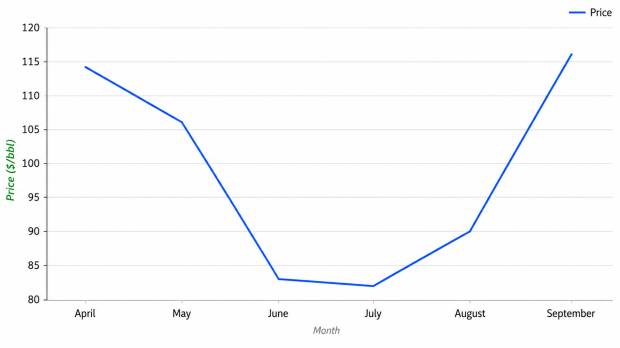
If we see the overall September crude pricing, the domestic basket has averaged around $115-120/bbl, reflecting more than a 35% rise from the June-August period.
With the nearing festive season and ambiguity surrounding the resolution of West Asia conflict, markets remain sceptical about domestic prices. Financial Express.com reached out to experts to understand the difference between international futures prices and Indian Crude Basket prices and the implications therein.
The gap between International Crude Futures and Indian Crude Basket
Indian Crude Basket reflects the physical prices of crude grades that the country actually imports, whereas the international futures prices represent the cost of crude for a particular delivery month.
For September, the domestic basket has a 77.81% share of Brent Dated (sweet crude) and 22.19% of Oman-Dubai crude (sour crude), according to data published by the Petroleum Planning and Analysis Cell.
Brent crude futures for November were trading over the $105/bbl , while the latest ICB figure was quoted at $120.80. This does not mean that the country is paying around $15 more than the future prices, but states that oil due for delivery in a few weeks costs more than oil due for delivery in the coming months.
“The futures market assumes this disruption eases. A refiner buying a cargo today does not get that assumption,” said Anindya Banerjee, Head of Commodity and Currency Research at Kotak Securities.
What factors are driving the ICB basket?
Now that the difference between futures and ICB prices is clear, it is important to understand that the basket average has advanced significantly from $83 in July and $90 in August to well past $120/bbl so far in September.
- Geopolitical uncertainty pushing prices
Hareesh V, Head of Commodity Research at Geojit Investments, explained that higher ICB prices are primarily being driven by a combination of factors such as the crude mix India imports, higher Dubai-Oman prices, increased freight and insurance costs, and supply concerns in West Asia. “Disruptions around the Strait of Hormuz may also be contributing to the current premium,” he added.
Additionally, the disruptions to Saudi Arabia’s recently restarted East-West oil pipeline continue to tighten the physical market availability of crude oil. As per several media reports, Saudi Aramco has reportedly informed Indian refiners that it may be unable to meet future obligations.
Experts note that this added to the push for prices of Middle Eastern crude, as Dated Brent, which now carries the majority of weightage in the basket, rose significantly higher, pushing the basket materially higher.
- Freight cost and Russian premium capping the decline
Banerjee explained that the cost to keep the oil flowing is further keeping the domestic basket prices high. “ Freight alone now adds an estimated $18 a barrel on a supertanker cargo to Asia, and that cost lands on Asian buyers, India included,” the Kotak analyst said.
Additionally, Banerjee pointed out that Russian crude was sold to India at a discount of $12/bbl before the beginning of the US-Israeli war with Iran. “It has since traded at a premium on several occasions, including in mid-September. Russian oil is no longer cheap oil — it is simply another scarce barrel,” he added.
So how high can the Indian basket rise?
Brent need not test its record highs for the Indian crude basket to peak. In a base case scenario, if the Saudi ship-to-ship workaround functions and the pipeline returns reasonably soon, the basket stays broadly in the $115–130 zone, said Banerjee.
The Geojit analyst added that the domestic basket could remain firmly above $120/bbl if these conditions, alongside US tariff-related concerns, continue to prevail.
Kotak’s Banerjee outlined another scenario and pointed out that if pipeline repairs are delayed and conditions within the Strait of Hormuz remain constrained throughout October, then the domestic basket may move even higher to as much as the $130–145/bbl.
Indian Crude Basket: Saudi supply scenarios
| Saudi supply scenario | Impact on Indian crude basket |
|---|---|
| Pipeline resumes soon | $115–130/bbl |
| Pipeline repairs delayed | $130–145/bbl |
| Pipeline remains non-functional | $150–160/bbl |
And, in a severe case scenario of the East-West pipeline being nonfunctional, further escalations in Hormuz, and rapid Russian displacement, the Indian crude basket may temporarily test the $150-160/bbl level, Banerjee said. Echoing a similar stance, Hareesh of Geojit noted that a short touch to $150 is possible if conditions deteriorate further.
Crude prices: Festive demand to add to pressure
The October-December festive period may see the domestic basket climb higher as petrol and diesel consumption is expected to increase, led by a boost in travel, transportation and industrial activity, these analysts said.
Banerjee explains this year would prove to be particularly difficult for the Indian markets as supply conditions have further tightened, led by Middle East disruptions. “Last October, total petroleum consumption rose around 8% month-on-month, with diesel up about 12%, and petrol up around 8%. In a normal year that is a seasonal footnote. This year it lands in the tightest diesel market on record,” he explained.
The Kotak analyst noted that record-high diesel refining margins, Russia’s extension of the diesel export ban, and low petrol stocks held by Chinese refiners are further expected to affect supply, which will also hit the Indian crude basket. “Diesel supply is shrinking from every direction at once,” he added.
“Stronger demand may improve refining cracks and increase crude requirements, adding further upward pressure on the Indian crude basket if supplies remain tight,” Hareesh said.
In all, higher domestic demand would mean less surplus fuel available for the country to export, which will further have Indian refiners bidding for physical crude, adding to basket pressure.
How high can Indian crude basket prices move in near-term
Overall, the upside for Indian crude basket seems to be moving higher in the near-term. Hareesh V noted that with India’s high reliance on Russian oil, its reduced availability could quickly lift risk premiums, pushing the ICB to record high levels. “In such a scenario, a move towards $150/bbl within a very short period would not be surprising,” he added.
Most market observers see the current trend continuing in the near term until there are some clear indications of a resolution of the Iran-US situation.