


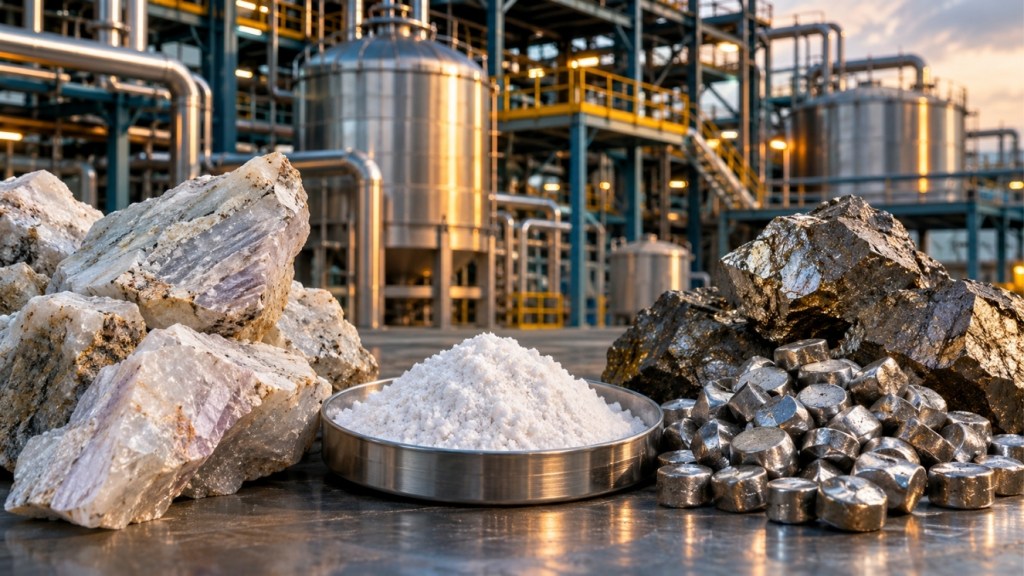

The Union Cabinet on Wednesday approved a Rs 2,814 crore scheme to establish four lithium and nickel processing plants in India, offering a 30% capital subsidy to boost domestic production of high-purity critical minerals and reduce import dependence in sectors including electric vehicles, battery storage and defence.
The five-year Capex Support Scheme to Promote Critical Mineral Processing, spanning FY27 to FY31, will support two lithium processing plants with a minimum capacity of 30,000 tonnes each and two nickel processing facilities with at least 50,000 tonnes capacity each.
The scheme will provide capital support capped at Rs 500 crore per lithium beneficiary and Rs 900 crore per nickel beneficiary. Cobalt is also expected to be recovered as a by-product of nickel processing.
The approval comes as India remains heavily dependent on imported refined intermediates and high-purity materials, with domestic processing constrained by high investment requirements, limited technology availability and access to raw materials.
The government aims to develop processing capabilities for lithium and nickel ores and intermediate products, supporting domestic value addition and supply chains for electric mobility, battery energy storage systems, electronics, speciality steel and defence.
Beneficiaries will be selected through a two-stage process involving technical qualification followed by competitive financial bidding. Two applicants for each mineral will be chosen based on the lowest capital support sought. Incentives will be released in three milestone-linked instalments.
“The Rs. 2,814 crore Capex Support Scheme is an important intervention to address one of the biggest gaps in India’s critical mineral value chain: domestic processing capacity,” said Nitin Gupta, co-founder and CEO of Attero.
He said the focus on lithium and nickel processing could encourage private investment and technology development while strengthening domestic value addition.