


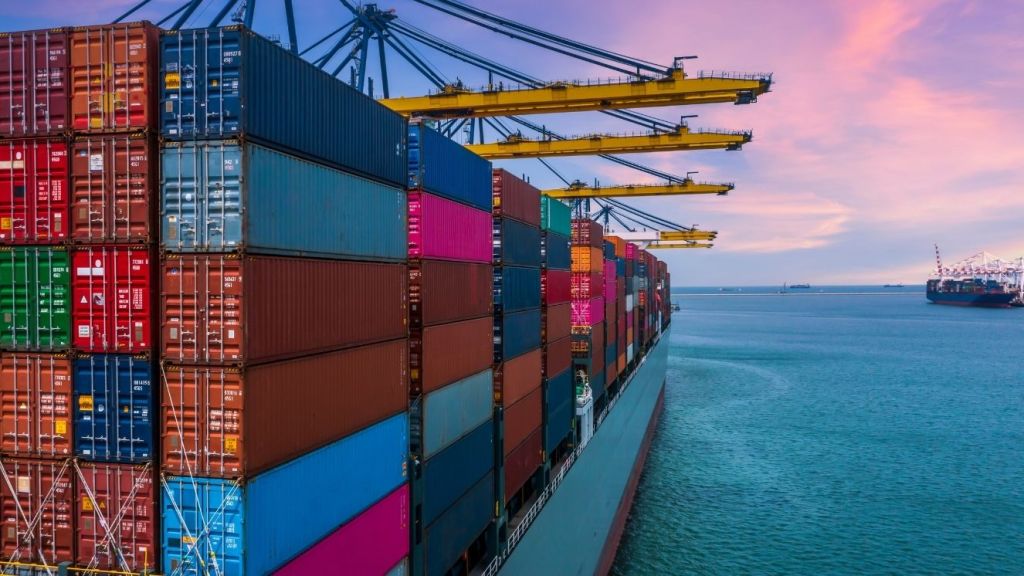

The Union Cabinet on Wednesday approved a Rs 10,000-crore Container Manufacturing Promotion Scheme, with a budgetary outlay extending up to the financial year 2039–40. The scheme aims to scale up domestic production nearly tenfold to 0.75 million twenty-foot equivalent units (TEUs) annually and reduce dependence on imports.
The scheme, announced in the Union Budget for 2026–27, will support both greenfield manufacturing facilities and the expansion of existing units. Of the total outlay, Rs 8,891 crore has been earmarked for operational expenditure assistance, Rs 859 crore for interest subvention and Rs 150 crore for testing and certification infrastructure, Information and Broadcasting Minister Ashwini Vaishnaw told reporters after the meeting.
The operational expenditure assistance will be provided for containers manufactured to global shipping standards and sold by eligible domestic manufacturers, helping bridge the cost gap with imported products. The interest subvention component will provide assistance at 3% per annum on eligible term loans for setting up new facilities and expanding existing capacities. The testing and certification component will support common facilities, including infrastructure for dynamic longitudinal impact testing.
The scheme was announced in the Union Budget of 2026-27. It seeks to address the shortage of containers that Indian exporters frequently face, particularly during disruptions to global shipping caused by geopolitical tensions, rerouting of vessels, port congestion or sudden changes in trade flows.
Vanshnaw said the target is for 15-20% of container manufacturing to be done in India. India’s annual import of containers is estimated at nearly 2 million units, while existing domestic manufacturing remains limited.
Scaling up domestic manufacturing capacity would require adequate domestic availability of speciality steel called Corten Steel in India. Unlike carbon steel, Corten steel forms a dense, protective iron-oxide layer (patina) when exposed to moisture and oxygen, making it most suitable for marine containers. Indian steel manufacturers like JSW, Tata Steel, SAIL and some smaller players have the capacity to make that steel.
Other requirements are corner castings, flooring, protective coatings, locking mechanisms and other hardware which are mostly imported. Hardwood Flooring Veneers and Bamboo Plywood are sourced from Malaysia, Indonesia, Vietnam, and Myanmar and China. High-Precision Locking Systems and Corner Castings are frequently sourced from China due to lower unit costs and bulk availability.
Currently, China manufactures 95% of the world’s shipping containers.
The government expects the scheme to establish an internationally competitive manufacturing base, potentially positioning India as a global export hub for shipping containers. It envisages around 3,000 direct jobs and more than 50,000 indirect jobs, while generating demand for ancillary industries supplying specialised steel, corner castings, wooden frames, paints and other components.
DCM Containers, part of DCM Shriram International, is among the early entrants in the domestic market. Global shipping major Maersk placed an order for 1,000 additional containers with the company in July 2026, following its procurement of domestically manufactured containers.
Other companies in the emerging domestic ecosystem include Jupiter Wagons, APPL Container, Kalyani Cast Tech and SYMCON Industries.