


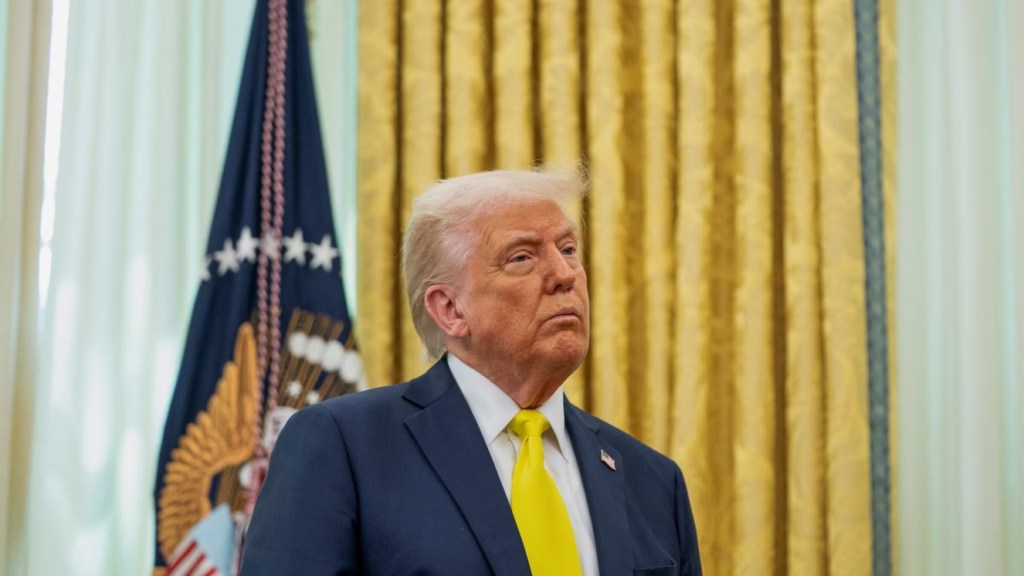

The blue tsunami that swept across America in the midterm elections is more than a setback for a sitting president. It is a rebuke to Donald Trump barely two years after his return to the White House. Democrats have captured both chambers of Congress, overturning Republican strongholds in Texas, South Carolina, and Kansas. Trump urged voters to treat the elections as a referendum on his leadership. They did, but not as he intended. His party’s losses, including those of candidates he endorsed, have punctured the notion that his electoral coalition is impregnable. Yet the result is not necessarily an endorsement of the Democrats. It is a warning against confusing a presidential victory with an unlimited mandate.
The reversal reflects the gulf between Trump’s promises and Americans’ everyday experience. He returned to power pledging prosperity, lower prices, and an end to costly foreign entanglements. Instead, households have faced persistent inflation, expensive housing and healthcare, and tariffs that have raised costs for businesses and consumers. The war with Iran has compounded the damage by pushing up energy prices and reviving inflationary pressures. Economic growth and relatively low unemployment have offered little consolation to families struggling with purchasing power. Trump’s preoccupation with confrontation and political score-settling appeared disconnected from voters’ immediate concerns. Nor could personal loyalty rescue weak candidates in traditionally Republican territory. Affordability, not political theatre, proved the sharper electoral test. The results suggest that voters who embraced his promise of change have not given him a blank cheque.
For India, the immediate question is not whether Trump has been weakened but how much American policy can change. Democratic control of Congress brings greater scrutiny of tariffs, executive decisions, and the Iran war. Yet the president retains authority over trade, immigration, and foreign policy, along with the power to veto legislation. CareEdge Ratings expects little immediate tariff relief, noting that crucial decisions remain with the White House. The unsigned bilateral trade arrangement still depends on negotiations between the two governments. Nor will Democratic gains necessarily soften Washington’s position on India’s Russian oil purchases: scepticism about Moscow crosses party lines. New Delhi must therefore resist treating the election as a diplomatic windfall. Congressional oversight could restrain arbitrary action, but political gridlock might delay agreements, while a bruised Trump could turn to confrontation to reassert his authority. India’s negotiating strategy must allow for all three possibilities.
The larger challenge is to protect India’s interests amid uncertainty that an electoral verdict alone cannot resolve. Prolonged conflict in West Asia threatens energy supplies, raises import costs, and complicates inflation management. A Democratic Congress could question military funding and press for diplomacy, but it cannot independently end the conflict. Restrictions on skilled-worker visas are unlikely to disappear overnight, and American protectionism extends beyond one party. India should deepen engagement with lawmakers across the aisle while continuing direct negotiations with the administration. It must also diversify export destinations, strengthen competitiveness, and reduce vulnerability to oil shocks. Strategic cooperation with the United States remains valuable, especially in the Indo-Pacific, but it should not come at the expense of independent choices. The election has demonstrated the resilience of American electoral accountability, not the arrival of predictable governance. For New Delhi, the sensible response is neither celebration nor alarm, but diplomacy backed by economic resilience. Trump may face new constraints at home; India must still deal with the powers he retains.