


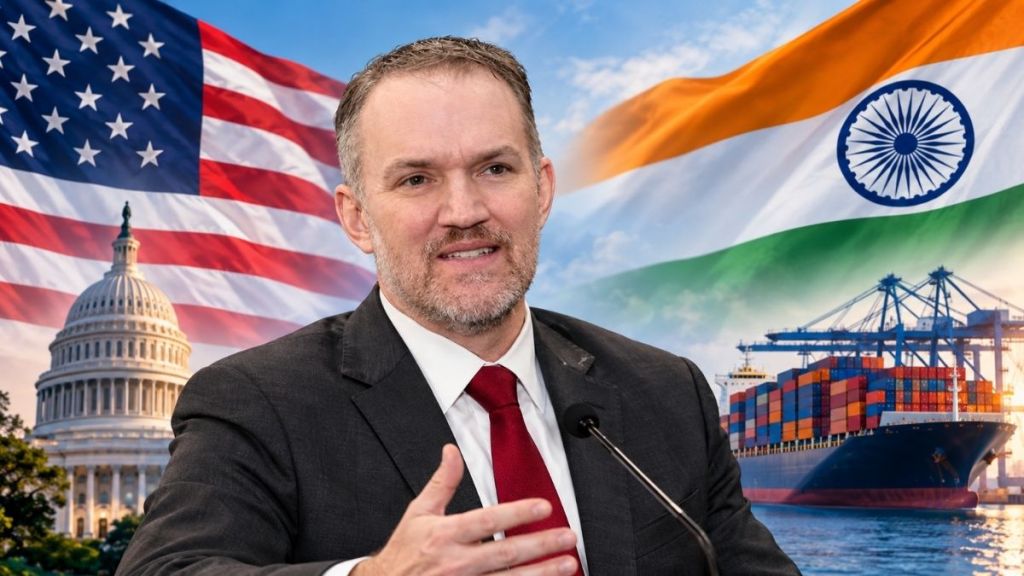

The United States Trade Representative (USTR), Ambassador Jamieson Greer, candidly remarked that the Indo-US trade deal is not imminent. Addressing a press conference after the G20 trade ministerial conference in Milwaukee, he stated that although the talks are best described as being in the “short strokes”—or final concluding stages—an announcement is not imminent. Interestingly, India’s Finance Minister Nirmala Sitharaman has indicated that the trade talks have reached a plateau. All of this contrasts sharply with optimistic assessments that it is done and dusted; that there are only small issues, commas, and full stops. This much-vaunted trade agreement thus is so near yet is a bridge too far. It remains only a work in progress despite several highly productive discussions to advance its prospects, including at Milwaukee.
The USTR appears to be in no hurry to conclude the trade deal as US tariffs are being weaponised to coerce India to accept a deeply unequal and one-sided agreement. India feels that giving in to mounting US demands for market access and addressing trade imbalances beyond a point is difficult. The Lindsey O. Graham Sanctioning Russia and Iran Act of 2026 provides US President Donald Trump powers to impose up to 100% tariffs on countries like India and China for buying Russian oil. After the US Supreme Court invalidated Trump’s tariffs, the USTR launched investigations under Section 301 of the Trade Act of 1974 on countries like India whose trade had inputs produced by forced labour. There is also a second Section 301 investigation on excess capacities.
This plethora of levies makes the tariff architecture of the putative deal—as the reciprocal levies of the interim agreement of February were voided by the apex court—highly uncertain. As if all this weren’t bad enough, recently announced US tariffs include an additional 15% levy on solar cells and modules with no carve-out for India. Earlier, new tariffs were announced on imported generic medicines effective from August 2028. In this highly uncertain milieu, India only wants a mutually beneficial trade agreement that gives it an advantage over the competition and insulates it from unilateral US tariffs. India has sought in vain for an early conclusion to the talks as only a deal would shield it from tariffs up to 100% on Russian oil and Section 301 investigations.
Regarding market access, India has been flexible in its negotiating position to significantly reduce duties on US industrial and agricultural products with firm red lines on not allowing genetically modified maize and soya bean and dairy items. Unfortunately, India does not have the leverage that China has—with its dominance in exports of rare earths—to force the US to come to an agreement. While Greer talked of a “universe of items that are sticking points” for a deal with India, the US had no choice but to agree to a temporary extension of a trade truce till January 10, 2027, with China at the summit between Trump and China’s President Xi Jinping. They also agreed to create a lower tariff regime covering $60 billion in trade in non-sensitive goods.
On trade imbalances, too, India has been heedful of US concerns. What can certainly take the edge off the US’s position—that it has been taken advantage of—is the fact that India’s bilateral trade surplus has shrunk year-on-year by 42% over a period when US tariffs of 50% were in place (September 2025 to February 2026). Even the latest numbers indicate a diminishing bilateral trade surplus that fell year-on-year by 21% to $14.7 billion in April-August 2026. India’s exports to its most important destination—accounting for a fifth of its total exports—were sluggish, if not flat, while imports from the US have steadily risen, especially petroleum products and electronic components.
But the US is unfazed by all of this and insists on addressing its trade imbalance with India through means beyond traditional trade negotiations. According to Sitharaman, the US also seeks to recover some of what it believes it has lost over the years. The bilateral trade deal in the making thus enters a highly problematical territory as unconventional demands are placed on India to reduce its bilateral trade surplus—that amounted to $33.9 billion in 2025-26—by purchasing $500 billion of American energy, information and communications technology, and other products, and making big-ticket investments in the US. Not surprisingly, the ongoing talks have hit an impasse.
Where does India go from here? As we do not have geo-economic leverage vis-à-vis the US, the most efficacious strategy will be to continue rigorous negotiations while concluding trade deals with other developed nations and middle powers to sustain the momentum of its trade. More progress is needed on the trade deal with the European Union that was concluded on January 27 but has not been signed into force. India aims to conclude its trade deal with Canada by the year-end. More bilateral and regional agreements should be on the anvil on a priority basis as India must diversify its trading relationships in a world fracturing into US-centric and Sino-centric blocs.
The writer is an economics and business commentator based in New Delhi.
Disclaimer: The views expressed are the author’s own and do not reflect the official policy or position of Financial Express.