



It has been six years since India’s space sector was opened to private players. India today is no longer circumscribed by its space programme’s founding vision of harnessing technology to help accelerate socioeconomic progress and deliver practical utility.
Technology transfers from the Indian Space Research Organisation (ISRO) to the private sector are taking place via the Indian National Space Promotion and Authorisation Centre (IN-SPACe). Like many other countries, India too is leaning on the private sector to take on much of the load.
Against this backdrop, IN-SPACe Chairman Pawan Goenka’s remarks that ISRO would eventually not manufacture any launch vehicles and that responsibility would be shouldered by the private sector or public sector undertakings, has left employees anxious. They fear ISRO will be privatised.
Both Goenka and ISRO have done well to emphasise that ISRO would remain central to the sector and continue to lead research and technology development, national and strategic missions, space science and exploration, and critical and frontier space capabilities.
The suggestion that ISRO will phase out manufacturing of commercial satellites and launch rockets is not new. The Indian Space Policy of 2023 stated that ISRO will transition from “the existing practice of being present in the manufacturing of operational space systems”, and that “mature systems shall be transferred to industries for commercial exploitation”.
The sectoral reforms, carried out since 2020, have led to a mushrooming of space startups — more than 450 are involved in launch vehicles, satellites, propulsion, ground systems, earth observation, communications, and space applications.
However, India’s space economy, estimated at around $8.4 billion, still forms a minuscule share of the global market over $650 billion. If the aim is to grow the sector to $44 billion by 2033, greater private sector participation is imperative. For a segment that has largely been a state monopoly, the liberalisation has yielded benefits such as greater investments, technological innovation, and entrepreneurial talent while creating new employment avenues.
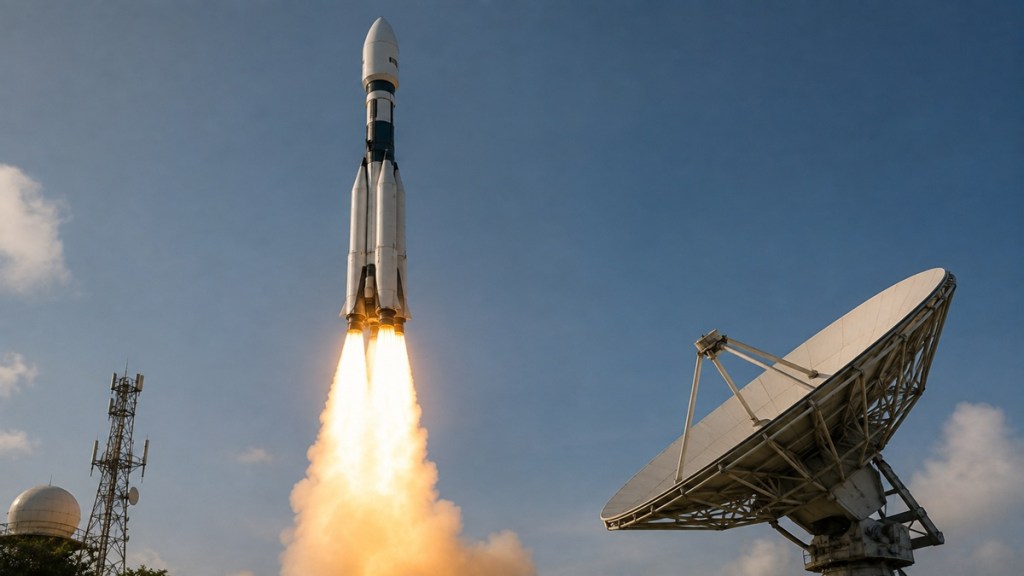
ISRO’s effort has been to focus more on frontier technologies, leaving the private players to scale up routine manufacturing. The private sector has had a significant presence in the production of rockets and worked with ISRO to launch rockets including the Polar Satellite Launch Vehicle (PSLV) and the Geosynchronous Satellite Launch Vehicle that last week sent India’s first imaging satellite into orbit.
One critical question is the viability of private companies independently running operations such as final assembly, integration, testing, and launch. IN-SPACe’s recent invitation to private firms to operate and maintain an upcoming ISRO rocket port in Tamil Nadu has raised questions on the ability of private players to deliver.
ISRO has so far transferred 120 technologies to the private sector, but former chief G Madhavan Nair has said that attempts to shift entire production of launch vehicles to industry have not fructified for years. The most recent arrangement involves ISRO’s commercial arm, NewSpace India Limited, working with Larsen & Toubro and Hindustan Aeronautics Limited to produce the PSLV.
For now, it may be more profitable for the private sector to seize opportunities in space technology-based applications. That said, besides affirming it will neither be privatised nor will its importance be diminished, ISRO must reassure employees that future recruitment would not be impacted.
A transparent vision that clearly demarcates roles will not only enable the space sector to grow, but also reinforce ISRO’s status as an enduring symbol of India’s scientific and technological potential.