



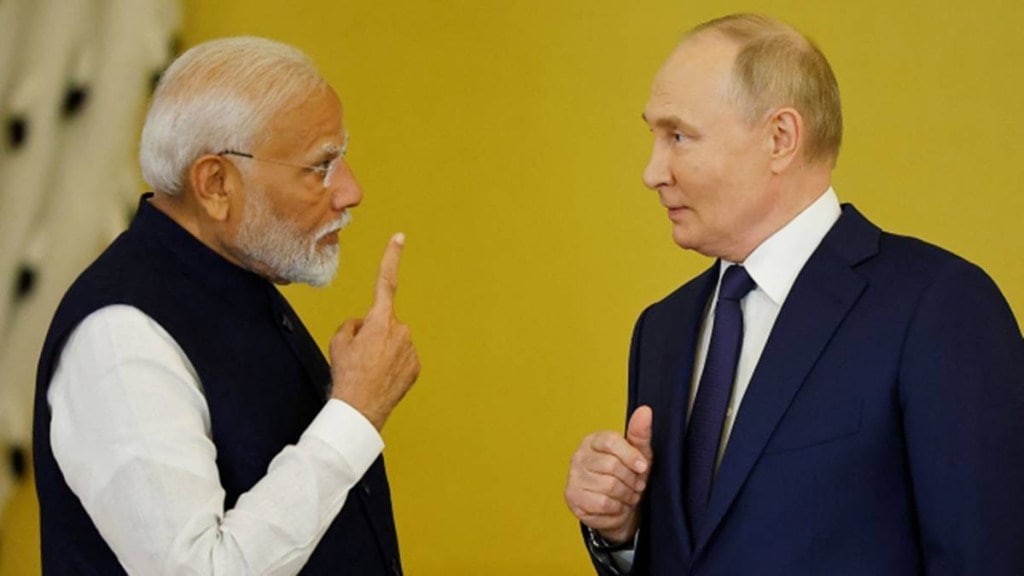
Despite the hugs and hyperbole at the first India-Russia summit to be held since Moscow invaded Ukraine in February 2022, Russia’s top strategic priority remains China, not India. The meetings between Prime Minister Narendra Modi and President Vladimir Putin on December 4 and 5 carried significant diplomatic and strategic weight, as arms, oil, and trade stood out in their discussions.
Arms supplies
Russia’s arms supplies to India have stood out in their relationship for some 50 years, and it remains India’s largest weapons retailer. But India was trying to diversify its arms sellers even before 2022, and Russia currently supplies about 36% of India’s weapons, with France and Israel in the second and third places respectively.
Russia’s war in Ukraine explains why deliveries of arms and spare parts to India have stalled over the last three years. It has failed to deliver two instalments of the S-400 Triumf missile, which India ordered in 2018, and which Modi hailed for its performance in the anti-terrorist Operation Sindoor against Pakistan last May. Moscow has subsequently said it will deliver them in 2026-27, but that remains to be seen. Meanwhile, India is reportedly keen to buy the more advanced S-500 and Su-57 fighter aircraft. But Delhi must contend with the fact that Russia is bogged down in Ukraine, which Moscow wants to conquer. This intention will not change and will continue to affect Russia’s weapons deliveries to India.
Delhi should note that Russia cannot even meet its own military needs. China has sent weapons to Russia, and Chinese representatives are involved in the production of drones on Russian turf. Moreover, a very backward, authoritarian North Korea has supplied more than 5 million artillery rounds to Russia. That amounts to 40% of ammunition from North Korea.
So, what will Russia actually deliver to India?
Russia-China strategic partnership
Even before “Ukraine”, Russia had a Comprehensive Strategic Partnership with China. Both countries share an interest in challenging the lone superpower, the US—which India doesn’t—and in promoting military ties and geopolitical alignment.
Compared to China, India has less to offer Russia. It also has a large trade deficit with Moscow and Beijing. Both India and China have reportedly given dual technology to Russia, both have bought large amounts of Russian oil. Limited domestic production capability leads India to import most of its needs. Until 2021, Saudi Arabia and Iraq were India’s largest oil sellers. Since then, Russia has surpassed both.
China’s GDP is more than $19 trillion, India’s is nearly $4 trillion. China’s defence spending is three times higher than India’s.
China is Russia’s largest trading partner. As much as 25% of Russia’s imports come from China, and 1.5% from India. China buys 14% of Russia’s exports. A mere 1.9% of Russia’s exports go to India, and 1.1% of India’s goes to Russia. Unsurprisingly, both India and Russia wish to increase trade ties.
The American factor also comes into the picture. How can India continue to cope with President Trump, who is no country’s ally or friend? Trump has penalised India with high tariffs for buying Russian oil. How India will therefore respond to Putin’s attractive offer of “uninterrupted oil flow” is anyone’s guess. India cannot ignore America and risk higher tariffs, because it buys 18% of India’s exports. Even if India-Russia trade reaches the hoped-for $100 billion by 2030, it will be less than the $131.84 billion achieved by the US and India in 2024-25.
Trump has not penalised China’s bigger purchases of Russian fuel because its dominance of global supply chains and Beijing’s sweeping new restrictions on exports of rare-earth, minerals, and magnet sectors would make punishing duties unsustainable for America.
Unlike India, Russia and China remain anti-US. November’s meetings between Russia’s Prime Minister Mikhail Mishustin and Chinese President Xi Jinping, and Chinese premier Li Qiang and Putin, dealt with joint military strategies and did not suggest that Russia will advise China to respect India’s territorial sovereignty. Or that India, militarily and economically weaker than China, will be able to drive a wedge between them.
Moscow and Beijing are more concerned about perceived American threats to their security. China does not want Russia to lose in Ukraine because, as Foreign Minister Wang Yi told Kaja Kallas, the European Commission’s Vice-President, this could allow the US “to turn its full attention to China”.
The message of multipolarity brings Russia, India, and China on the same platform, but India will not be anti-American per se, no matter what its grievances against the Trump administration might be. Putin’s trip to India conveyed the message that Russia was not internationally isolated. Putin said that China and India are Russia’s close friends and that Moscow places “great value” on its relations with both countries. Chinese commentators, writing in the state-steered Global Times, observe that the positive India-Russia interactions represent normal exchanges among member states of the Shanghai
Cooperation Organization and BRICS, contributing to the advancement of global multipolarity. What really concerns China and Russia is that the only superpower should not dominate the world. Delhi should also note Putin’s reference to “Russia, India, and other like-minded nations”, who are “working towards a just and multipolar world”. Putin’s visit will shore up India’s prestige and probably increase Russia-India trade, but not at the expense of a stronger, and therefore more useful, Chinese strategic partner. And, given the chance, India wants to strengthen ties with America economically, strategically, and socially.
The author is Founding Professor, Centre for Peace and Conflict Resolution, New Delhi
Views are personal