


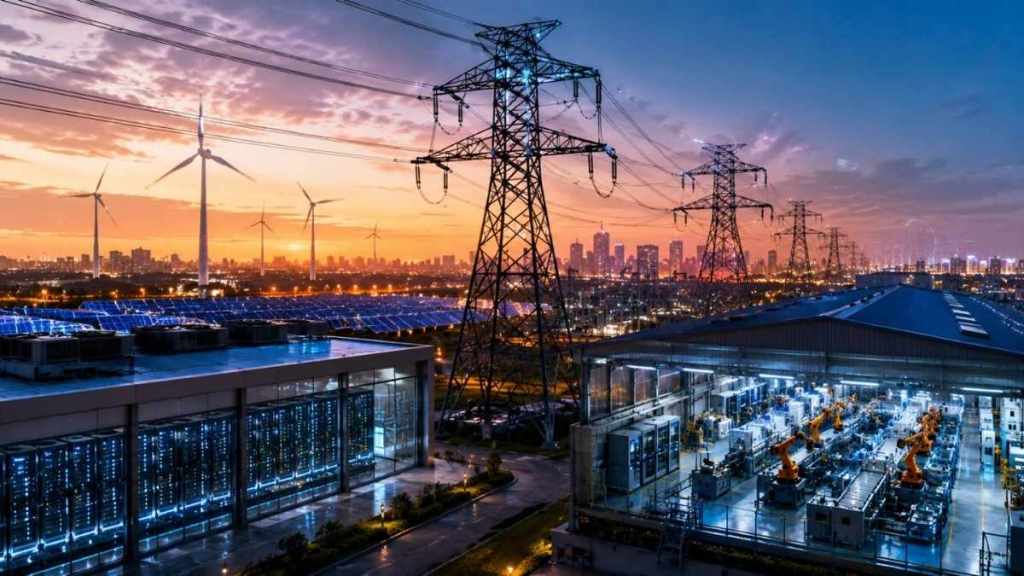

India’s push to build data centres is an important part of its ambition to become a global hub for artificial intelligence (AI), cloud computing, and digital services. The investment pipeline is growing, with Google committing $15 billion to an AI hub in Visakhapatnam, Reliance Industries partnering with Meta on a 168-megawatt (Mw) facility in Jamnagar, and Tata Consultancy Services announcing a $7-billion plan for data centres.
Such investments can strengthen digital infrastructure, attract technology businesses, and support the development of an AI ecosystem. But data centres are not like conventional factories. They require large tracts of land, uninterrupted electricity, and substantial infrastructure for cooling. As states compete to attract investments, the challenge is to ensure that the rush to build capacity does not outpace the availability of these resources. Protests by residents against proposed projects in Thane and Visakhapatnam, over concerns ranging from power and water to land acquisition and environmental impact, are a reminder that the physical requirements of the digital economy cannot be overlooked.
The power requirement is particularly significant. Data centres operate round the clock, and the expansion of AI workloads is increasing the need for high-density computing and reliable electricity. A proposed Amazon Web Services facility in Thane, for instance, has been reported to require 422 Mw of power, illustrating the scale of demand a single project can create. Dedicated connections and backup systems can protect operations from interruptions, but they do not eliminate the need for adequate generation and transmission capacity.
Renewable energy can help meet the additional demand more sustainably, although round-the-clock operations require arrangements to manage the intermittency of solar and wind power. States must therefore assess not merely whether electricity can be supplied to a project today, but whether the wider grid can accommodate successive rounds of expansion without compromising reliability or raising costs for other consumers.
Water presents a similar challenge. Data centres generate substantial heat, and conventional cooling systems can consume significant quantities of water. This is a particular concern in regions already facing seasonal shortages or competing demands from households, agriculture, and industry. The availability of land and tax incentives may make a location attractive to developers, but neither guarantees that its water resources can support large facilities over the long term.
Technology offers some solutions: air cooling, closed-loop systems, and the use of treated wastewater can reduce freshwater consumption. Yet the effectiveness of these measures depends on the design of individual facilities and local conditions. Equally important is assessing the cumulative impact of several facilities concentrated in one area, rather than treating each project as an isolated investment.
None of this should detract from the need to build data centre capacity. Delaying investment through uncertain policies or cumbersome approvals would undermine the opportunity to strengthen digital infrastructure. But speed should not come at the expense of planning. The Centre and state governments need a coordinated framework that maps suitable locations against power availability, grid connectivity, water stress, and land-use constraints.
Incentives should encourage resource-efficient designs, while developers should bear a transparent share of the cost of infrastructure created specifically to serve their facilities. Consultation with local communities can also help identify concerns before projects become contentious. The ability to provide reliable power and water will increasingly determine where capacity can be added. The digital economy may operate in the cloud, but the infrastructure supporting it is firmly rooted in the physical world.