


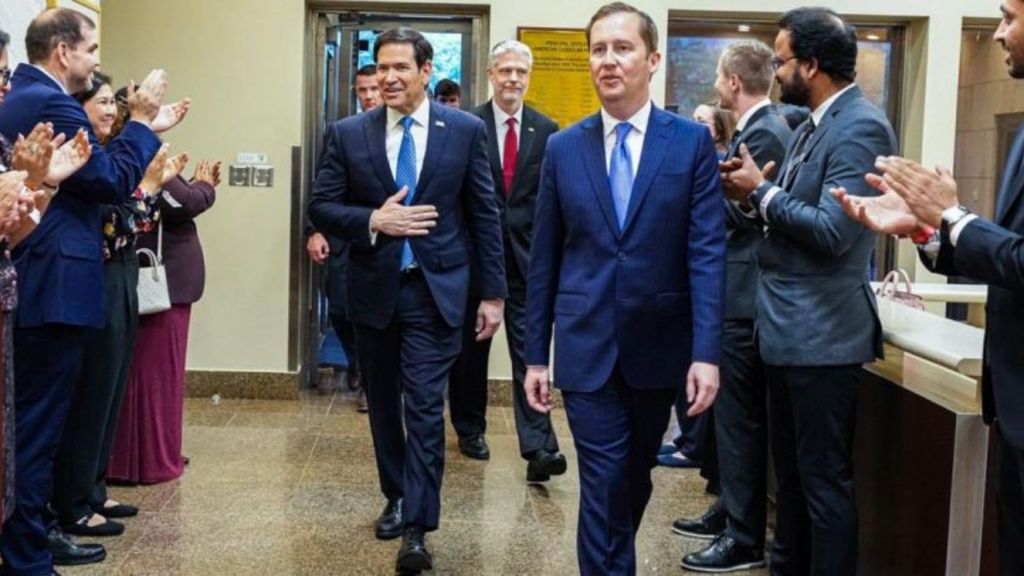

US Secretary of State Marco Rubio’s visit to Reliance Industries’ Jamnagar refinery on Wednesday puts energy security and industrial investment at the centre of his India trip. Coming after meetings with industrialist Gautam Adani and Tata Sons Chairman N Chandrasekaran, the visit underlines Washington’s growing recognition of India’s industrial capabilities and their strategic importance in an increasingly uncertain global energy market. Reliance, with its formidable refining infrastructure, has emerged as a focal point for potential India-US cooperation in global oil supplies. Although details of Rubio’s discussions with Reliance’s top leadership were not immediately available, his remarks to reporters ahead of the visit clearly indicated Washington’s thinking. The US wants Reliance to refine more Venezuelan crude and is exploring wider partnership opportunities, potentially including investment in Venezuela’s oil production. Both propositions merit consideration, but they involve distinctly different commercial calculations.
Jamnagar’s importance extends well beyond its status as the world’s largest single-site refining complex, with a combined processing capacity of 1.4 million barrels per day. Its sophisticated facilities can process heavy, sulphur-rich crude, including Venezuelan grades that many refineries cannot handle efficiently. Reliance’s investments over decades have created an industrial advantage that now carries considerable geopolitical significance. For India, greater access to Venezuelan crude could make sound economic sense, particularly if available at attractive discounts. With the country dependent on imports for over 85% of its crude requirements, diversification is an economic necessity. Additional supplies could improve refining margins, widen sourcing options, and reduce vulnerability to disruptions in traditional supply markets. However, the economics must account for landed costs, freight, payment arrangements, sanctions compliance, and reliability of deliveries. The attraction of discounted crude should never obscure these considerations.
The more complicated proposition is investment in Venezuela’s upstream oil industry. Unlike crude procurement, exploration and production involve substantial long-term capital commitments, operational uncertainties, and exposure to political and regulatory risks. Venezuela’s troubled petroleum sector, history of sanctions, and uncertain investment environment make careful scrutiny essential. Diplomatic encouragement cannot substitute for rigorous commercial evaluation or adequate contractual safeguards. There is also a larger strategic question. India’s energy security is best served by maintaining access to the widest possible range of suppliers, including Russia, Venezuela, West Asia, and the US. Russian crude has helped Indian refiners manage costs, while Venezuelan supplies could provide another commercially attractive option. Replacing dependence on one source with excessive reliance on another would defeat the purpose of diversification. Equally, India’s procurement decisions should not become instruments of another country’s geopolitical priorities, however important the bilateral relationship.
Rubio’s visit nevertheless highlights the growing convergence of Indian industrial strengths and American energy interests. Reliance’s involvement in a proposed US refining project illustrates the potential for cooperation extending beyond crude purchases to investment, processing and long-term supply arrangements. Such partnerships could strengthen energy security and create economic value on both sides. New Delhi should facilitate commercially viable opportunities while preserving the autonomy of Indian companies to make procurement and investment decisions on economic merit. Washington, for its part, must recognise that durable energy partnerships require predictable sanctions policies, regulatory certainty, and dependable market access. The most constructive outcome of Rubio’s visit would be more secure and competitively priced crude supplies, stronger industrial partnerships, and greater flexibility for Indian refiners. Energy diplomacy succeeds when national interests and business economics reinforce each other, not when commercial decisions are subordinated to geopolitical calculations.