


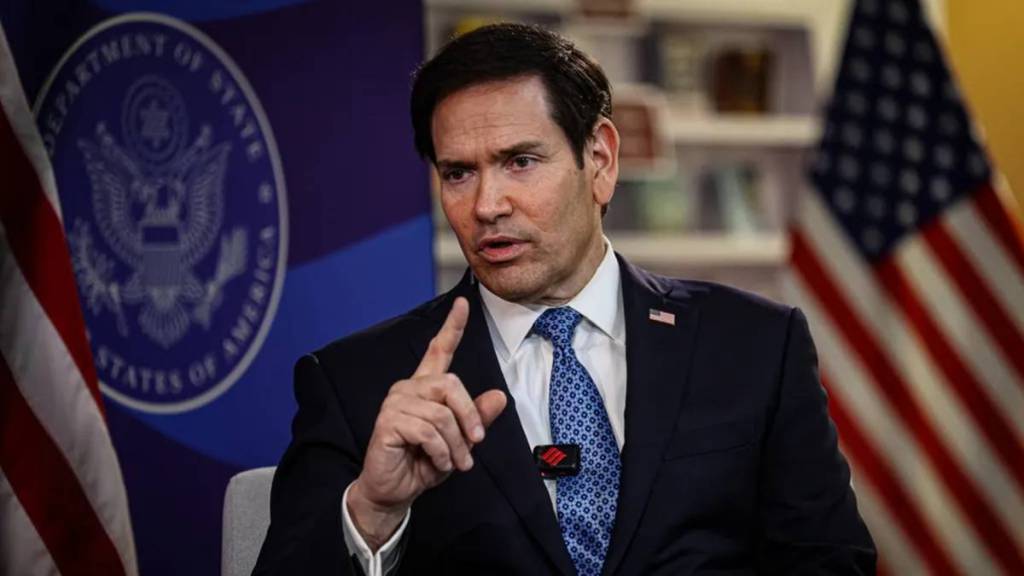

Transactionalism and flattery rank high on the US-India-Russia relationships. Accompanied by businessmen, Secretary of State Marco Rubio visited Mumbai and Jamnagar from October 20-22 . Prior to his trip, Rubio even referred to India as an “important ally”. That was better than being lambasted as a hellhole by President Donald Trump less than six months ago. As US diesel prices rose to record highs, largely because of America’s inability to defeat Iran since it invaded that country with Israel in March, Trump decided that America would buy Russian diesel with the intent of easing diesel prices to improve the Republicans’ chances of winning November’s mid-term elections.
Branding India anew as “a refining superpower”, Rubio travelled to Jamnagar, in Prime Minister Modi’s home state of Gujarat, to tour Mukesh Ambani’s Reliance Industries oil refinery complex, which is the world’s largest. An old buyer of Venezuelan oil, Ambani was quick to cultivate ties with the Trump administration by investing in the first new refinery project in the US in 50 years, and by purchasing more Venezuelan oil barrels after last January’s Trumpian coup in Venezuela.
Rubio even showed understanding of India’s decision to continue purchasing Russian oil by voicing appreciation of India’s difficulties in pivoting from Russian imports “in a day”.
Essentially, Rubio engaged with India’s largest concentration of economic power—one which led Elon Musk to sarcastically label Ambani as the prime minister and “real boss” of India.
Two preferences of the Trumpian establishment are clear. First, they signify that although corporate financiers might compete with each other, they are simultaneously the prime movers and keystone of international relations. Whether that signals Washington’s disregard of India’s aspiration to be treated as a favoured international partner, despite their Comprehensive Global Strategic Partnership, is uncertain.
Second, Washington doesn’t want to be dependent on any single country, and Rubio advised India to diversify its oil suppliers. India should buy less from Russia, which currently provides 50% of its oil imports, and buy more Venezuelan and American oil.
From a different angle, External Affairs Minister Subrahmanyam Jaishankar voiced the expectation that India’s partners should show “zero tolerance” for global terrorism—implying Pakistani-trained and -sponsored terrorists—when he met Rubio. But Delhi should realise that the US will use Pakistan to project its aims in West Asia—as it has since the Cold War—regardless of India’s more recent talk of anti-terrorism. And Trump claimed that his mediation staved off an Indo-Pak war in 2025—which India denied. Moreover, given that Pakistan and China are close partners, at a time when Trump is cultivating Beijing, Islamabad gains a further advantage in Washington.
On trade, Rubio’s expectation that a deal was in the offing also came as a surprise. As recently as on October 1, US Trade Representative Jamieson Greer affirmed that a bilateral trade deal between the US and India was “not imminent”, although negotiations were in their final phase. And Delhi has been fed up that Washington’s sole criteria to reduce India’s $58-billion trade surplus, which has prevailed over many years, is apparently to make up “for all that they’ve lost over these years”. Trump, however, underlined “the power that we have with us”, while Jaishankar pointed to America’s unpredictable trade policies.
Now, the US expects trade with India to hit a record high on $500 billion—compared to $ 240 billion at present—within three years, and is ready to skip unresolved matters in the final deal.
Washington has taken into account an anticipated India-US trade deal to waive tariffs on Delhi’s Russian oil purchases. India’s ability to turn crude oil into diesel could be particularly valuable in improving their trade ties. Commercial and strategic interests are intertwined.
Militarily, America is not one of India’s three top arms retailers. Washington will not give the F-35 aircraft or co-produce it with India because Delhi retains close military ties with Moscow. India has bought the S-400 Triumf air defence system and is considering buying the SU-57. Turkey, a NATO ally, also bought the S-400, which resulted in Trump 1.0’s decision to cancel its F-35 contract in 2019. Allies and the weapons they receive do matter to Trump, although he wants them to pay more for their defence against Russia or China.
America is within its rights to regulate immigration or what Jaishankar euphemistically referred to as people-to-people contacts in Mumbai. Although new rules have been introduced to curb Indians and foreigners from residing in the US, Rubio claims they do not target India. But the debate over the regulation of immigration is tied to Trump administration’s MAGA nativism, and its ideas of racial supremacy. Those rules continue to come into conflict with Delhi’s analogous talk about India’s civilisational greatness and claim to be the world teacher.
At another level, India’s response to Vice President JD Vance’s insult to “indentured” Indian workers in America suggests that immigration has become a social and political quarrel between Delhi and Washington, partly because Indians have long perceived Indo-Americans as having enhanced their global stature, partly because America is the favourite emigration destination for Indians—but not vice-versa. Their remittances account for nearly 2% of India’s GDP. This is slightly more than Delhi’s spending on health for more than a billion citizens.
India’s dependence on the US stems from its slow progress, and it will not vanish if the latter buys diesel from Ambani. Prosperous countries make the best allies, said Trump during his first term. Even then, as America’s current ties with its West European allies reveal, prosperity alone is no guarantee of trust between allies and partners. India would be politically wise to draw lessons from that reality.
Disclaimer: The views expressed are the author’s own and do not reflect the official policy or position of Financial Express.