


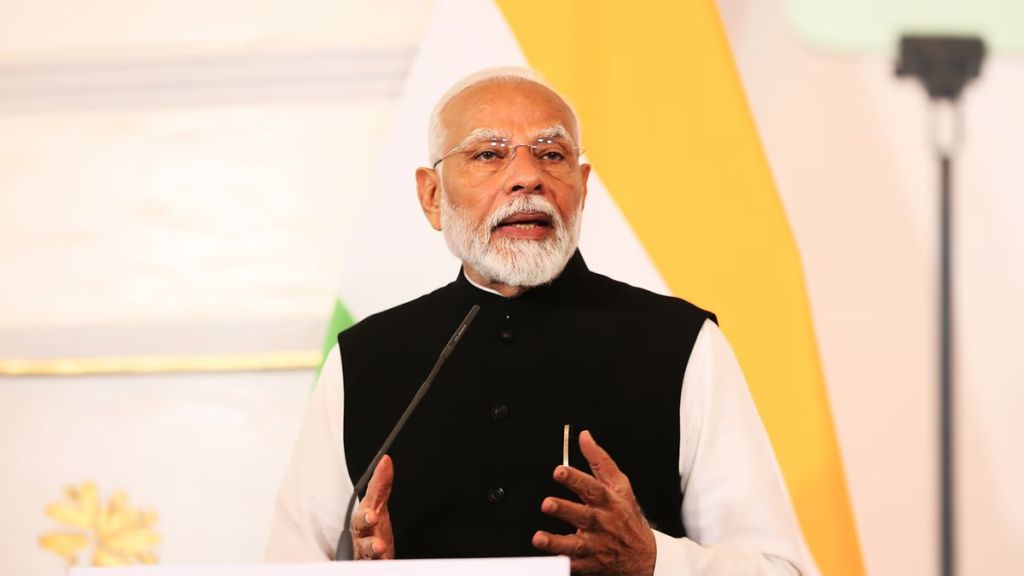

Narendra Modi has completed 25 years in public service, 13 years as chief minister of Gujarat and 12 as Prime Minister of India. It is time to recall his major achievements as well as challenges that face the nation over the next 10 years or so. As an agricultural economist, let me only comment on agriculture in Gujarat and at all-India level. More importantly, I would like to spell out what PM Modi still needs to do to put agriculture on a sustainable high-growth path that can significantly augment farmers’ incomes.
Let me start briefly with his term as chief minister of Gujarat from 2001-02 to 2013-14. Gujarat experienced an agrarian miracle by registering a growth rate of more than 9% per annum in the sector, almost unheard-of even in the heydays of the Green Revolution in Punjab. It was achieved with his emphasis on water augmentation for irrigation, through check dams as well as by securing a good share of the Narmada river’s waters. He also separated feeder lines for irrigation and rural households to ensure power reaches farmers for timely irrigation.
Roads that connected markets were given equally high priority. Agri-extension work through Krishi Mahotsav, where government functionaries and private sector joined hands to reach farmers in every village, showcased their latest technologies. Bt Cotton, approved by the Vajpayee government in 2002, did wonders in Gujarat and prosperity of the rural masses followed. It is largely because of this magic in Gujarat that he was elected time and again.
In 2014, when he took over the reins as Prime Minister, India was hit by a drought, which was followed by another in 2015. Incidents of back-to-back drought had occurred only thrice in a century. Modi’s experiences in Gujarat came handy and he put water (irrigation) on high priority along with crop insurance (PM Fasal Bima Yojana).
As a result of that, almost 60% of India’s gross cropped area is irrigated today. This has given India a much-needed food security of basic staples. India has emerged as the largest producer and exporter of rice, and even after giving free food (rice or wheat, 5 kg/person/month) under the PM Garib Kalyan Yojana, we have buffer stocks that are more than four times the norm for rice and almost thrice for wheat.
India is also a net exporter of agricultural products. In 2025-26, India exported roughly $53 billion worth of agri-products, with rice and marine products leading the show, and imported agri-goods worth $40 billion (primarily edible oils and pulses).
Overall, average annual growth of agri-GDP under the Modi, from 2014-15 to 2025-26, has been 4%. It is not as high as he achieved in Gujarat, but good enough especially when population growth is below 1%. This is what has ensured India’s food security.
But as we look towards the near future, or even his dream of Viksit Bharat by 2047, we see several challenges in agriculture. Let me list just two that deserve his urgent attention.
First, in our production basket, there is a major mismatch between demand and supply. We have too much rice and wheat and very little of pulses and oilseeds. We have so much rice that we now plan to put almost 7 million tonnes of it in ethanol, which is perverse as the net energy balance of this is negative, and so is its economics. Atmanirbharta (self-sufficiency) in pulses and oilseeds cannot be achieved unless the incentive package for pulses and oilseeds matches that of rice and wheat.
Our research at ICRIER shows that paddy cultivation in the Punjab-Haryana belt is lucrative because of large input subsidies (on power, fertilisers, and canal irrigation) amounting to almost Rs 40,000/hectares. If we want farmers to shift from paddy to pulses, which we should to relieve pressure on groundwater and also save environment, we should reward pulse/oilseed growers to the tune of about Rs 35,000/ha. It will not be an extra burden on the exchequer as it will result in savings on input subsidies (power and canal) by the states and the Centre (fertiliser). Can PM Modi announce a special programme on these lines on 50:50 basis at least in Haryana where the water table has been receding by 1.7 feet annually. That will also then encourage Punjab to follow suit.
Second, Modi’s dream of doubling farmers’ real incomes has remained unfulfilled. The Ashok Dalwai Committee had pointed out that it would need agricultural GDP to grow at 10.4% to achieve this goal. We know that the real growth has been at 4%—not bad, but it can surely be better. The normal course of action to augment farmers’ incomes has been to diversify from basic cereals to high-value agriculture—fisheries, poultry, milk, fruits and vegetables, etc. These are perishable commodities that demand efficient value chains and connecting them to high-income consumers in metros and abroad.
But there is one strategy that can augment farmer incomes manifold in a short period of time. And that is agri-photovoltaics—where a farmer is both the annadata and urjadata (provider of food and energy). Such farmland is for dual use: producing energy through solar panels at a height of 10-11 feet with due spacing for photosynthesis of crops underneath. ICRIER has set up a pilot in Rajasthan where farmer income grew by eight to 10 times. If Modi can tweak the PM-KUSUM scheme on the lines of PM-Surya Ghar scheme, offer the same subsidy, and feed in tariff at even half the cost of supply to rural areas under traditional set-up, he can usher in a new revolution, say “Surya Khet Kranti”, on the lines of Operation Flood in milk.
Disclaimer: The views expressed are the author’s own and do not reflect the official policy or position of Financial Express.