



By Amol Agrawal
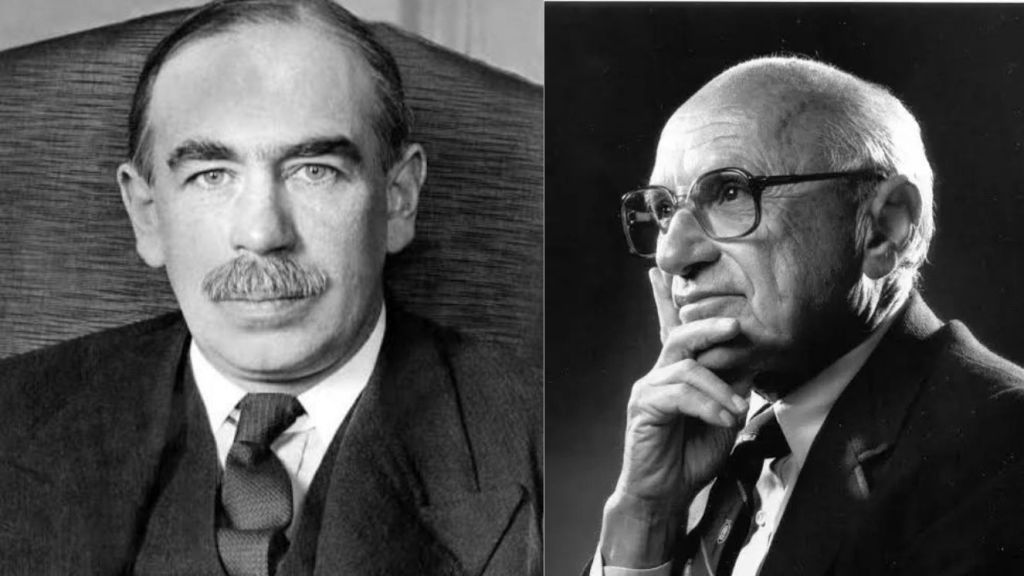
The 2026 Nobel Prize in economics was awarded to Robert Hall and Michael Woodford for “microeconomic foundations of macroeconomic stabilization”. The Nobel Committee extensively cited British economist John Maynard Keynes (122 times in the Scientific Background document) for laying the foundations of the stabilisation policy. Economist John Cochrane of Stanford University commented that the Nobel laureates’ work can be traced to Milton Friedman. It is quite interesting how the two major warring ideas that shaped the subject of macroeconomics have joined hands for this year’s prize.
In 1936, John Maynard Keynes published The General Theory of Employment, Interest and Money. Although Keynes does not mention macroeconomics even once in his book, his framework shaped macroeconomics as a distinct subject. Keynes wrote the book challenging the classical theory which suggested that markets will resolve the world economy from Great Depression. Keynes wrote that markets were not clearing as wages and prices were sticky and that they do not change instantly as shown by traditional economics. As markets were not functioning, Keynes argued for a large-scale government stimulus to resurrect the economy.
The Great Depression was followed by the Second World War which too required large-scale government intervention. The twin forces of depression and wars led to a surge of Keynesianism across economic policy and economics departments in universities. Keynesianism got a boost when Alban William Phillips, in 1958, noted a negative trend between inflation (wages) and unemployment. This relationship, called the Phillips curve, showed there is a trade-off between the two economic variables. Policymakers can choose between inflation and unemployment.
In 1968, Milton Friedman entered the hallowed debates of economic stabilisation. He argued that the trade-off between inflation and unemployment exists only in the short run. If inflation is allowed to rise, it feeds into expectations. Over time, people start seeing higher inflation and demand higher wages. Firms respond to higher wages by cutting down labour and employment. In the end, we have both high inflation and high unemployment. Friedman’s prognosis came true in the 1970s when world economies suffered from high inflation and unemployment or stagflation.
The world of macroeconomics was now divided into two major warring factions: Keynesianism and the Chicago School. Keynesianism advocated government role in economic stabilisation whereas the latter suggested that government should play a minimal role in economic affairs. The Chicago School also revived monetarism, which said money supply leads to inflation. As central banks are responsible for money supply, they play a major role in economic stabilisation. While Keynesianism was based on sticky wages and prices, Chicago was based on free markets and rational expectations.
Friedman was joined by his University of Chicago colleague Robert E Lucas Jr who criticised Keynesianism as a vague theory. He argued for a new macroeconomics framework built on microeconomic foundations and rational expectations. Few economists insisted on retaining the Keynesian ideas of sticky prices/wages. The debates resulted in a New Keynesian approach where macroeconomic decisions are the result of millions of decisions by households and businesses. Individuals have rational expectations that if policy is anticipated, it will not have any impact.
In this historiography of macroeconomics enters the work of the 2026 Nobel Laureates. Keynes had argued that income is a sum of consumption, investment, government spending, and net exports. In most countries, consumption forms the largest share of a country’s income and thus it is important to determine consumption. Keynes said that consumption is a function of income, and if income rises consumption does too. Friedman noted that consumption is driven by permanent income, not a temporary income like government transfer. Hall turned the consumption debate on its head, stating that consumption cannot be predicted based on income. Instead, he suggested, households make consumption decisions based on their expectations of the future. People change consumption only if there is a change in information about the future.
Woodford was one of the key figures of the New Keynesian School which summed up the stabilisation policy in three equations. The first equation asked how output responds to change in interest rates. The second, based on the Philips curve, asked how output and expectations impact inflation. The third fed into the first two equations and asked how central banks interest rates impact inflation and output.
Thus, Woodford moved away from money supply to interest rates and provided a modern monetary policy framework in which central bank interest rates impact output and inflation. Woodford’s research added to Hall’s analysis, saying that consumption is also impacted by interest rates. If a central bank lowers interest rates and these are not expected by households, consumption could be higher than expected.
Woodford drew deep insights from Swedish economist Knut Wicksell’s work on natural/neutral interest rate which neither stimulates nor reduces consumption. In fact, Woodford’s book title, Interest and Prices, was inspired by that of Wicksell’s book. His ideas are now used by central banks and finance ministries across the world. The Urjit Patel Committee report that established inflation targeting at the RBI mentions New Keynesian Woodford models as the basis for the inflation targeting framework.
The 2026 Nobel is as much a prize for economics as macroeconomic history. Most economists who have contributed to this history have been awarded the Nobel Prize. Hall and Woodford are the latest additions to the galaxy.
The author teaches at the National Institute of Securities Markets.
Disclaimer: The views expressed are the author’s own and do not reflect the official policy or position of Financial Express.