


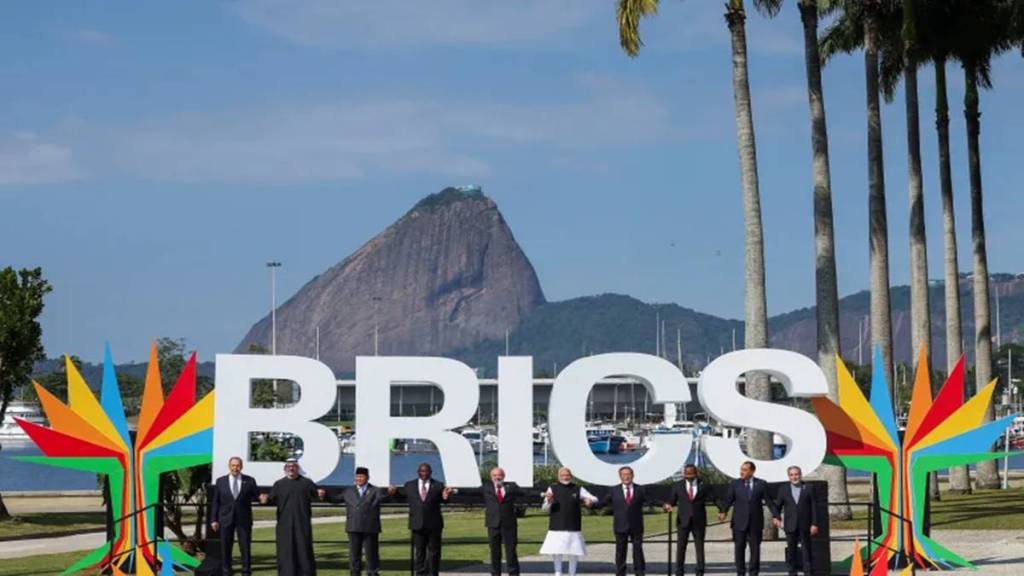

When India hosts the 18th BRICS Summit in New Delhi on September 12-13, it will lead a bloc that is economically powerful but politically divided. China, Russia, and Iran want the 11-member group to expand rapidly, challenge the dollar, and become a stronger anti-Western alliance. India opposes this approach. It sees BRICS as a non-aligned platform for economic cooperation, equal governance, and the interests of the Global South — not as a vehicle for Chinese leadership or conflict with the West.
India assumed the BRICS chairmanship in January and will hand it over to China next year. It faces a difficult balancing act at the summit. As chair, it must bridge differences within a diverse group that includes Russia and Iran, both under US sanctions. It must also prevent China from dominating the agenda while ensuring that India’s position in BRICS does not conflict with its role in the Quad and its other Western partnerships.
India must also be cautious about proposals for a BRICS currency or other similar initiatives that Washington may see as an attack on the dollar. The US has already threatened BRICS countries with 100% tariffs for pursuing de-dollarisation.
These challenges leave little room for bold initiatives. Trade in local currencies offers a safe way forward. It could reduce transaction costs by 2-5% without threatening the dollar’s global role. The US cannot prevent two sovereign countries from using local currencies or a payment system of choice, but within the BRICS agreement on a preferred system won’t be easy.
Navigating Financial Architecture
China supports mBridge, a blockchain-based network that uses central bank digital currencies (CBDCs) for cross-border payments. Its participants include China, Hong Kong, Thailand, the UAE, Saudi Arabia, and Malaysia. More than 95% of its settlement volume reportedly uses China’s digital yuan.
India may instead propose the Project Nexus model. Nexus is designed to connect the instant-payment systems of India, Singapore, Malaysia, the Philippines, and Thailand. It does not require a common blockchain and is expected to begin live operations around mid-2027.
China may push its Cross-Border Interbank Payment System (CIPS) as an alternative to SWIFT, the dominant messaging network banks use to conduct international payments. Since CIPS operates outside Western control, it attracts countries seeking protection from sanctions. Its use is growing, especially as Gulf oil exporters accept more payments in yuan.
India may separately propose linking the CBDCs of BRICS members for trade and tourism. New Delhi will present this as a way to make payments faster and cheaper — not as an effort to weaken the dollar.
Beyond payment systems, the summit will discuss a BRICS Startup Innovation Fund and a Network on Digital Agriculture. It will also cover resilient supply chains, clean energy, green finance, and reforms of the IMF, World Bank, and UN. As chair, India must reconcile differences and forge consensus on a joint declaration.
BRICS began modestly. Goldman Sachs economist Jim O’Neill coined the term “BRIC” in 2001 for four promising emerging economies — Brazil, Russia, India, and China. They formed a group in 2006 and held their first summit in Yekaterinburg, Russia, in 2009. South Africa joined in 2010, turning BRIC into BRICS, which has since expanded to include Egypt, Ethiopia, Iran, the UAE, and Indonesia, and Saudi Arabia.
Western countries closely watch BRICS because of its collective strength. Its 11 members account for about 30% of global GDP, nearly half the world’s population, a quarter of global merchandise exports, and a fifth of imports. The glue holding this diverse group together is a shared dissatisfaction with Western dominance. Its members object to their limited voice in global institutions and oppose the use of the dollar, financial networks, and unilateral sanctions as tools of pressure.
BRICS has several achievements. Its Shanghai-based New Development Bank (NDB) has approved more than $30 billion for infrastructure, sustainable development, and green-energy projects. The group also created the $100-billion Contingent Reserve Arrangement to help members handle balance-of-payments pressures. It has promoted local-currency trade, established the BRICS Vaccine R&D Centre, and strengthened South-South cooperation.
Internal Fractures
Deep divisions prevent BRICS from acting as a united global power. India and China have territorial and strategic tensions. Members disagree on whether BRICS should remain non-aligned or become an anti-Western bloc. Their political systems and views on global issues also differ. China’s economic dominance creates fears that Beijing could control BRICS institutions.
BRICS has no permanent secretariat, binding treaty, common trade agreement, or central monetary authority. Decisions require consensus and usually result in declarations rather than enforceable commitments. These weaknesses grow as the group expands and becomes more diverse.
Expansion is itself divisive. China supports rapid entry for countries such as Pakistan, Turkey, Belarus, and Venezuela to increase the bloc’s geopolitical influence. India wants clear entry criteria. It opposes Pakistan over terrorism and security concerns, is cautious about Turkey’s support for Pakistan, and rejects admitting countries simply because they oppose the West.
India also rejects a common BRICS currency. It would require a central monetary authority, coordinated fiscal rules, and a shared monetary policy. Members are unwilling to surrender these powers.
Differences also exist over the NDB. China wants more capital to expand lending and admit new members. India fears that linking contributions and voting rights to economic size could allow Beijing to dominate the bank.
India is also wary of Chinese infrastructure proposals that could bring the Belt and Road Initiative (BRI) into BRICS. It opposes the BRI mainly because the China-Pakistan Economic Corridor passes through territory India claims.
India’s position has drawn criticism from Paulo Nogueira Batista Jr, a former NDB vice-president. He has called India a “Trojan horse” and an “outlier” within BRICS. He argues that India’s close ties with the US and Israel, its membership of the Quad, and cautious approach to de-dollarisation weaken anti-Western unity.
But this criticism misunderstands India’s role. BRICS can remain relevant only by delivering practical benefits without demanding political alignment. At the New Delhi summit, India must keep the group focused on the Global South, open to the world, and free from domination by any single country. The summit’s real test is whether BRICS can deliver practical gains without becoming another confrontational geopolitical bloc.