



By Ajay Srivastava
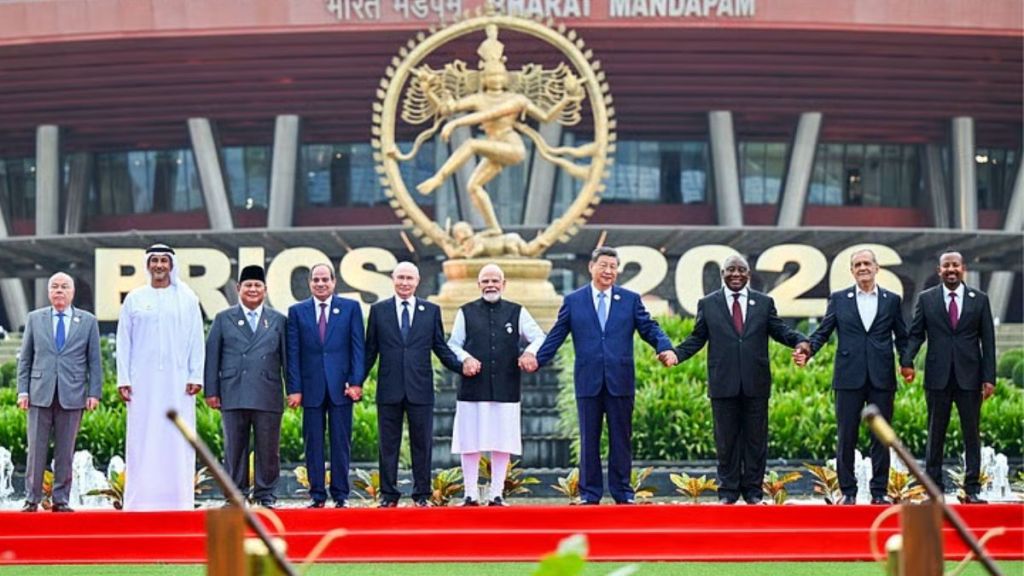
The New Delhi Declaration, adopted at the 18th BRICS Summit in New Delhi on September 12, devotes at least 19 paragraphs to wars, sanctions, terrorism, nuclear risks, territorial disputes, and humanitarian crises. Yet its most striking feature is not what it says, but how carefully it avoids saying who is responsible.
This ambiguity is deliberate. BRICS brings together countries with sharply different strategic interests and relationships. Some confront the US and Europe; others depend on Western markets, investment, and security partnerships. A declaration acceptable to all must acknowledge global conflicts without forcing members to agree on every aggressor, victim, or remedy.
The result is a document written largely in diplomatic code.
Paragraph 22 condemns unilateral economic and secondary sanctions not authorised by the UN Security Council. It does not identify the countries imposing them. Still, the target is evident: US and EU sanctions against Russia and Iran, as well as threats of penalties against countries and companies that are trading with them.
Cuba is an exception to the caution. Paragraph 27 explicitly raises concern about the tightening of the blockade against Cuba and calls for an end to economic, commercial, and financial restrictions. The country imposing these measures (the US) is unnamed, but the reference is clear.
The declaration is equally careful in addressing the dangerous escalation in West Asia. Paragraph 28 calls for maximum restraint, protection of civilians, and diplomacy. It also stresses the need to maintain the smooth flow of global trade, supply chains, and energy. This appears directed at the US, Israel, and Iran, together with their regional allies. It also implicitly warns against any action that could obstruct the Strait of Hormuz.
Paragraph 29 goes further by expressing serious concern over deliberate attacks on peaceful nuclear facilities under International Atomic Energy Agency safeguards. But it identifies neither the attacker nor the attacked. The likely reference is to Israeli or US attacks on Iranian nuclear facilities.
On Gaza, however, the declaration is more detailed and less evasive. It calls for maintaining the ceasefire, ending violence, and ensuring full humanitarian access. It opposes the forced displacement of Palestinians and any attempt to change Gaza’s geography or demography. It condemns starvation as a method of warfare, attacks on civilians and healthcare facilities, and the obstruction or politicisation of humanitarian assistance. Albeit Israel isn’t named, the references are clearly directed at its military operations and policies in Gaza.
The declaration supports full UN membership for Palestine and the establishment of a sovereign Palestinian state within the 1967 borders, with East Jerusalem as its capital. It also notes South Africa’s case against Israel at the International Court of Justice and Israel’s obligation to facilitate humanitarian aid to Gaza. These provisions place the Palestinian question at the centre of BRICS’ political message. The criticism is directed primarily at Israel, while the call for full Palestinian membership also implicitly addresses the US because of its position in the UN Security Council.
The document is unusually direct on Lebanon. It welcomes the ceasefire, condemns continuing violations, and calls on Israel to withdraw from Lebanese territory. It denounces attacks on UN peacekeepers and mourns the deaths of four Indonesian personnel serving with the UN Interim Force in Lebanon. Here it names Israel.
Other conflicts receive shorter but still significant treatment. Paragraph 37 calls for an immediate and permanent ceasefire in Sudan’s war between the Sudanese Armed Forces and the Rapid Support Forces (RSF). It highlights the humanitarian crisis, the spread of extremism, and the need for an “African solution to African problems”. The appeal is directed at Sudan’s two warring sides and, indirectly, at their foreign backers — particularly the UAE which is accused of supporting the RSF, and Egypt, Iran, Turkey, and Russia that have supported the Sudanese Armed Forces. The UAE denies arming the RSF.
The declaration supports a Syrian-led political transition, post-conflict reconstruction, action against foreign terrorist fighters, and the withdrawal of occupying forces. It again avoids identifying those forces which could include Israel, Turkey, and the US. The vagueness reflects the difficulty of securing consensus among members with different positions on Syria’s political future.
For India, the strongest diplomatic gain appears in paragraph 40. The declaration condemns “in the strongest terms” the terrorist attack in Jammu and Kashmir on April 22, 2025. It calls for zero tolerance of terrorism and action against cross-border movement, financing, and safe havens. Pakistan is not named, but the references to cross-border terrorism and safe havens reflect India’s concerns about Pakistan-based terrorist networks.
The declaration also defends South Africa’s position in the G20. Paragraph 116 rejects any arbitrary revision of G20 membership and stresses that South Africa is a founding and full member. This appears to respond to US pressure against South Africa’s participation and signals BRICS’ determination to resist unilateral attempts to reshape major multilateral institutions.
The most conspicuous omission is the Russia-Ukraine war. The declaration neither names the conflict nor identifies Russia as the aggressor and Ukraine as the country attacked. Instead, paragraphs 23 and 24 use general language about ongoing conflicts, sovereignty, and peaceful resolution through “dialogue, consultation, and diplomacy”.
The New Delhi Declaration should therefore not be read only as a list of agreed positions. It is also a map of BRICS’ internal divisions. Where agreement is strong — Palestinian statehood, opposition to sanctions, and condemnation of terrorism — the language is firm. Where interests clash — Ukraine, Iran, and the role of foreign forces — the wording becomes abstract.
This diplomatic ambiguity helped India produce a consensus declaration from an increasingly diverse bloc. But it carries a cost. A group that condemns aggression without consistently identifying the aggressor may preserve unity, yet struggle to shape outcomes. BRICS has shown that it can speak about global conflicts. Whether it can act on them remains a much harder question.
The writer is Founder, Global Trade Research Initiative.
Disclaimer: The views expressed are the author’s own and do not reflect the official policy or position of Financial Express.