



By Chandrajit Banerjee
Director General, CII
The Indian-New Zealand Free Trade Agreement (FTA) deserves a warm welcome, not only for giving India’s businesses predictable access to a high-income, rules-driven market, but for linking India more closely to the wider Pacific region. It also reinforces a clear pattern in India’s trade policy: steady, FTA-led integration with every major market and regional grouping. It is a timely step that will bring Indian and New Zealand businesses, workers and communities closer together, and set the stage for a partnership that grows richer with time.
Levelling the field for Indian exporters
New Zealand has eliminated customs duties on 100% of its tariff lines, leaving no Indian product outside the zero-duty net. Until now, they faced duties of up to 10% on hundreds of product lines, while competitors from China, Australia, Japan and South Korea sold into the same market with preferential access under their trade agreements. In price-sensitive categories such as apparel, footwear and leather, that kind of margins made winning order extremely challenging for Indian exporters. FTA levels the playing field.
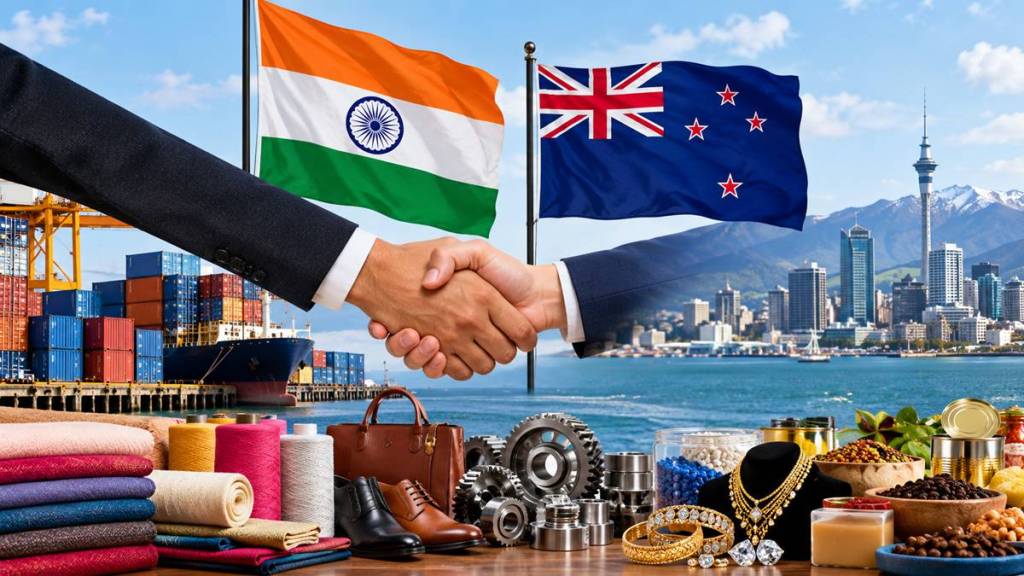
Some of the key beneficiaries of the FTA are the labour-intensive sectors like textiles, apparel, leather, footwear, engineering goods, plastics, gems and jewellery, processed foods. Their producers are based across in MSME clusters from Tiruppur and Kanpur to Jalandhar and Surat, and many of their workers are women. Export growth here translates directly into jobs and incomes.
Addressing costs beyond tariffs
For an MSME, a duplicate inspection or a consignment stuck at the border can cost more than any duty. The India-New Zealand FTA includes disciplines that tackle behind the border rules that can impede trade. A good example is the pharmaceuticals and medical devices annex, where the New Zealand has committed to accept good manufacturing and clinical practice inspection reports from comparable regulators such as the US FDA, the European Medicines Agency, the UK’s MHRA and Health Canada.
Another example are the facilitation measures included in the customs chapter which commits both sides to release standard cargo within 48 hours where possible, and express consignments and perishables within 24 hours.
Opening doors for Indian talent
Services trade depends on people, and here the agreement is notably forward-looking. New Zealand has opened 118 services sectors to Indian providers, and the mobility annex creates clear and stable pathways for business visitors, intra-corporate transferees, contractual service suppliers and independent professionals. This supports Indian strengths in computer services, engineering, R&D, management consulting and health services.
Several features stand out. A new temporary employment entry pathway admits up to 5,000 skilled Indian professionals at any one time, for stays of up to three years. Indian students face no numerical cap, with post-study work rights of three years for STEM bachelor’s and master’s graduates and four for doctoral scholars. A further 1,000 Working Holiday visas a year are open to young Indians, and dedicated channels cover doctors, nurses, AYUSH practitioners, yoga instructors, chefs and music teachers. Time-bound steps towards mutual recognition of qualifications in engineering, architecture and accounting will spare professionals from redundant examinations.
Such provisions build the people-to-people ties on which lasting commercial relationships can be built upon.
Capital, technology and recognition
New Zealand has committed to facilitate $20 billion of investment into India over 15 years, spanning manufacturing, renewable energy, agri-technology, skills and emerging technologies. The word “facilitate” matters. The outcome will depend on bankable projects and active outreach by Indian firms, and industry should treat the commitment as an invitation to bring them forward.
Technology cooperation is built into the text as well. Under the Agriculture Productivity Partnership, action plans for kiwifruit, apples and honey will bring Centres of Excellence, improved planting material, grower training and expertise in orchard management and post-harvest practices to Indian growers. It is knowledge transfer with a clear purpose: higher yields, better quality and stronger farmer incomes.
The intellectual property chapter strikes a careful balance. It preserves India’s TRIPS flexibilities on public health, supports small enterprises and start-ups, and recognises genetic resources and traditional knowledge, encouraging the use of databases such as India’s Traditional Knowledge Digital Library.
Perhaps most striking is the formal recognition of India’s heritage. The agreement carries New Zealand’s first annex on health and traditional medicine, covering Ayurveda, yoga and the wider AYUSH systems alongside Maori health practices. New Zealand has also undertaken to amend its geographical indications law within 18 months, subject to its domestic legislative process, so that protection extends beyond wines and spirits. That opens the way for Basmati rice, Darjeeling tea and India’s handicrafts to be safeguarded against misuse in the New Zealand market.
A window to the Pacific
New Zealand’s standing in the Pacific is far greater than its size would suggest. It is a trusted partner across the Pacific Islands and part of the region’s major trade arrangements, including RCEP and CPTPP. A close commercial relationship with Wellington gives Indian businesses a credible foothold in this wider region, along with better knowledge of its standards, supply chains and partners. As India deepens its engagement with the Indo-Pacific, a rules-based partnership with a like-minded democracy is a valuable step.
From agreement to advantage
It is now up to Indian businesses to leverage these agreements optimally. Industry now has three immediate tasks. The first one is mastering rules of origin and documentation, followed by focused effort towards using the new regulatory and recognition pathways, and building partnerships with New Zealand firms, including through the mobility channels that have become available. CII will work with the government and member companies, particularly MSMEs, to spread awareness, resolve implementation issues and help exporters and investors turn this agreement into advantage.
Disclaimer: The views expressed are the author’s own and do not reflect the official policy or position of Financial Express.