



By Aravind Sanka & Pavan Guntupalli, Co-Founders, Rapido
Mobility is a major recurring household expense, but India’s cost-of-living debate rarely treats it that way. The discussion tends to focus on the cost of living in a particular place, rather than the cost of getting from one place to another. The Household Consumption Expenditure Survey shows that conveyance accounts for 7.59% of monthly per-capita expenditure in rural India and 8.46% in urban India. For a household, each journey is a recurring cost and its affordability can determine how easily people can access economic opportunities without owning a vehicle.
The fare is only one part of that cost. A commuter may need to pay to reach a bus depot, metro, or railway station, pay for another ride after getting off, spend an hour in traffic, or decide that owning a vehicle is the only practical way to complete the journey. The question is not whether an individual bus or metro ride is cheap. It is what the entire journey costs in money and time.
The time involved in making a journey is itself an economic cost. The ministry of statistics and programme implementation’s Time Use Survey 2024 found that men aged 15 to 59 years spend an average of 77 minutes daily in commuting for employment activities. For women in that age group, the average is 67 minutes.
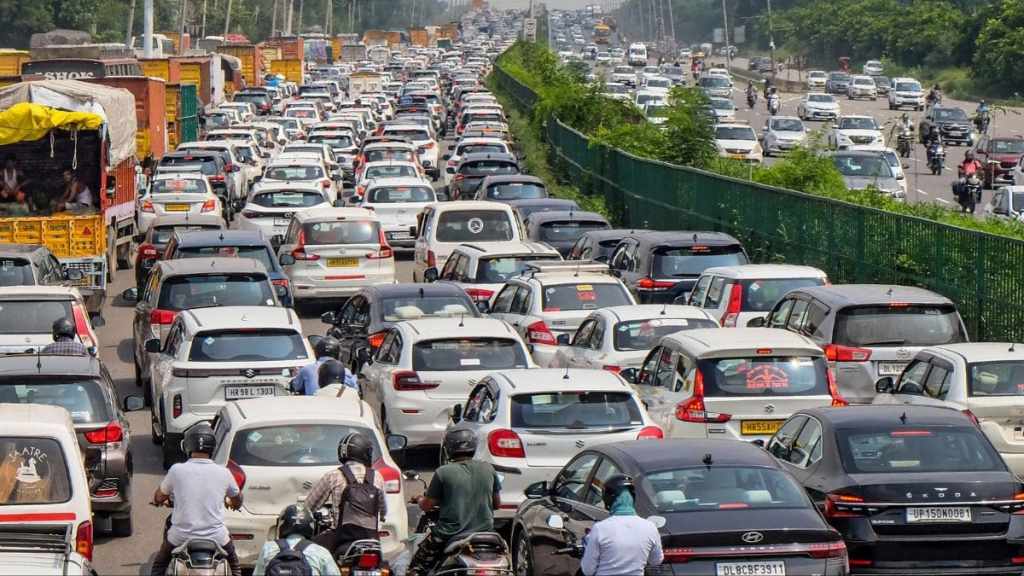
Traffic adds another layer to the cost. The Economic Survey 2025-26 cites the TomTom Traffic Index 2024, which estimated that commuters lost 117 hours to rush-hour traffic in Bengaluru, 103 hours in Mumbai, and 76 hours in New Delhi. It cites another study that estimated traffic-related late arrivals cost Bengaluru around 7.07 lakh productive hours in 2018, equivalent to an estimated Rs 11.7 billion in lost productivity. The figures use different measures but point to the one problem: congestion imposes a measurable economic cost beyond the money spent on the journey.
This directly affects people. A job may be technically reachable but impractical if the journey takes several hours. This applies to education and essential services.
When a faster connection brings another erstwhile inaccessible part of a city or region within a reasonable commute, more jobs become viable. The Namo Bharat corridor between Delhi and Meerut illustrates this. Early accessibility estimates cited in the Economic Survey suggest that around 6.9 to 7.6 lakh jobs between these locations are within one hour.
However, the benefit of a fast rail connection does not begin when a passenger enters the train or end when they leave it. People still have to reach the station at one end and get from the destination station to work, college, or an essential service.
Bengaluru offers a recent example. In March, its transport corporation introduced feeder services connecting residential areas on the Yellow Line. The services cost Rs 6-25 and ran every 35 to 40 minutes. These areas had previously lacked direct bus connectivity, leaving some residents dependent on cars and two-wheelers even for short trips.
A low-cost metro ride has limited value if reaching the station requires an expensive, inconvenient, or time-consuming connection. The same applies at the other end of the journey. Public transport becomes more useful when people have affordable ways to connect to it.
This is a wider limitation of public transport. The ministry of housing and urban affairs of India recommends 40 to 60 buses per lakh population, while the Economic Survey puts India’s urban bus fleet at about 47,650, with nearly 61% concentrated in nine megacities. Even where a city has a metro, bus, or regional rail network, fixed-route public transport cannot provide a direct connection for every origin and destination.
This is where different modes can work together. A commuter might use a shared two-wheeler to reach a metro station, take the metro for the longer part of the journey, and use another connection at the destination. A private vehicle provides a different combination of cost, travel time, and flexibility. The relevant comparison is therefore the complete journey: what does each combination cost, how long does it take, and does it require the household to own a vehicle.
The value of public transport ultimately depends on the journey it enables, from a person’s starting point to their final destination. First- and last-mile connections are part of that affordability equation. A transport network becomes more economically useful when people can combine its different modes to reach work, education, and essential services without having to own a vehicle simply to bridge the gaps between them.
Consider a commuter living three kilometres from a metro station and working four kilometres from the station at the other end. The metro may be the most affordable way to cover most of the journey, but the commuter still has to get to the station and then to their destination. Walking may add substantial time. Taking an individual autorickshaw for both legs can raise the daily cost. Owning a motorcycle or car adds the costs of purchase, fuel, maintenance, parking, and insurance.
A shared two-wheeler offers another way to make those shorter connections without requiring the passenger to own a vehicle. For some journeys, it may offer a practical balance of cost and travel time. For others, walking, buses, or autos may make more sense depending on distance, availability, and the time of day.
Thus, the case for shared mobility is not that it should replace public transport, or that it is cheaper. Its role is to give commuters another option where fixed routes or other modes may not work as well for a particular journey. The Economic Survey 2025-26 recognises this role, calling for greater use of shared and point-to-point modes, including bike taxis, alongside public transport to address first- and last-mile gaps.
For households, that choice matters because every journey has a cost. Making more ways to complete that journey available can reduce the need to own a vehicle simply to get around the city.