



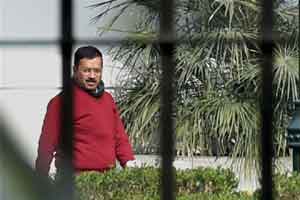
The recently announced results of the Delhi election shocked everyone—probably even Kejriwal himself. The overwhelming mandate of 67 out of 70 seats has put immense pressure and responsibility on Kejriwal and the Aam Aadmi Party (AAP) to follow through with their promises. Jan Lokpal Bill, full statehood to Delhi, free WiFi, 15 lakh CCTV cameras, free bijli-paani are just some of the populist promises contained in a 70-point manifesto. Was the resounding AAP victory because of its populism or something else—especially, the frustration and anger at the non-delivery of basic services for all residents, rich, poor and the middle-class? Add the inefficient and corrupt practices followed by the MCD (BJP-ruled), and the hafta practices of the Delhi Police, and you have a solid basis for booting out the old and drafting of the new. Therefore, while policies targeted at the poor are always welcome, they are reminiscent of practices of old government (all puns intended) and not the new promised by the AAP. From the latter, we expect delivery and performance.
Of the 70-point programme, we intend to examine, in some detail, the “intellectual” and “economic” origins of one of the AAP defining policies—free water for all. Water is a necessity—its demand is little influenced by price or income. While the AAP’s focus on universal access to water is commendable, its economic plan for free water is not.
The AAP policy of free “lifeline water” is the provision of 20 kilolitres (kl) of free water per month to every household with a metred connection. But, according to a 2013 CAG report, nearly 25% of the households (8.3 lakh households) did not have access to piped water, as is shown in the accompanying table. Unlikely that those without access to water were not poor; according to a poverty line that is 50% above the Tendulkar poverty line, 25% of residents of Delhi are absolutely poor. And the AAP policy of free water does zilch to help these most-needy residents at this point in time.
Among these water-free households, 6.2 lakh were provided water through tankers with an average per capita supply of only 3.82 litres per day. Moreover, 6.2% of these households do not receive any water supply—in the form of tankers or piped water connection. But, like Marie Antoinette would have reasoned, these residents are supposed to drink tea from imaginary free water supplied to them by the AAP! Free water for the rich and the middle-class, but not the poor?
But there are further problems with the AAP’s pro-poor (but in name only) water policy. Any additional consumption (over 20 kl) would result in the household having to pay for the entire amount of water consumed, i.e., anyone consuming 20.1 kl would pay for 20.1 kl as opposed to the additional 0.1 kl. This is, in essence, an “infinite tax” policy, the like of which has never been practiced in the world, not even in the world of voodoo economics. Instead of reducing corruption, this policy will lead to greater corruption—households will have an incentive to tamper with the metre to ensure that it shows lesser consumption than that attracting the infinite tax.

So, from where did the AAP get their idea of provision of free water? Extensive perusal of the literature does yield an example of a very distant but “similar” water policy. More than a decade ago, in 2000, President Thabo Mbeki of South Africa (SA) outlined the following water policy: All poor South Africans should receive 6 kl of water for free per month; for any additional consumption, the household would be charged for the entire amount. An infinite tax, yes—but a non-binding one.
Note that the SA limit of 6 kl is less than one-third of the AAP level (20 kl). Also, the SA policy was based on a household size of 8 as opposed to the household size of 5 for AAP. Converting these numbers into per capita per day (pppd) values, SA’s policy mandated 25 litres pppd whereas the AAP’s policy is almost 6 times that value—135 litres pppd. Most importantly, there was clear targeting of the poor people in the SA policy.
The AAP policy, on the other hand, targets the rich and results in a transfer of money from the larger size, poorer households to the smaller size, richer households (as shown in the table). The AAP policy is a “reverse Robin Hood” strategy, plain and simple (goo.gl/Osk3PG, “Kejriwal’s Waterfront”, The Financial Express). So, how is this policy any different from the ill-conceived and ill-fated “dole-economics” of the Congress-UPA?
Our suggestion is to scrap the free water policy for all and instead target the poor localities and the localities with no access to piped water. Ideally, the poor should not have a problem paying for the water, as they are currently paying exorbitant amounts for procuring water from the tankers. This targeting is one of the easiest to achieve as the poorer localities are already known and thus, can be effortlessly directed through the water connection. Such a targeting would be as straightforward as imposing a head tax, i.e., impossible to avoid and impossible to arbitrage.
Water is unlikely to be carried from the poor localities to the rich. (Incidentally, the head tax is so named because if someone did not pay, then a simple medieval solution was “off with their heads”!).
If the AAP government is able to provide piped water connections to all, then that itself will be a big achievement. While Kejriwal has stated that “all group housing societies that are not connected with DJB supply network shall be connected with the DJB water pipes within a month of formation of the AAP government”, it has to ensure the same for all of Delhi. And this will not be cheap. A statement by the AAP after the Delhi budget in 2014 said, “Even by the most conservative estimates, at least R3,000 crore would be required to lay down the network for piped water in just some parts of the city.” With the free water policy as well, this amount will rise to approximately R3,500 crore. That is almost 10% of the current budget of Delhi.
While there is no doubt that the AAP has chosen issues that are relevant to the people through their Delhi Dialogue series, it is not clear whether much research was carried out to design their policies. If it had, it would not be enunciating voodoo policies for problems that can be tackled in a straightforward manner. There is simply no need, political and economic, to provide free water. A basic question: what would the poor prefer—free or cheap water for 2 hours or water all day at a higher price; or equivalently—electricity 24/7 or 2 hours electricity for half the price?
Along with their other promises (the more sensible ones) such as water accounting and quality monitoring, building community toilets, improving education and health infrastructure, adequate street lighting, the new AAP government will be in a severe financial crunch if doesn’t start prioritising its policies for effectiveness and the likelihood of benefitting Delhi in the long-term (or at least in the next 5 years). Populism does not pay—it never does. Time for the AAP to start concentrating on delivery and performance. If it does, both the AAP and Delhi will benefit enormously.
By Surjit S Bhalla & Prasanthi Ramakrishnan
Bhalla is co-author, with Ankur Choudhary, of the recently-released book Criconomics – Everything you wanted to know about ODI cricket and more; Prasanthi is an economist at Oxus Investments