



By Ashok Gulati & Subhodeep Basu, Respectively Distinguished Professor and Research Fellow at ICRIER
India’s solarising journey is a commendable one. Just before the Narendra Modi government was sworn in 12 years ago, the country had just 2.82 Gw of installed solar capacity. By last month, this had risen to 168.04 Gw, making India the third-largest player in solar, after China and the US. Much of this (74%) is utility-scale, led by big companies like Adani Green Energy, ReNew, NTPC, JSW Energy, and Greenko Energy. Tata Power Solar is more into engineering, procurement, and construction. Roof-top solar accounts for roughly 20%, and the remaining (about 6%) is off-grid and hybrid projects.
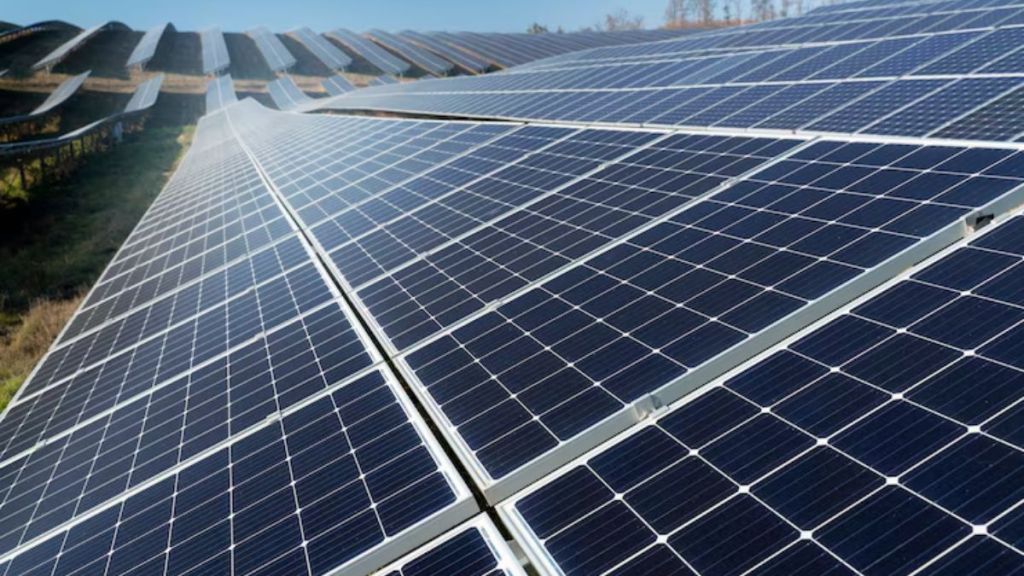
The utility-scale solar model enabled rapid, cost-efficient deployment. These are ground-mounted solar parks, largely on degraded or wastelands given by the government. The biggest is Khavda Solar Park (30 Gw) coming up in Rann of Kutch.
Rooftop solar has picked up some momentum under the PM Surya Ghar Muft Bijli Yojana, which aims to bring rooftop solar to one crore households. A household installing a 3-kilowatt (kW) system gets Rs 78,000 in central subsidy. States like Uttar Pradesh add another Rs 30,000, taking total support to Rs 1.08 lakh, against the estimated cost of Rs 1.8 lakh. This amounts to a 60% subsidy. The Delhi government has gone even further and is ready to install free rooftop solar.
Where the Modi government has not yet succeeded is the Pradhan Mantri Kisan Urja Suraksha evam Utthan Mahabhiyan (PM-Kusum) scheme. The government had earlier envisioned it largely for solar pumps. But component A of PM-Kusum does specify that farmers can have up to 2 Mw power plants on their land. But there was no subsidy. It is now time to rethink the PM-Kusum component A and provide capital subsidy.
Further, ground-mounted solar projects on agricultural land need to be banned, as they directly conflict with food security. India cannot afford that. The solution is agri-photovoltaics (agri-PV) — solar panels fixed at a height of about 11 feet, with due spacing that allows land to be fully cultivated beneath the panels. This is a dual use of land for producing food as well as energy. By giving a fillip to component A of PM-Kusum, the government can achieve three objectives simultaneously.
First, it can augment farmers’ income eight-10 times. Second, it can reduce the government’s power subsidy bill. Finally, it can produce clean energy that can help rural areas industrialise. To realise this, capital must be made accessible to farmers or farmer producer companies at rates that are applicable under priority sector lending, besides fixing the feed-in-tariff at half the cost of supplying power to rural areas under the current set-up.
PM Surya Ghar, in comparison, has an outlay of Rs 75,021 crore. The World Bank has also approved an $820 million loan, with concessional finance and a grant, to support PM Surya Ghar and mobilise private financing. PM-Kusum has no equivalent financing window. It is high time the World Bank also thought in terms of solar cooperatives on the lines of milk cooperatives under Operation Flood, and came forward to unleash a revolution in rural areas where solar becomes the “third crop” for farmers.
An ICRIER initiative establishes proof of this concept. A 600-kW PM-Kusum-A plant in Rajasthan, financed by a Rs 1.4-crore loan from SBI, Rs 60 lakh from farmer contributions, and Rs 35 lakh from Kotak Mahindra’s CSR funds, showed that farmer’s income rose from about Rs 40,000 per acre from wheat and bajra to nearly Rs 4 lakh through energy sales and shade-tolerant horticulture. That is a ten-fold income potential.
Agri-PV addresses another major distortion in India’s power sector. Agriculture consumes nearly 260,000 gigawatt hours of electricity annually while paying tariffs far below the cost of supply. The CAG’s recent report puts the average cost of supply at about Rs 8.5/kWh against realisation of around Rs 1/kWh from agricultural consumers, a subsidy of roughly `7.5/kWh. With the annual tariff subsidy bill at about Rs 2.35 lakh crore, agriculture may account for nearly 85% of the burden, and higher rural supply costs could push this above 90%. This adds to discom financial stress.
A differentiated feed-in tariff of `4.5/kWh, almost half of the cost of supply of power, can improve project viability and accelerate adoption. For discoms and state governments, this needs no additional expenditure, only smarter use of existing subsidies.
The demand for energy is going to go up exponentially as AI data centres start springing up. They are power and water guzzlers. They will also have to invest in battery storage or pumped hydro storage without depending on the lithium-ion supply chain. Agri-PV projects should therefore be planned with storage and local grid requirements in mind.
India has seen the power of catalytic finance before. Operation Flood, the foundation of the White Revolution, was supported by a World Bank loan. It helped build a self-sustaining network of village dairy cooperatives and benefitted millions of milk producers. A similar opportunity exists for solar cooperatives. It can go even further and make all gaushalas solar power plants based on the agri-PV concept and process dung into organic manure to be sold with subsidised urea.
India has shown it can scale solar. The next challenge is to ensure the benefits reach the farm gate. The question is no longer whether India can harvest the sun. It is whether India’s farmers can own a meaningful share of that harvest. Once farmers’ incomes increase, as ICRIER’s pilot in Rajasthan has shown, it can spur a manufacturing revolution through augmented demand.