


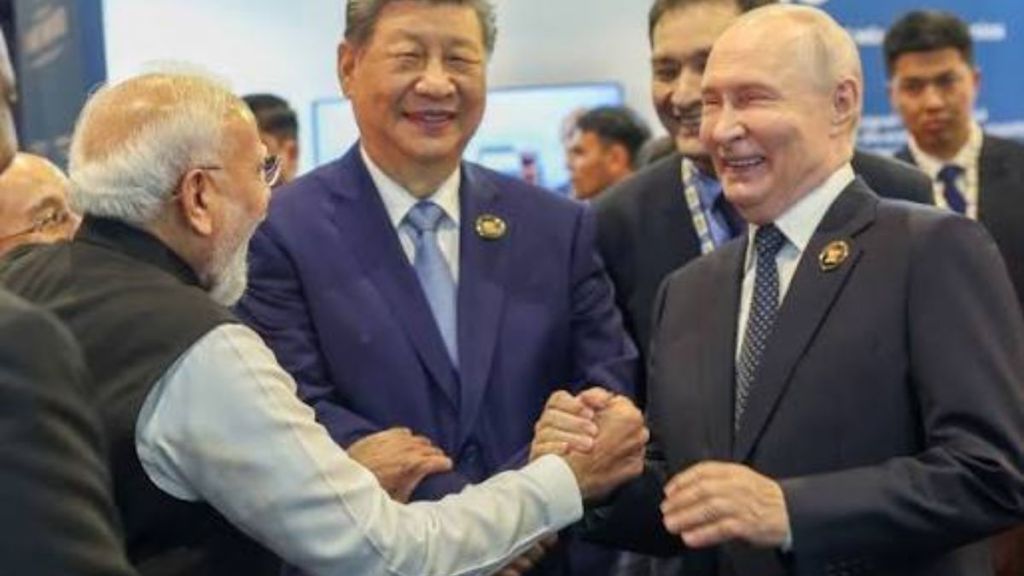

The highlight of a successful BRICS summit under India’s chairship was no doubt the bilateral meetings of Prime Minister Narendra Modi with the Presidents of Russia and China, Vladimir Putin and Xi Jinping respectively. These meetings among the founding members of BRICS were highly consequential as they entailed bilateral problem-solving. They took place amid the raging West Asia conflict and unilateral tariff disruption of US President Donald Trump. India has a special and privileged strategic partnership with Russia and is one of the biggest buyers of its oil. Modi and Putin agreed to further strengthen this partnership which has shown “resilience in the backdrop of geopolitical uncertainties”. India’s relations with China are showing signs of a Himalayan thaw. At their meeting, both leaders agreed that the two countries should take a strategic and long-term perspective of their ties and differences should not become disputes.
Modi and the Russian leader talked about closer trade ties, including the implementation of the Programme for Economic Cooperation 2030, besides cooperation in energy, infrastructure, technology, defence, and culture. But the major bilateral problem for India is the need for more balance in its trade that is skewed by its dependence on Russian oil, resulting in a high deficit. Both sides resolved to push bilateral trade to $100 billion from current levels of $60 billion by 2030. This is challenging as India would have to massively step up its exports of pharmaceutical, agricultural, and engineering products. Moscow has accumulated a substantial amount of rupees that it has not been able to deploy. The bilateral meeting also discussed cooperation in fertilisers and civil nuclear cooperation. Russian officials indicated possible upgrades of the BrahMos supersonic cruise missile system and supply and production of Su-57 aircraft.
The Modi-Xi bilateral was the buzz of the BRICS summit as it involved two of the most important nations of the grouping, whose relations have been in deep freeze due to a border standoff since April 2020. Modi emphasised that peace and tranquillity on the border was essential for improved bilateral relations. As there is now a semblance of peace — despite reports of tension in Arunachal Pradesh — institutional exchanges have gradually resumed and the cooperation list has continued to lengthen. Here again, a major bilateral problem highlighted by Modi was the critical need to address the “structural trade imbalance” due to India’s massive bilateral deficit because of its dependence on imports of industrial inputs, machinery, and electric components, among others, from China. India’s exports face market access barriers.
However, the Modi-Xi meeting readouts do not mention India’s policy on foreign direct investment from China which has seen some relaxation of late. While China wants more relaxation of investment restrictions, India may link any further easing to progress on resolving the border dispute. India, for its part, is also concerned about the dragon’s export controls on rare earths and magnets needed for electric and hybrid vehicles. There are also restrictions on the export of ingots, wafer technology, battery cells, and cell technology. For such reasons, India’s relations with China remain fraught. Nevertheless, it is a major positive that meetings are taking place at the highest political levels of both nations. Bilaterals of India with Russia and China may have dominated the conversation at the summit, but they strengthen BRICS as a grouping. India and China getting together is also transformational for the world economy.