



By Rohit Puri,
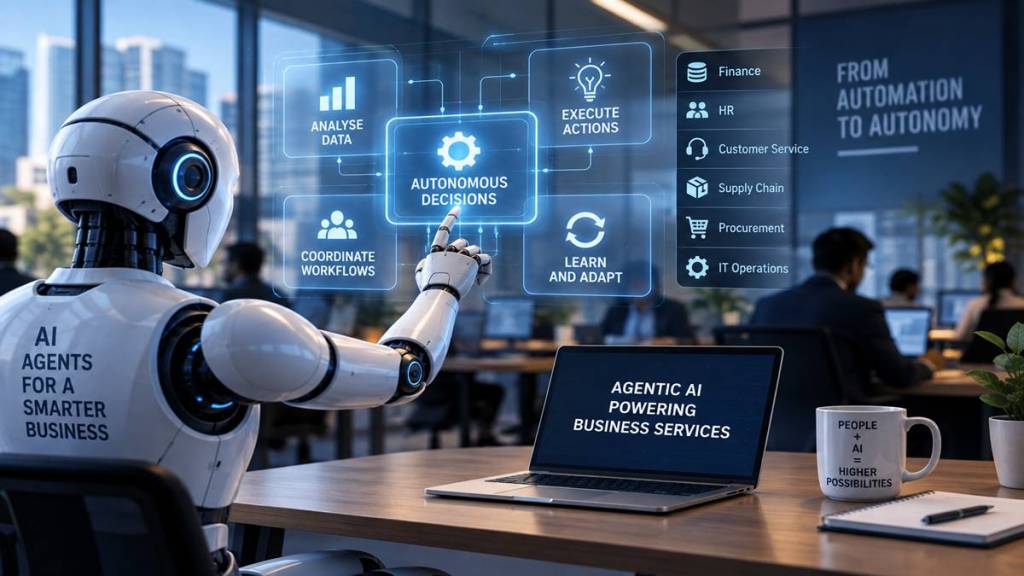
Business process services (BPS) are entering a new phase of evolution. Enterprises today are moving away from traditional robotic process automation (RPA) and investing in autonomous AI agents capable of analysing data, decision-making and execute actions across business functions. The move towards agentic BPS has the potential to fundamentally reshape how organisations operate at scale.
As AI adoption accelerates, these systems are transforming from being simple action assistants to autonomous, decision-making partners. As per Gartner, by 2028, at least 15% of day-to-day work decisions will be made autonomously by agentic AI. It also reports that 33% of enterprise software applications will include agentic capabilities, which is currently less than 1%. In enterprise context, agentic systems today represent a cultural shift by coordinating multi-stage workflows, collaborating across business functions, learning from feedback and adapting their decisions based on outcomes.
The AI systems are increasingly being deployed in environments like cloud operations and business services. The rise of agentic AI highlights risks like access control, regulatory exposure and auditability – underscoring the importance of human oversight and governance.
Why closed-loop model is essential
A key design principle emerging from enterprise AI implementation is the use of closed-loop operating models. These models feature two layers which integrate intelligence, insight, orchestration and oversight allowing organisations to not only deploy agentic AI responsibly but also improve continuously with feedback.
The first step is the intelligence layer (Presto) which analyses enterprise data, workflow patterns and performance metrics to identify opportunities for automation while also flagging areas of risk. With constant monitoring of autonomous agents, this layer can reveal inefficiencies, deviations from normal operation and potential compliance gaps. This helps enterprises build transparency in agentic AI operations, improving its trustworthiness and aiding in successful adoption.
Post analysis comes the orchestration layer (DICE), which governs the lifecycle of these agentic systems. The second layer allows organisations to embed the guardrails, policies and audit capabilities directly into the design and deployment of autonomous agents – making their actions visible and adjustable with evolving conditions.
Both layers work together to create a feedback-driven governance loop, strengthening both performance and control over time. The model comes across as a powerful tool with continuous learning and refinement, while also being rooted in operational transparency.
Agentic business process services – The next frontier
As organisations today move away from RPAs towards agentic AI, a parallel shift is underway towards services-as-software (SaS), a dashboard-like platform that is modular, scalable and subscription-based, delivering packaged, outcome-focussed capabilities ready to plug-in and use. At the core of this is agentic business process as a service (BPaaS) which involves AI agents that autonomously run entire business process from start to finish.
Pairing this system with the closed-loop model, ensures that while the process become autonomous, they remain transparent, auditable and aligned to business objectives. This evolution enables business agility and faster time-to-value, allowing organisation leaders to focus on business priorities, while the AI agents take care of the execution.
Agentic AI is already reshaping how business process services work across sectors:
Contact centres use AI agents to autonomously summarise calls and resolve issues, escalating to human judgement only when necessary.
Insurance providers can run real-time eligibility checks, asses claims and initial payouts without any human touchpoints.
AI agents in finance reconcile accounts, flag anomalies and keep a perfect audit trail.
Human resource teams can use AI agents to automate onboarding, resume screening and other functions.
Governance built in, not retrofitted
Agentic AI differs from traditional automation by not following pre-defined rules, but rather acting autonomously by monitoring context, adapting to changing conditions and achieve outcomes. This is one of the clearest lessons for enterprise AI adoption that governance must be baked into every layer of the agentic system design and cannot be a retrofit post deployment.
Governance frameworks focus on transparency, auditability and ethical safeguards. These frameworks aim to deliver trusted AI services, aligning with legal and societal norms and serve as a critical component for responsibly scaling autonomous agents. By embedding policy-based guardrails, role-based permissions and real-time controls, enterprises can scale autonomy without amplifying risks.
Human oversight remains essential
Despite rapid advances in autonomy, AI won’t replace humans but rather aid in amplifying the speed and scale of decision-making. Enterprises consistently indicate that human oversight plays a crucial role in ensuring trust and sustainability of fully autonomous operations.
Human oversight plays a key role in defining strategic intent by setting goals, risk tolerance and ethical boundaries; providing judgement by reviewing highlighted edge-case errors before taking further action; ensure accountability and responsibility of decisions made that satisfy governance frameworks.
Human oversight not only acts as a safety measure, but as a competitive advantage. This “humans in-the-loop” hybrid model combines the speed and scale of autonomous agents with the judgement and contextual awareness of human stakeholders, preserving trust, safety and quality.
Scaling autonomy with trust
Agentic BPS isn’t just a technology upgrade, but rather an operating model shift. With human oversight, closed-loop models continuously identify opportunities and orchestrate agents responsibly achieving speed without chaos, scale without risk amplification and innovate without eroding trust. In a world where autonomous AI agents become embedded into core business processes, its future belongs to organisations which place human oversight at the centre of intelligent operations.
The writer is global head, Business Process Services, NTT Data.
Disclaimer: The views expressed are the author’s own and do not reflect the official policy or position of Financial Express.