



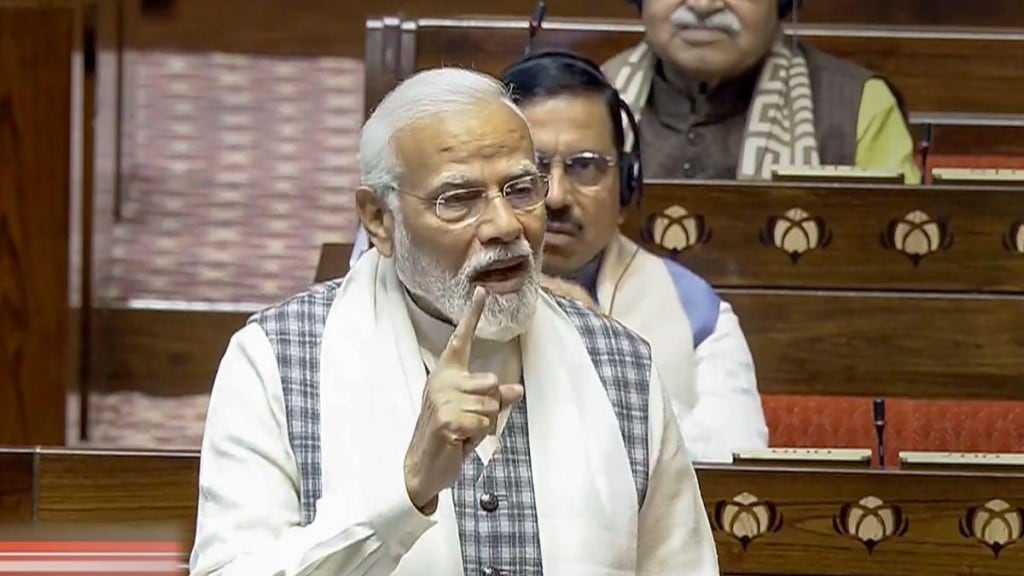
The irony was not lost on anyone. Prime Minister Narendra Modi, in his ‘customary’ pre-session remarks on December 1, 2025, urged members of Parliament — especially “one or two parties” — to remember that Parliament was a place where “there should be delivery, not drama”.
Provocative remarks
It was an ominous start to the winter session. It is worth quoting the words of Mr Modi:
“Unfortunately, there are one or two parties that cannot even digest their defeat. I thought that enough time has passed since the Bihar results and they would have recovered, but hearing their statements yesterday, it seems that their defeat is still troubling them. ……..
“….There is plenty of space in the country to shout slogans. You have already shouted where you were defeated. You can shout even where you are going to be defeated next. But here, we should emphasise policy, not slogans.”
He also took a dig at state-specific parties. “In some states there is so much anti-incumbency that leaders, after being in power there, are unable to go among the people ………they come to Parliament and pour out all their anger here.”
It was classic double-speak. At the start of every session, the government will proclaim to the world that it has nothing to hide and nothing to fear, and that any subject can be discussed in Parliament, but there is a catch: the catch is ‘subject to the Rules’. The Rules are in the book of Rules of Procedure, but the interpretation and the application of the Rules lies in the hands of the Presiding Officer (Speaker or Chairman) often in consultation with the government’s floor leaders. When the Opposition places its agenda in the Business Advisory Committee, invariably, every subject is opposed by the government. This leads to acrimony and, what the prime minister disparaged, ‘drama’.
Whose agenda?
Bills and the Budget are the government’s agenda. The Question Hour does not allow for a discussion. A real, free-wheeling discussion, at the instance of the Opposition, can only take place through an adjournment motion or, to a lesser extent, a short duration discussion or a calling attention notice. These are time-honoured parliamentary devices and there are rules.
An adjournment motion is, for some reason, considered a censure of the government.
The rule, however, is unambiguously clear: in the Lok Sabha, Rule 57 reads: Notice of an adjournment motion shall be given ……on a specific matter of recent occurrence involving responsibility of the Government of India. In the Rajya Sabha, Rule 267 allows for the business of the House to be suspended in order to, implicitly, discuss a matter of urgent importance.
A short duration discussion is governed by Rule 193 (Lok Sabha) and Rule 176 (Rajya Sabha) to discuss a matter of urgent public importance.
A calling attention notice is the most innocuous. Rule 197 (Lok Sabha) and Rule 180 (Rajya Sabha) allow a member to call the attention of the minister to a matter of urgent public importance and the Minister is obliged to make a statement.
The data given below proves conclusively how every door and window has, gradually, been closed to the Opposition. The situation has actually worsened in recent years as the Modi government has become increasingly adamant:
| Year | Adjournment Motion (LS) | Adjournment Motion (RS) | Short Duration Discussion (LS) | Short Duration Discussion (RS) | Calling Attention Notice (LS) | Calling Attention Notice (RS) |
| 2014 | – | – | 9 | 6 | 9 | 4 |
| 2015 | 1 | – | 8 | 4 | 3 | 5 |
| 2016 | – | – | 9 | 9 | 4 | 10 |
| 2017 | – | – | 4 | 7 | 1 | 3 |
| 2018 | – | – | 1 | 2 | – | 2 |
| 2019 | – | – | 4 | 4 | – | 6 |
| 2020 | – | – | 2 | 1 | – | – |
| 2021 | – | – | 3 | 3 | 1 | – |
| 2022 | – | – | 5 | 2 | – | – |
| 2023 | – | – | – | 2 | – | – |
| 2024 | – | – | 2 | 3 | 1 | – |
| 2025 (upto Nov.) | – | – | – | – | 1 | – |
Door, windows closed
The numbers speak for themselves. In its first term, the Modi government opposed an adjournment motion because it feared the stigma presumably attached to such a motion. It was tolerant of short duration discussions or calling attention notices but, in the second term, the intolerance was evident; the door was closed but the windows were open. Returning to office for the third term, with less than a simple majority for the Modi-led BJP, the government closed the windows too. Are we to assume that there was no matter of urgent public importance that merited a discussion?
Tragically, debate was shut out in the Rajya Sabha more than in the Lok Sabha. Many members attributed this to then Presiding Officer. In September, a new Chairman took over in the Rajya Sabha. I suppose the Chairman is on a learning curve; besides, the 2025 winter session is too short to form a view.
To put it bluntly, the government does not believe that a vibrant and debate-rich Parliament will strengthen democracy. The government, led by Mr Modi, is implacably opposed to dialogue, discussion and debate. The irony of Mr Modi’s pre-session remarks cannot be missed.