



By Anita Inder Singh
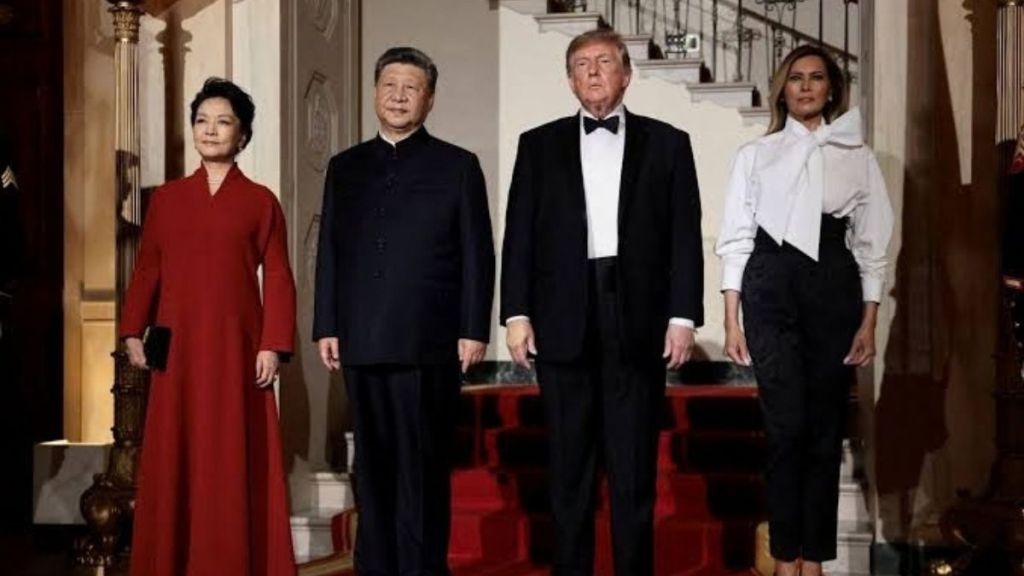
The warm welcome extended by President Donald Trump to China’s President Xi Jinping and his wife, the singer Peng Liyuan, augured happy personal relationships and well as a reduction of Sino-US differences on trade, artificial intelligence (AI), and Taiwan. The trade agreement signed in South Korea in October 2025 until November 10 was extended until January 2027. But Trump’s hospitality, which made Xi and his wife feel “truly at home”, could not disguise the fierce competition between America and China for global clout as they see themselves as the world’s two great countries.
China’s export-led economy was high on the agenda. China’s exports rose by 25% over the last year. That increase was driven mostly by a weakening yuan and global AI demand. Since this has given China leverage, Washington has accused Beijing of deliberately maintaining trade imbalances.
In fact, related to trade is America’s wish to restrict China’s development of AI. As several American businessmen recently called for an AI slowdown that China suspects is meant to contain its rise, the state-steered China Daily accused America’s leading AI companies using calls for a slowdown to “blunt China’s AI advance”. Although Trump hailed AI as the next Industrial Revolution or Internet, and predicted that it could account for 25% of America’s GDP, Washington and Beijing mistrust each other. Because neither wants to slow down, in Trump’s words, whoever wins AI, wins! He has even aired the ideas of an “AI Force” and an “AI Czar”.
The priority given to trade was clear as China’s Vice Premier, He Lifeng, spent four days in Washington before Xi’s arrival and Trump happily announced that several trade deals were on the cards. Yet, the result of the summit was more about a trade armistice than crafting a grand reset of trade and investment strategies. Neither side has announced trade breakthroughs or significant deals on agriculture or Boeing jets. Generally, Trump prefers incremental agreements to maintain tariff leverage over Beijing.
On another plane, since China possesses some 70% of the world’s critical minerals and rare earths, America seeks access to rare-earth elements while trying to prevent China from using export controls as leverage as it dominates global critical mineral refining which is essential for both AI and the energy transition.
Restrictions on rare-earth exports have become one of the most contested issues between Washington and Beijing, as China wants assurances that the US will not misuse export controls.
At the security level, the summit’s broader strategic significance was determined by what it signalled to America’s allies, including Japan, the Philippines, and South Korea, who had been keeping an eye on Xi’s visit to Washington. They are concerned about a major shift in the international security environment. For, contemporary US-China relations cannot be understood through the bilateral lens of the Cold War. Coalitions, rather than individual states, appear to be shaping the balance of power in the Indo-Pacific, especially as Trump’s America looks unreliable as a bulwark against China.
For example, Japan gave up its post-World War II pacifism and embarked on full militarisation following Russia’s 2022 invasion of Ukraine. “Ukraine today might be East Asia tomorrow”, warned the former Japanese premier, Fumio Kishida, at the time, in an obvious reference to Taiwan. The Philippines has expanded military access for US forces. South Korea and Japan have deepened security cooperation despite old political strains. And even before “Ukraine”, the creation of AUKUS (2021) by the Biden administration marked the deepening of defence cooperation between Australia, the United Kingdom, and the US, especially on nuclear issues.
From Beijing’s viewpoint, the significance of these developments extends beyond any single summit. Therefore, America is no longer the only challenge faced by China. An increasingly integrated coalition of allies could be a stronger threat. Their coalition-based military architecture could menace China. But the countries involved in stronger military collaboration see themselves as defending themselves against China’s expansionism.
Trump obviously didn’t wish to raise China’s hackles on Taiwan, which, for Beijing, is the most important issue in China-US relations. Xi drew the red line over Taiwan and advised the US to handle the issue carefully. Before Xi’s arrival, Trump dismissed talk of a military conflict on Taiwan with the words that Washington was not looking for a war 9,500 miles away from America. He was silent on a promised defence deal with Taipei after Xi’s departure from Washington.
Overall, the personal force of a Xi-Trump meeting should not be underestimated. For, America and China are at the centre of global politics.
Countries weaker than the US and China will not be able to counter them. Instead, they will accept any so-called “rules” made by Washington and Beijing in the name of world peace.
The Trump-Xi summit could create an informal, personal bilateral power structure that could result in world-influencing decisions taken by Washington and Beijing. Those decisions, as China’s Global Times opines, have nothing to with a rules-based or multilateral order, nor do they necessarily serve anyone else’s interests. Instead, the summit is a highly tactical head-of-state diplomacy which will affect the world for at least the next 24-plus months, as long as Trump is president. Countries weaker than China and America should be on the alert as Trump and Xi plan to meet again this year — at the APEC (Asia-Pacific Economic Cooperation) summit in China, and the G20 summit in the US. Yet, at the same time, these two leaders are seriously constrained by the challenges posed by the rivalry between their countries. In the long run, neither China nor the US will unilaterally frame the global order according to their whims — they will also have to keep in mind the need for the world’s stability, security, and peace.
The writer is Founding Professor, Centre for Peace and Conflict Resolution.
Disclaimer: The views expressed are the author’s own and do not reflect the official policy or position of Financial Express.