



By Aishwarya Khosla
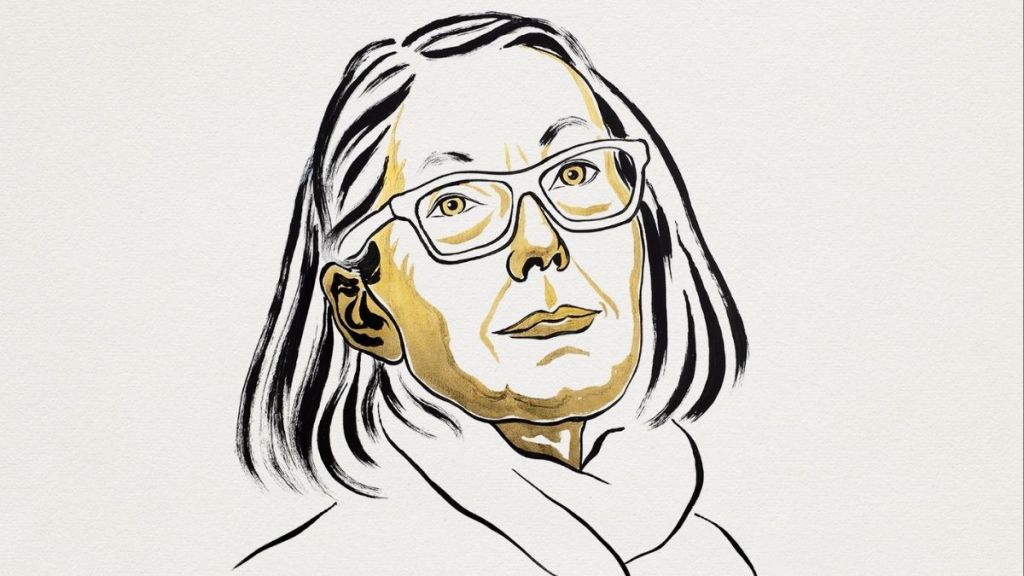
For once, the bookies got it right. At the end of September, Ladbrokes had Anne Carson at 33/1, but a day before the Nobel Prize in Literature was announced, she was joint favourite, with the Chinese novelist Can Xue. The Nobel was once famous for its surprises; think Bob Dylan, or Abdulrazak Gurnah. But that is in the past. This year, Carson was clearly the safest bet. Since the Academy’s 2018 scandal, the winner has alternated between men and women, and after László Krasznahorkai won last year, people expected a woman. She might be a safe pick, but her ideas are seismic, and I dare say, a few Indians might do well to at least hear.
Carson is a classicist who wrote her doctorate on Sappho, an ancient Greek lyric poet, and spent more than three decades teaching ancient Greek at Princeton, McGill and Michigan. Her first book of poems appeared when she was 42, late in an age when 12-year-olds are published authors. Everything original in her work rests on the unglamorous labour of reading dead languages line by line, year after year, until she produced something unconventional, thought-provoking, and original, despite its classical basis.
Not just original, Carson, whom one might be scared to approach for fear of arcane, complex prose, is one of the most playful writers. Proof that you cannot break a tradition in an innovative and original way until you know it inside out.
In Autobiography of Red (1998), she takes the surviving scraps of a lost poem by Stesichoros, a Greek poet who told the story of Herakles’ monstrous victim Geryon partly from the monster’s side, and turns them into a novel in verse about a shy, winged teenager who falls for a careless Herakles and gets his heart broken. In her translations of Sappho, she prints brackets where the papyrus is torn, rather than smoothing over the gaps. She writes that Stesichoros’ fragments read as if someone had torn up the poem and buried it in a box, and she tells the reader, “Here. Shake,” a line any author would do well to remember. An example of her playfulness and comfort with gaps is the title of Red Doc>(2013), which comes from the name of the file on her computer, an accident, which she simply kept. When a stray keystroke sent the book’s margins haywire, she left them that way too.
Carson’s Nobel comes in a year of epics on the big screen, from Christopher Nolan’s The Odyssey to Nitesh Tiwari’s Ramayana, which releases next month. But we have sadly lost Carson’s brand of playfulness, a hallmark of Indian tradition. The Ramayana exists in hundreds of tellings: in Sanskrit, Tamil, and Bengali; in Jain, Buddhist, and folk versions; and across Southeast Asia. In some, Sita is Ravana’s daughter; in others, Ravana is the tragic hero. Each was in dialogue with the others, and that is how the story survived for 2,000 years.
The scholar AK Ramanujan made this argument in his essay ‘Three Hundred Ramayanas’. In 2011, Delhi University dropped the essay from its history syllabus after protests. Our epics are increasingly treated as scripture to be guarded, not literature to be reread and argued with. They have become rigid sermons rather than a dialogue that connects our culture and beliefs across generations. In today’s India, a filmmaker’s costume choice can start a controversy, and a novelist’s reinterpretation can invite a police complaint.
These stories matter to millions, but refusing dialogue, gaps and asterisks included, risks freezing them. The Ramayana and Mahabharata did not survive two millennia by being told the same way twice. Perhaps the next retelling should be a dialogue with Gen Z, Alpha and Beta.
India has a growing body of retellings in English and Indian languages, and readers hungry for them, but what it lacks is confidence that comes from knowing the material inside out like Carson, and the belief that a retelling can deepen reverence rather than threaten it. If there is a takeaway, let it be this: that the study of Sanskrit, Tamil and Pali deserves funding as seriously as engineering.
The Academy’s choice may not have been bold, but the writer it chose stands for a rebellious idea that the classics stay alive only when each generation has the knowledge to understand them and the nerve to remake them.
Carson ends one of her best-known prefaces by inviting readers to shake the box. We, too, should be brave enough to shake ours.
The writer is copyeditor at indianexpress.com