



By Mitul Shah & Sunil Sanghai
India has just made the cloud giants a bold offer: Run your global business from Indian soil and pay almost no tax on it for close to 20 years. It is a smart move, but quietly skips the hardest question of all. A modern data centre is no longer a building with some servers. It is a very expensive pile of chips that sit inside a building. The offer takes care of the tax on tomorrow’s profits. It does nothing about the cost of the chips that create them.
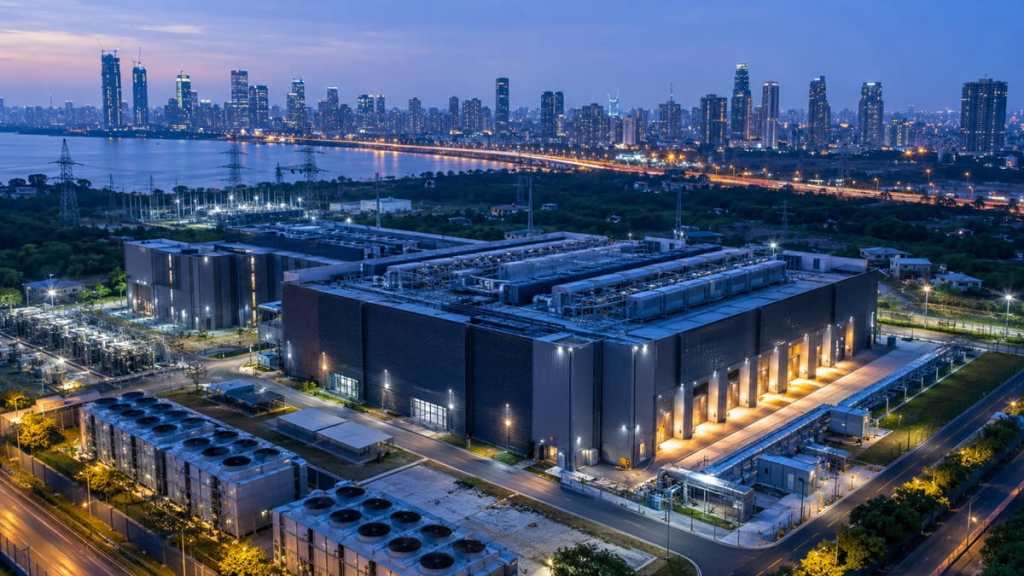
Start with the part that is easy to fund. The physical data centre, land, building, power and cooling can be financed through a real estate investment trust (REIT) or an infrastructure investment trust (InvIT). These structures are dull by design, and that is exactly why they work. A REIT or InvIT likes assets that sit still and earn rent for years — office towers, warehouses, or the concrete and steel shell of a data centre. It can happily hold a cooling plant tied to a colocation contract that runs for a decade or more. Steady asset, steady rent, steady payout.
Now the twist, and it is India’s data centre financing problem in a single picture.
The numbers behind the boom are familiar by now. India’s data centre capacity has roughly quadrupled, from about 375 Mw in 2020 to around 1,500 Mw in 2025. The FY27 Budget went a step further, offering a tax holiday until 2047 for foreign companies that serve the world’s cloud demand from India. The message is simple: Run your global cloud business through an Indian data centre, and the income you earn from customers abroad pays no Indian tax for the better part of two decades.
But a tax holiday is a promise about profits. We need to now focus on who pays for the asset that produces those profits. And in an AI data centre, that asset is mostly silicon. The compute layer, meaning the graphics processing units (GPUs) plus the servers, networking, and liquid cooling built around them, now eats up most of the money, commonly 60-80% of the total, and even more in the densest sites. The land, building and power, the very things a REIT or InvIT understands, are now the smaller slice.
Which is why “how many megawatts have you announced” is the wrong question, and “how exactly are you paying for the chips” is the right one. GPUs are the textbook case for leasing. They cost a fortune upfront, go out of date quickly, and renting them makes far more sense than owning them outright. But under India’s GST, leasing equipment without transferring ownership usually attracts the same rate as the equipment itself, which is 18% for computer hardware. So the government offers a 20-year holiday on profits with one hand, and with the other collects 18% on the very asset. In theory, the tax can be claimed back as credit. In practice, it must first be paid, recorded, and recovered, and if the output is treated as an exempt supply rather than a zero rated export, that credit can get stuck for good.
None of this is unique to India, and that is the good news, because the rest of the world has already written the playbook. The idea everyone has landed on is simple: Do not fund a building that lasts 30 years and a chip that lasts three in the same way. Split them.
When Meta built its Hyperion campus in Louisiana, it did not put $30 billion on its own books. It set up a separate company, kept 20%, let Blue Owl and a group of pension and insurance investors own the rest, and then leased the site back. Around $27 billion of debt sits in that vehicle, not on Meta’s balance sheet. CoreWeave took the opposite route and funded the chips directly, pledging its GPUs and customer contracts as security for loans worth billions. Elon Musk’s xAI is raising huge sums through a vehicle whose only job is to buy Nvidia chips and rent them back. Nvidia itself has pulled together a large group of investors to raise more than half a trillion dollars for exactly this kind of chip financing.
The pattern repeats everywhere. The infrastructure that lasts decades gets patient capital, the kind a REIT or InvIT provides. The silicon that ages in a few years gets leasing, vendor finance, or loans raised against contracted cash flows. You put the building in a REIT or InvIT. You fund the GPU some other way.
India is closer to this than it looks. It already has an established REIT and InvIT market, about 32 listed trusts holding close to `10 lakh crore in assets, with a combined market value of roughly `5 lakh crore. That is solid proof that Indian investors will happily buy stable, income-earning infrastructure. Indian data centre operators are now lining up to tap the public markets. The real question is whether investors will price them as steady, REIT-like cash machines or as jumpy, fast-growing tech stocks. The honest answer is that it deserves a specialist financing model.
That is where GIFT City can finally prove its worth. The International Financial Services Centres Authority (IFSCA) has floated a proposal to treat the leasing of GPUs and related data centre equipment as a proper financial product inside the IFSC, the same move that made GIFT a credible home for aircraft and ship leasing.
A quick lesson from history, is in order. In the late 1990s, telecom companies laid enormous amounts of fibre worldwide, certain that demand would show up. When the bubble burst, most of it sat unused for years. The industry called it dark fibre. GPUs bought with cheap borrowing against contracts that later vanish could become this cycle’s dark fibre, only with an even faster fall in value. So whatever we build must reward real usage, not press releases.
The writers are respectively Senior Vice President and Founder & CEO, NovaaOne Capital Pvt Ltd.
Disclaimer: The views expressed are the author’s own and do not reflect the official policy or position of Financial Express.