


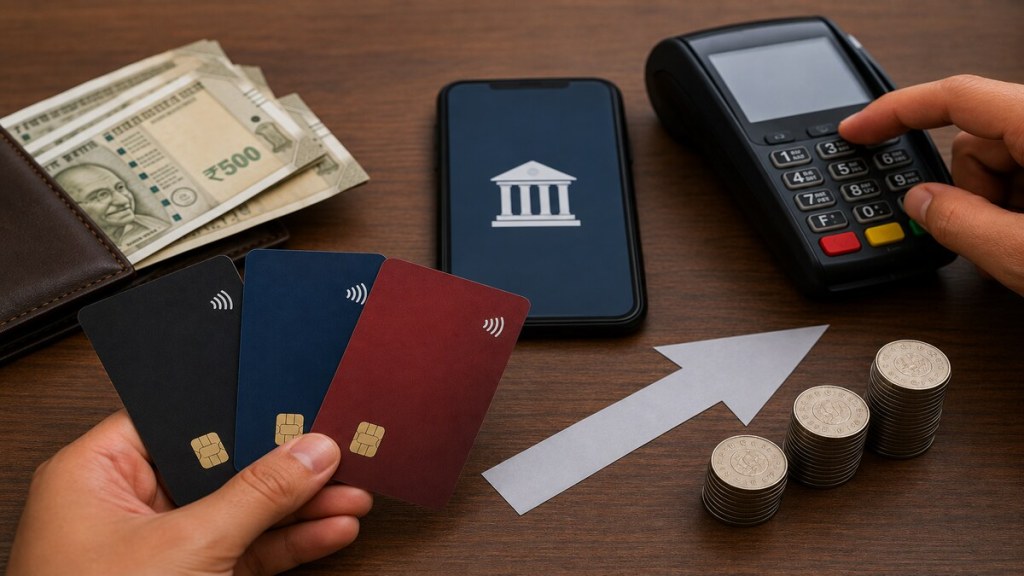

If you have a credit card bill of Rs 1 lakh, then it may seem easy to manage if your bank allows you to convert your outstanding balance into an Equated Monthly Instalment (EMI).
After completing some simple steps, your hefty credit card bill can turn into a monthly installment. The option may sound financially good to you, but do you know, with the convert-to-EMI option, how much you actually end up paying the bank?
Credit card issuers often offer an EMI conversion option when cardholders have a large outstanding balance or make a high-value purchase; however, the EMI may come with hidden charges such as interest rates, processing fees, GST, and preclosure charges, which can allow you to immediately drain your savings or cash in one transaction.
So here’s what you should do if you have a credit card bill of Rs 1 lakh and your bank allows you to convert to an EMI option.
Rs 1 lakh credit card bill: Should you convert it to EMI?
If you can comfortably pay your credit card bill in full by the due date, paying the entire amount is the more cost-effective option, as you avoid interest and EMI-related charges altogether.
However, if paying the full amount would strain your finances or result in carrying forward the outstanding balance, converting it into an EMI can be a more manageable option.
For instance, if a Rs 1 lakh outstanding balance is not paid in full and the applicable finance charge is 3.75% per month, the interest for the first month alone could be around Rs 3,750, subject to the card’s terms and applicable taxes.
“More importantly, once the interest-free period is lost, new transactions would also start attracting finance charges, which can quickly lead to a debt spiral,” said Santosh Agarwal, CEO, Paisabazaar.
“In such a situation, converting the bill into an EMI before the due date can help spread the repayment over several months,” Agarwal recommended.
For example, at an interest rate of 1.75% per month for 9 months, a Rs 1 lakh balance would result in an EMI of approximately Rs 12,106 per month, excluding any processing fee and applicable taxes.
This makes the repayment more manageable and avoids the potentially higher cost of revolving your card debt.
The actual cost of an EMI depends on the interest rate, tenure, processing fee, and applicable taxes.
For example, if Rs 1 lakh is converted into a nine-month EMI at 1.75% per month on a reducing balance, the EMI would be approximately Rs 12,106, taking the total EMI repayment to around Rs 1.09 lakh. This means the interest component would be around Rs 9,000.
A processing fee would be added to this amount. This is typically charged as a percentage of the amount converted, subject to a specified maximum. GST is also applicable on the interest and eligible fees/charges as per prevailing tax rules.
Consumers should, therefore, compare the total repayment amount, rather than looking only at the monthly EMI or interest rate.
“If the cardholder can comfortably pay a portion of the Rs 1 lakh bill upfront, it may be more cost-effective to do so and convert only the remaining amount into EMI, as this reduces the principal on which interest is charged,” stated Agarwal.
This can lower the overall interest outgo.
However, consumers should first check the terms offered by their card issuer, as card issuers may not allow partial payment followed by EMI conversion of the remaining outstanding amount.
How should consumers compare a credit-card EMI with the card’s revolving credit interest rate, a personal loan, or other borrowing options?
Consumers should compare the total cost of borrowing, rather than looking at the interest rate alone.
Revolving credit-card debt can be particularly expensive when the outstanding balance is not paid in full, as finance charges can be significantly higher than the rates typically offered on personal loans or other forms of borrowing.
When comparing a credit-card EMI with a personal loan or another borrowing option, consumers should consider the interest rate, processing fee, applicable taxes and other charges, and calculate the total repayment amount over the entire tenure.
Converting credit card bills to EMI: What happens to your credit score?
Converting a large credit-card bill into EMI may not necessarily hurt your credit score if repayments are made on time.
However, the outstanding amount may still be considered as part of your overall credit obligations since credit utilisation and repayment history are among the factors that affect your credit score.
“Depending on the card issuer’s terms, the converted amount may also reduce the credit available on the card until it is repaid. This could be relevant when applying for fresh credit, as lenders may consider your existing debt obligations,” said Adhil Shetty, CEO, BankBazaar.
Converting your card bill to EMI? Check these costs
Look beyond the monthly instalment and check the total cost.
Consider the interest rate, tenure, total interest payable, processing fee and any pre-closure or foreclosure charges.
RBI requires card issuers to clearly disclose the principal and interest before converting a credit-card transaction into EMI. GST may also apply to applicable fees and other taxable charges.
Read the terms carefully, as costs and pre-closure conditions can vary across issuers.
What are the key differences between converting a purchase into EMI and converting the entire outstanding credit-card bill into EMI?
Converting a purchase into EMI spreads the cost of the eligible transaction into installments.
A bill-to-EMI conversion generally covers a larger outstanding amount. This may mean servicing a larger debt over a longer period. Neither option is necessarily more expensive.
The cost can depend on the amount converted, interest rate, tenure and applicable charges. Before choosing, compare the total amount repayable, processing fees, pre-closure terms and any impact on your available credit limit.
The aim should be to keep the repayment manageable without extending the debt unnecessarily.
Disclaimer: This article is for informational purposes only and should not be construed as investment, financial, tax, or legal advice. Any illustrations, examples, or return projections used in this article are for explanatory purposes only and do not guarantee actual investment outcomes. The views and opinions expressed by experts quoted in this article are their own and should not be considered investment recommendations. Readers should consult a qualified professional before making any financial decisions.
Every financial journey has a turning point. What’s yours?
Financial Express is launching a new series highlighting real experiences with money, investments, and the taxman. Did a sudden tax rule catch you off guard? Did a piece of financial advice change your life? Your story could provide invaluable, practical lessons for thousands of fellow taxpayers. Share your experience with us. We respect your privacy: no stories will be featured without a direct conversation and your full consent. Thank you.