


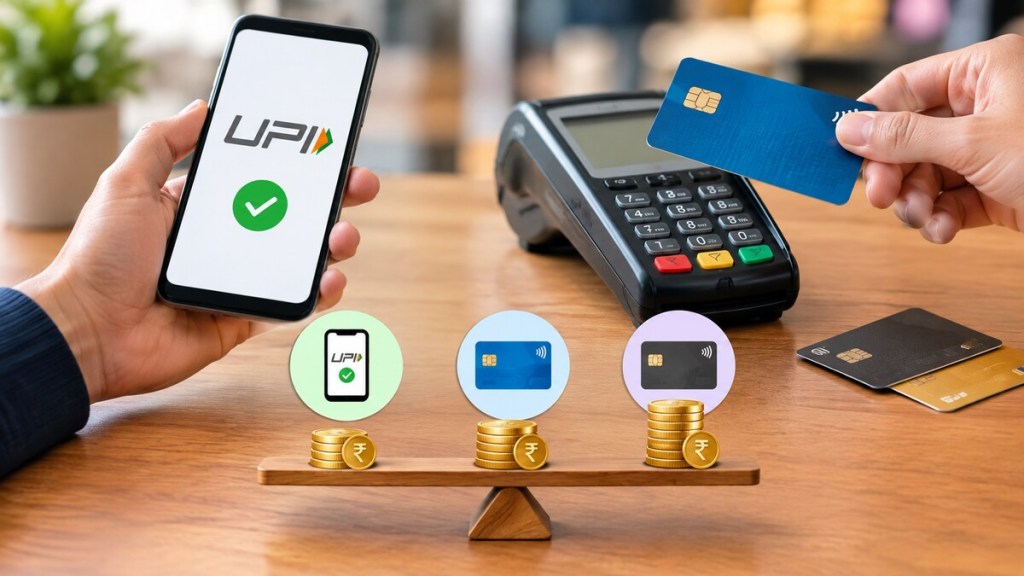

The National Payments Corporation of India (NPCI) has announced that starting on October 15, 2026, certain Person-to-Merchant (P2M) UPI transactions over Rs 2,000 will be subject to a 0.4% Merchant Discount Rate (MDR).
For eligible UPI payments exceeding Rs 2,000, there is a 0.4% Merchant Discount Rate (MDR); for amounts over Rs 75,000, the MDR is capped at Rs 300 per transaction. NPCI claims that all person-to-person (P2P) UPI transactions will remain completely free, regardless of the amount transferred.
UPI payment system and its MDR are significantly lower than those of other payment methods, including credit cards, debit cards, wallets, etc.
Compared to all conventional card-based transaction fees, UPI MDR is designed to be far less expensive. Debit card MDRs are limited to 0.90%, although standard credit card MDRs usually fall between 1.5% and 2.5% per transaction, according to NPCI.
Compared to other payment processing methods like credit cards or payment gateways, this rate of 0.4% is far lower. While accepting digital transactions, this cost differential enables merchants to reduce their payment processing costs.
“Because the proposed UPI MDR is significantly lower than credit card fees and applies only above specific transaction thresholds, shopkeepers have no economic incentive to inflate retail shelf prices. Consumers will continue paying the exact listed price for goods and services,” said NPCI in an FAQ statement named ‘Merchant Discount Rate (MDR) on Select UPI (P2M) Transactions’ released on 15th September.
NPCI has further clarified that separate credit product regulations apply to credit-linked UPI payments, such as RuPay Credit Cards linked to an UPI or approved bank credit lines. Credit-linked transactions adhere to regular credit card policies because they involve short-term loans funded by issuing banks.
The MDR introduced applies specifically to direct user-account-to-merchant-account UPI transactions.
When is UPI still cheaper than cards after MDR?
For consumers, the fundamental position does not change: UPI continues to remain free. The new MDR is a merchant-side cost and cannot be passed on to the customer as a UPI transaction charge. For merchants, UPI is also likely to remain among the lowest-cost digital payment options.
UPI continues to offer a relatively straightforward cost structure for eligible merchant payments. From October 15, transactions above Rs 2,000 will attract an MDR of 0.4%, with the merchant charge capped at Rs 300.
“For example, a Rs 10,000 eligible UPI payment would attract Rs 40 in MDR. Debit and credit card costs can vary based on the card, merchant and payment arrangement. When deciding between payment methods, look at the transaction value, applicable charges, available offers and rewards, and the payment terms attached to each option,” said Adhil Shetty, CEO, BankBazaar.
Further, UPI payments up to Rs 2,000 and qualifying small-merchant transactions continue to carry zero MDR. Accordingly, even after the change, UPI remains structurally cost-efficient, particularly from the merchant’s perspective.
UPI vs debit vs credit cards: Which payment mode suits each purchase?
For small purchases, convenience and acceptance may matter more. For larger purchases, consumers can compare discounts, cashback, rewards, payment limits and the cost of using credit.
“A credit card can offer a grace period and rewards if the bill is paid in full by the due date. A debit card draws directly from the linked bank account, while UPI offers direct account-to-account payment,” stated Shetty.
Also check for any applicable fees and payment limits before choosing a method. The payment method should fit the transaction and the features that matter most to you.
For small-value versus high-value purchases, what factors should consumers consider when choosing between UPI, debit cards and credit cards?
For routine, small-value payments, UPI is likely to remain the natural choice because of its convenience, instant settlement and absence of any consumer transaction charge.
For higher-value purchases, however, consumers should look beyond the payment instrument itself and compare the overall economics of the transaction.
Credit cards may offer cashback, reward points, purchase protection or an interest-free credit period, which can outweigh the apparent cost difference where no additional convenience fee or surcharge is imposed.
Debit cards provide direct payment from available funds without creating credit exposure, while UPI offers speed and simplicity but generally results in an immediate transfer of funds.
“Transaction limits also matter. Standard UPI transactions are generally subject to a Rs 1 lakh per-transaction limit, although higher limits apply to specified categories and individual banks may prescribe lower limits. Consumers should therefore consider the final payable amount, rewards, payment limits, dispute protections and security, rather than choosing solely on the basis of the payment mode,” said Prabhat Ranjan, Senior Director, Nexdigm.
Could the introduction of UPI MDR alter consumer behaviour or push more users towards debit or credit cards? Which transactions are likely to see the greatest impact?
A significant immediate migration away from UPI appears unlikely because the MDR is not being levied on consumers. Person-to-person transactions remain free, merchant payments up to Rs 2,000 remain outside MDR, and qualifying small merchants also continue under the zero-MDR framework. The Government estimates that approximately 96% of UPI merchant transactions by volume will remain unaffected.
“The more visible impact may instead arise in high-value retail transactions- electronics, jewellery, travel, hospitality or other discretionary purchases where merchants compare the cost of accepting different payment instruments and consumers compare card rewards against UPI convenience,” said Ranjan.
“Credit cards could become relatively more attractive for high-ticket purchases where rewards, cashback or financing benefits are significant. However, this would be a commercial choice rather than a consequence of UPI becoming directly chargeable to consumers,” Ranjan further added.
Could MDR encourage merchants to offer discounts for one payment method over another? What should consumers watch for on the final bill?
It could lead to greater payment-method-based pricing decisions, particularly in businesses operating on thin margins. A merchant absorbing payment-processing costs may have a commercial incentive to encourage a lower-cost mode through discounts or promotional offers.
However, there is an important distinction between offering a genuine discount and passing the UPI MDR on to the customer. Under the new framework, the UPI MDR is to be borne by the merchant and should not be recovered from the consumer as a separate UPI charge.
Consumers should therefore check the final payment screen or invoice for any convenience fee, platform fee, surcharge or other amount that appears only after selecting a particular payment mode. The relevant comparison is not merely the advertised product price, but the net amount ultimately payable after all payment-related additions and discounts.
Look at the final cost and value of the transaction rather than one fee or benefit in isolation. A Rs 500 discount on a Rs 10,000 purchase, for example, can significantly alter the economics of using one payment method over another.
Factor in any convenience or other applicable fees, along with cashback, rewards and payment terms. If you use a credit card, account for the value of the rewards or grace period only when you can repay the bill in full by the due date.
Should consumers now compare the total cost of payment—including MDR, convenience fees, discounts, cashback and rewards—instead of simply assuming that UPI is always the cheapest option?
Yes, although one qualification is important: consumers should not treat MDR itself as a direct UPI charge because, under the new framework, it remains a cost to the merchant.
The better approach is to compare the effective transaction cost. A payment option carrying no direct fee may not necessarily be economically superior if another mode offers meaningful cashback, reward points or an instant discount. Conversely, a seemingly attractive card reward can quickly lose its value if the merchant or platform levies a convenience fee exceeding the benefit.
Accordingly, consumers should compare the final amount payable after considering convenience fees and surcharges, merchant discounts, cashback or rewards, the value of any credit period and applicable payment limits. UPI will continue to be highly cost-effective for most everyday transactions, but for larger purchases, the cheapest payment method may increasingly depend on the economics of the individual transaction rather than the payment instrument alone.
Key takeaway
UPI users should rely on official updates issued by the Ministry of Finance, the Reserve Bank of India (RBI) and the National Payments Corporation of India (NPCI) for accurate information on payment charges.
Given the circulation of rumours and misleading claims on social media, users are advised not to rely on or forward unverified messages. Press releases and notifications issued through the Press Information Bureau (PIB), RBI and NPCI should be treated as the primary sources for authentic regulatory and policy updates.
Users should also check verified notifications and announcements available through their respective banking applications.
Disclaimer: This article is for informational purposes only and should not be construed as investment, financial, tax, or legal advice. Any illustrations, examples, or return projections used in this article are for explanatory purposes only and do not guarantee actual investment outcomes. The views and opinions expressed by experts quoted in this article are their own and should not be considered investment recommendations. Readers should consult a qualified professional before making any financial decisions.
Every financial journey has a turning point. What’s yours?
Financial Express is launching a new series highlighting real experiences with money, investments, and the taxman. Did a sudden tax rule catch you off guard? Did a piece of financial advice change your life? Your story could provide invaluable, practical lessons for thousands of fellow taxpayers. Share your experience with us. We respect your privacy: no stories will be featured without a direct conversation and your full consent. Thank you.