



Starting from October 15, 2026, as enforced by the National Payments Corporation of India (NPCI), the payment landscape is set to change for Person-to-Merchant (P2M) transactions.
A 0.4% Merchant Discount Rate (MDR) applies to eligible UPI payments above Rs 2,000; the MDR would be limited to Rs 300 per transaction for amounts over Rs 75,000.
According to NPCI, regardless of the amount transferred, all person-to-person (P2P) UPI transactions will continue to be totally free.
This means that UPI users can continue to use UPI for free transactions, and there will be no fees associated with utilizing UPI to make payments. They can continue to use UPI applications for all regular, everyday expenses without worrying about any fees.
Additionally, there are no fees for anyone using UPI to send or receive money to or from another person (or even for self-transfers). This is true whether you are sending money to a relative, splitting a bill with friends, or making self-transfers between your own linked bank accounts.
Under Person-to-Person-Merchant (P2PM) guidelines, small merchants receiving up to Rs 1 lakh per month through UPI QR codes enjoy a mandatory zero MDR.
Regarding the MDR rule on Select UPI (P2M) transactions, however, the NPCI released an FAQ (Frequently Asked Questions) page on 15th September, on which it clarified that UPI is a homegrown payment system, and its charges (MDR) are much lower than other payment instruments such as credit cards, debit cards, wallets, etc.
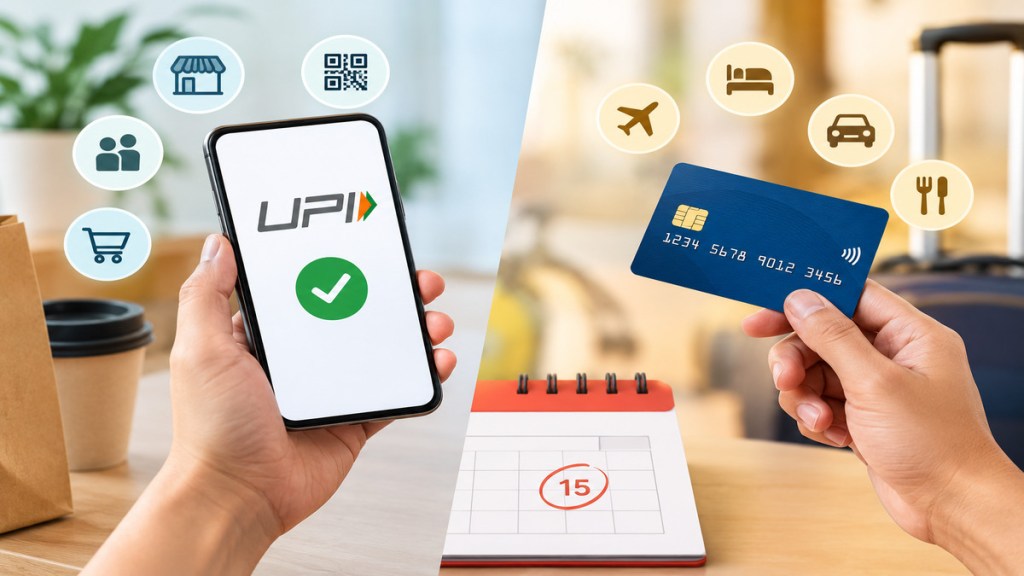
Hence, it raises an important question for consumers: when should you continue using UPI and when could a credit card make more sense?
When should you pay by card and when by UPI?
For merchants, the relative cost of accepting UPI versus credit-card payments depends on the applicable MDR and the type of transaction. If UPI transactions above Rs. 2,000 start attracting MDR for merchants, the cost advantage of UPI over credit cards may come down.
However, the actual impact may vary according to the merchant, transaction value and other factors. Whether this would indirectly have any impact on consumers remains to be seen.
“For a Rs. 10,000 purchase, consumers should compare the total cost and value of each option. With a direct UPI payment from a bank account, the full Rs. 10,000 is deducted immediately. There is no reward or cashback on a regular bank-account UPI transaction, although merchants may offer UPI-specific discounts or offers. However, with a credit card, the consumer may earn reward points or cashback, and there may also be card-specific discounts or other benefits,” said Santosh Agarwal – CEO, Paisabazaar.
“For example, if a credit card gives 1% cashback on the purchase, the consumer could receive Rs. 100 in cashback on a Rs. 10,000 transaction. A card offering a higher reward rate may provide greater value. Credit cards can also provide a cash-flow advantage because the payment is not deducted from the bank account immediately,” Agarwal further added.
The interest-free period can also provide some flexibility, provided the cardholder pays the entire outstanding amount by the due date and does not incur interest or late-payment charges. Some large purchases can additionally be converted into EMIs, allowing the cost to be spread over several months.
However, if credit card dues are unpaid by the due date, the fees, charges and the impact it has on your credit score outweigh the advantages.
“A number of RuPay credit cards also allow consumers to earn rewards, loyalty points or cashback on eligible UPI transactions. This can make credit-linked UPI useful even for relatively small everyday purchases. However, transaction size alone, therefore, should not determine whether a consumer uses UPI or a credit card,” Agarwal stated.
A small transaction could still be worth putting on a credit card if it earns cashback or rewards, while a large transaction may be better paid through UPI if the card does not offer value-back.
Consumers should check whether their particular card rewards UPI transactions, what categories qualify, whether there are reward caps or exclusions, and whether the reward rate differs from that applicable to regular card transactions.
Key takeaway for customers
A credit card can make sense for a large purchase when it offers rewards, cashback or an interest-free credit period.
“The new UPI MDR does not automatically make cards more attractive. Since MDR is a merchant-side charge, the choice should depend on the card’s benefits and your ability to repay on time,” said Adhil Shetty – CEO at BankBazaar.
“UPI may be more suited for routine spends where the money is already in the bank account. Take a weekly grocery run, for example. The payment goes through instantly, there is no bill to track later, and the balance shows exactly what is left for the month. The same holds for other everyday purchases,” Shetty further added.
From 15 October, a merchant fee framework will apply to specified payments above Rs 2,000, though the way customers pay stays the same. For spends made from available savings, UPI remains a direct way to pay.
The introduction of MDR on higher-value UPI transactions may lessen the cost advantage of UPI over credit card payments in certain cases, although the extent of the impact is likely to vary. Whether this ultimately translates into higher prices or additional fees for consumers remains to be seen.
From a consumer perspective, the payment method should not be decided by transaction value alone but by the complete economics of a transaction, including rewards or cashback, UPI or card-specific discounts, reward caps and exclusions, and associated fees and charges.
Disclaimer: This article is for informational purposes only and should not be construed as investment, financial, tax, or legal advice. Any illustrations, examples, or return projections used in this article are for explanatory purposes only and do not guarantee actual investment outcomes. The views and opinions expressed by experts quoted in this article are their own and should not be considered investment recommendations. Readers should consult a qualified professional before making any financial decisions.
Every financial journey has a turning point. What’s yours?
Financial Express is launching a new series highlighting real experiences with money, investments, and the taxman. Did a sudden tax rule catch you off guard? Did a piece of financial advice change your life? Your story could provide invaluable, practical lessons for thousands of fellow taxpayers. Share your experience with us. We respect your privacy: no stories will be featured without a direct conversation and your full consent. Thank you.