


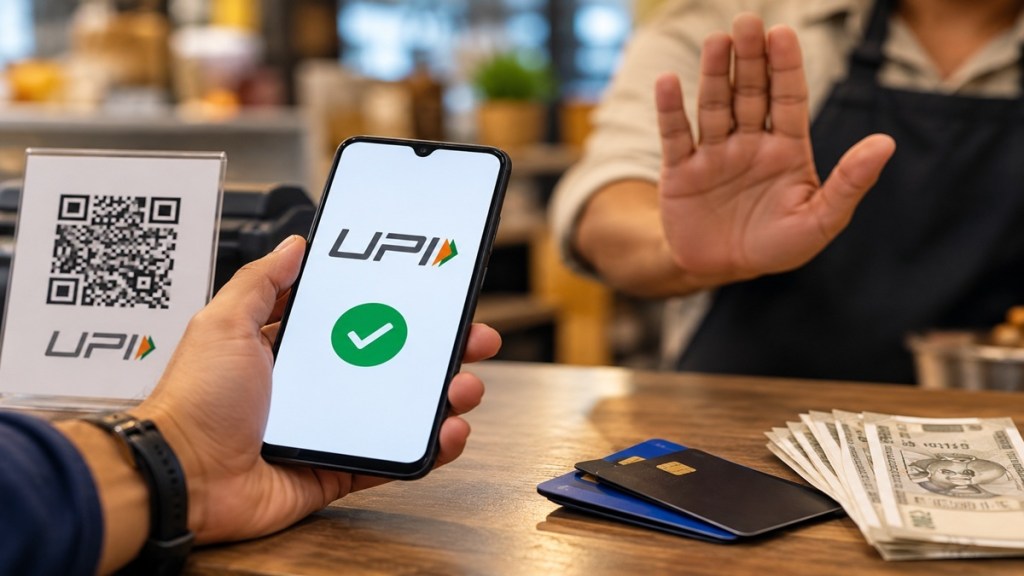

For years, UPI has had one big advantage at the payment counter. It was quick, familiar and free. That equation is set to change for some merchant payments from October 15.
A new Merchant Discount Rate (MDR) of 0.4% will apply to specified UPI person-to-merchant transactions above Rs 2,000. For transactions of Rs 75,000 and above, the MDR will be capped at Rs 300. Payments between individuals will continue to remain free. Small merchants covered under the P2PM category will also remain exempt.
For consumers, there is an important distinction. The new MDR is a charge on the merchant side, not a fee that the customer is supposed to pay. The government framework also says merchants cannot pass the MDR on to customers as a surcharge.
But that does not mean there will be no change in behaviour.
A customer paying Rs 3,000 at a store may still scan the same QR code and pay Rs 3,000 through UPI. But the merchant will now have a Rs 12 MDR cost under the standard 0.4% rate.
That raises a bigger question. If the merchant has to bear the cost, will some businesses start encouraging cash or cards instead? And could customers themselves start choosing cards for larger purchases because of rewards, cashback or credit?
The answer may not be immediate. But October 15 could become an important test for how India’s UPI ecosystem evolves after years of zero-MDR merchant payments.
What exactly is changing from October 15?
The new framework applies to specified P2M, or person-to-merchant, UPI transactions above Rs 2,000.
The standard MDR is 0.4%. A Rs 3,000 UPI payment would therefore mean an MDR of Rs 12 for the merchant. A Rs 50,000 payment would mean Rs 200.
For transactions of Rs 75,000 and above, however, the MDR is capped at Rs 300. So a Rs 1 lakh payment would not attract Rs 400 at 0.4%. The maximum MDR would be Rs 300.
There are also important exemptions and special categories.
Small merchants under the P2PM framework who receive up to Rs 1 lakh a month through UPI QR codes into their bank accounts will continue to get zero MDR. The framework also provides concessional flat MDR of Rs 5 for certain categories such as fuel, insurance, telecom and railways for transactions above Rs 2,000.
So the headline that “UPI will now be charged” is misleading. UPI is not becoming a paid service for ordinary consumers.
The government says consumers will continue to make UPI payments without transaction charges, while person-to-person payments will remain free irrespective of the amount. The change is mainly about how the cost of running the UPI merchant-payment ecosystem is shared.
Why is MDR being introduced now?
This is at the heart of the debate. UPI has grown to a scale where keeping the system running requires substantial spending on servers, technology, fraud prevention, cybersecurity and payment infrastructure.
The Finance Ministry’s FAQ says industry estimates put the annual cost of maintaining UPI operations at around Rs 20,000 crore. The government says the MDR revenue will remain within the UPI ecosystem and can be used for infrastructure, cybersecurity, innovation and customer service.
The government is also proposing a dedicated fund for small merchants, particularly to support digital-payment infrastructure and merchant onboarding in Tier 3 to Tier 6 centres and other targeted areas. The detailed framework for this fund is to be finalised in consultation with the RBI.
This is therefore not simply a decision to make UPI more expensive.
It is also an attempt to create a revenue model for a payment system that has largely operated without a merchant fee. And that is where the next question comes in.
Will consumers move back to cards?
Probably not in a big way immediately. The customer does not have to pay the 0.4% MDR. So there is little direct financial reason for someone to change from UPI to cash just because the merchant is paying MDR.
Archit Singh, Partner at Circle of Counsels, said: “I do not expect any meaningful migration away from UPI, because the consumer pays nothing extra and so has no reason to change. It is important to note that the 0.4% MDR is a merchant-side charge, and the framework expressly prohibits apps from levying platform fees and merchants from surcharging customers.”
There is another reason UPI may remain difficult to displace. It has become a habit.
NPCI data shows that UPI processed 24,508.96 million transactions worth Rs 29.82 lakh crore in August 2026. That is more than 24.5 billion transactions in a single month.
The average transaction size works out to roughly Rs 1,217. That is also important because most UPI transactions are still relatively small.
The government’s own FAQ says transactions up to Rs 2,000 account for more than 95% of P2M transaction volume. So the bulk of everyday UPI usage remains outside the standard 0.4% MDR threshold. But larger purchases are different.
Someone buying a television, paying a large restaurant bill, making a high-value retail purchase or paying a large business invoice may already have a reason to use a credit card. Rewards, cashback, interest-free credit periods and EMI options can make cards attractive.
Singh said: “Credit cards will continue to win on specific high-value purchases where consumers want rewards& points, cash back arrangements, EMIs, or credit float, but that is a pre-existing preference, not a consequence of this MDR. Hence the change may be minuscule.”
That distinction matters. The new MDR may not suddenly push consumers away from UPI. But it could strengthen the existing preference for cards in some high-value transactions.
The bigger question is what merchants will do
The consumer may not care about a Rs 12 cost on a Rs 3,000 transaction. The merchant might. For a large retailer, 0.4% may be a manageable payment-processing cost. But for a small business operating on thin margins, every additional cost matters.
Vaibhav Kakkar, Senior Partner at Saraf and Partners, said: “For small retailers working on very thin margins, there could be considerable impact, however it is unlikely to shift payment modes for businesses at large given the various carve outs and exemptions.”
The numbers also put the cost in perspective.
A Rs 3,000 transaction means Rs 12.
A Rs 10,000 transaction means Rs 40.
A Rs 50,000 transaction means Rs 200.
At Rs 75,000, the standard calculation reaches Rs 300 and the cap kicks in. A Rs 1 lakh transaction would still carry a maximum MDR of Rs 300. For a merchant, the impact will therefore depend on the size and volume of UPI payments rather than simply whether the business accepts UPI.
Can merchants charge customers extra?
No. The framework says merchants cannot pass the MDR on to customers as a separate surcharge. But enforcement could become one of the most important parts of the policy.
A merchant could theoretically tell a customer that a card or cash payment is preferred for a large transaction. Or a merchant could offer a discount for cash. That could create a different kind of payment behaviour without formally charging a UPI fee.
Singh said: “Legally, merchants cannot pass the MDR on as a surcharge. However, the rule cannot prevent a quiet embedding of the cost in prices, a ‘cash discount’, or informal refusals to accept UPI above a certain amount.”
This is where the policy will be tested on the ground. The rule can prohibit a surcharge. But preventing a merchant from simply nudging a customer towards another payment method is more difficult.
Kakkar also pointed to the enforcement challenge: “Since passing on the cost to consumers is prohibited, monitoring and enforcement would be a priority, even if its efficacy remains to be seen.”
For consumers, therefore, the important thing after October 15 will be to understand the difference between a legitimate price and an additional charge imposed specifically for using UPI.
Could people start splitting large payments?
This is another interesting possibility. Suppose someone has to pay Rs 5,000. One possible workaround would be to make multiple payments below the Rs 2,000 threshold.
But that would not necessarily be a smart solution. For consumers, there is little incentive to do this because they are not paying the MDR in the first place.
Singh said: “Splitting is unlikely to come from consumers, since they bear no charge. If it happens, it will be merchant-driven, with the trader asking the buyer to pay Rs 5,000 in three instalments to stay under Rs 2,000.”
There could also be problems with reconciliation, refunds and failed transactions.
Kakkar said: “Salami slicing of transactions will create reconciliation problems, complicated refunds and additional payment failures making such a behavioral shift unlikely.”
There is an even more serious issue if businesses try to route commercial receipts through accounts or QR codes that are not meant for that purpose.
Singh warned: “The more likely workaround is to routebusiness receipts to personal accounts or use personal QR codes to remain within the zero-MDR P2PM category. Both practices carry real risk.”
He added: “Repeated sub-threshold payments are a recognised red flag in bank transaction-monitoring systems and can trigger account scrutiny or freezes. Diverting business income into personal accounts also creates income-tax and GST exposure.”
That means merchants should not look at the Rs 2,000 threshold as an invitation to restructure transactions artificially.
Could cash make a comeback?
This is perhaps the most interesting consumer-side question. UPI has taken away much of the inconvenience associated with cash. A customer does not need to carry notes, find change or visit an ATM. So even if a merchant prefers cash because it avoids MDR, the customer may still prefer UPI.
But merchant behaviour can influence consumer behaviour. If a shop starts offering a small cash discount on a Rs 20,000 purchase, some customers may choose cash. If a merchant refuses UPI for a large transaction, the customer may have no choice but to use another method.
Kakkar said: “A certain range of high value transactions may see some migration to other methods but this is only speculation at this point, and can only be confirmed from data that will be collected after the October 15 enforcement.”
That is an important caveat. There is currently no post-implementation data to establish how consumers will actually behave. The real evidence will come after October 15.
What about credit cards?
Cards could become more attractive in some high-value transactions, but not necessarily because UPI becomes expensive for the consumer.
The reason is different. Credit cards already offer rewards, cashback, EMI facilities and a credit period. For certain purchases, consumers may prefer these benefits over paying directly from their bank account through UPI.
The new UPI MDR could therefore create a small shift in the economics for merchants as well. The government says the new UPI MDR remains substantially below traditional card-based fees. Its FAQ cites typical credit-card MDRs of 1.5% to 2.5% and debit-card MDRs of up to 0.90%, compared with the 0.4% UPI MDR for the specified transactions.
So UPI is still cheaper for merchants than many card-payment alternatives. That makes a wholesale migration from UPI to cards less likely.
But there is now a legal challenge too
The MDR debate has moved beyond merchants and consumers. On September 28, the Supreme Court refused to grant an interim stay on the new MDR framework and issued notices to the Centre, RBI and NPCI on a challenge to the policy. The court is examining questions around the legal and policy basis of the new framework.
That means the October 15 implementation remains an important date, but the legal challenge is now another part of the story. The Supreme Court has not at this stage stopped the rollout. The Centre, RBI and NPCI have been asked to respond to the challenge.
This also means there is an important distinction between the policy being challenged and the policy being stayed. As of now, the latter has not happened.
Why this could be a turning point for UPI
UPI’s biggest strength has been its simplicity. Scan. Enter the amount. Pay. There has been no need for consumers to think about payment charges at the point of purchase.
The introduction of MDR changes one part of that model, even though the customer continues to pay no direct fee.
The government argues that a predictable revenue stream is necessary to support the infrastructure behind UPI. The Finance Ministry’s FAQ says MDR revenue is intended to remain within the ecosystem and support infrastructure, cybersecurity, innovation and customer service.
There is also a competition angle. A sustainable revenue model could potentially make it easier for smaller payment companies and fintech firms to compete with the biggest UPI apps, according to the government’s stated rationale.
Kakkar sees another possible benefit: “Over time, MDR could fund better infrastructure, security and customer service, but its success will depend on preserving merchant acceptance and preventing customer surcharges.”
Singh also sees the move as part of a broader shift in how India’s digital-payment infrastructure is funded: “This is fundamentally a sustainability correction.”
He added: “A predictable revenue stream should fund fraud prevention, cybersecurity and competition beyond the two dominant apps.”
That is the larger question behind the 0.4% MDR. The debate is not simply about whether a merchant has to pay Rs 12 on a Rs 3,000 transaction.
It is about whether UPI can remain as cheap and convenient as it is today while also building a sustainable financial model for the infrastructure supporting it.
So, will Rs 2,000+ UPI payments move to cards or cash?
For now, there is no evidence to say that UPI users will suddenly move away from the platform. The consumer-facing cost remains zero. Most low-value UPI transactions are outside the new MDR threshold. Small merchants under the exempt P2PM category are also protected.
But high-value transactions could see some experimentation. Some consumers may prefer cards where rewards or credit are useful. Some merchants may encourage cash or other payment methods to avoid MDR. Some businesses may try to find ways around the threshold.
The extent of any such shift will only become clear once the new framework is actually implemented. The more immediate issue is therefore not “Will UPI become expensive?” It is “Who will ultimately absorb the cost of making UPI sustainable?”
The government says the cost will remain on the merchant side and that consumers cannot be surcharged. Merchants, meanwhile, will have to decide whether the convenience and reach of UPI are worth the new processing cost.
For consumers, the best thing to remember from October 15 is simple: you are not supposed to pay an extra 0.4% merely because you use UPI. For merchants, the calculation is different.
A Rs 12 cost on a Rs 3,000 sale may be manageable. But across thousands of transactions, it can become a meaningful business cost. That is where the real impact of UPI MDR will emerge.
And after years in which the question was how quickly UPI could grow, the next phase may be about something equally important: how to pay for that growth without weakening the convenience that made UPI so successful in the first place.
Disclaimer: This story is for informational purposes only and does not constitute legal, financial, tax or investment advice. The impact of UPI MDR on merchants and consumer payment behaviour may vary. The actual effect on payment patterns will become clearer after the new framework takes effect on October 15. Readers and businesses should refer to official guidelines and seek professional advice where required.
Every financial journey has a turning point. What’s yours?
Financial Express is launching a new series highlighting real experiences with money, investments, and the taxman. Did a sudden tax rule catch you off guard? Did a piece of financial advice change your life? Your story could provide invaluable, practical lessons for thousands of fellow taxpayers. Share your experience with us. We respect your privacy: no stories will be featured without a direct conversation and your full consent. Thank you.