


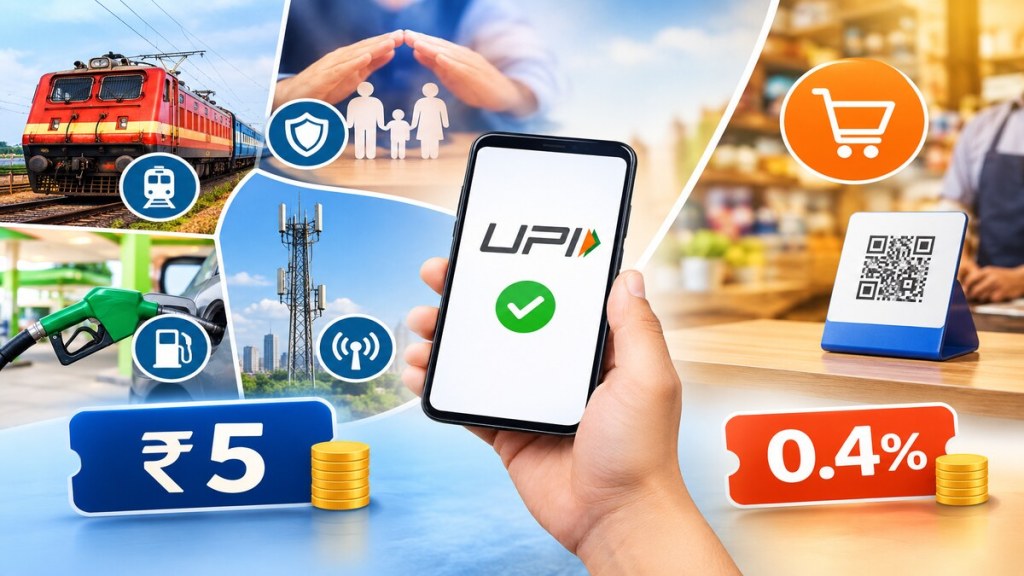

Starting October 15, certain person-to-merchant (P2M) UPI transactions above Rs 2,000 will be subject to a 0.4% MDR under the UPI New Rules 2026 guidelines announced by the National Payments Corporation of India (NPCI). Transactions totalling Rs 75,000 or more will have a maximum MDR of Rs 300.
The Ministry of Finance has made it clear that a flat MDR of Rs 5 per transaction will apply for transactions above Rs 2,000 for certain merchant categories, notably railways, telecom services, insurance, and fuel, among others. These particular sectors pay a flat charge of Rs 5, regardless of the transaction amount, instead of using a 0.4% variable rate.
“This flat-rate model prevents cost escalations in critical public services, utility bill collection, and thin-margin sectors like fuel retail. It ensures that essential consumer services remain low-cost and digitally efficient,” the Ministry of Finance said.
This difference raises the obvious question of why these merchant groups are eligible for a flat MDR rather than a percentage rate.
Therefore, it is important for both merchants and customers to fully understand the proposed slabs and rules. What they should know is as follows.
Why do some UPI merchants face a Rs 5 cap, while others face 0.4% MDR?
The differential appears to reflect a calibrated policy choice between two competing objectives making the UPI ecosystem financially sustainable and avoiding a disproportionate transaction cost on essential or relatively thin-margin services.
Railways, fuel, telecom, insurance and specified utility-type payments typically involve high transaction volumes and, in several cases, comparatively limited merchant margins or regulated pricing.
Applying a straight 0.4% MDR to such sectors could translate into a materially higher payment-acceptance cost without any corresponding increase in the cost of processing the transaction.
A flat Rs 5 charge therefore operates as a form of sector-specific cost protection, while still requiring these transactions to contribute towards the payment infrastructure.
For other eligible merchant transactions above Rs 2,000, the 0.4% MDR subject to an overall Rs 300 cap creates a value-linked contribution towards maintaining the UPI ecosystem, including banking infrastructure, technology, cybersecurity and payment processing.
“The policy rationale behind a lower fixed cap for sectors such as railways, insurance, fuel and telecom is likely to preserve affordability and encourage seamless digital payments in services that have a significant public interest and inclusion dimension,” said Ramkumar Subramanian, Partner, Grant Thornton Bharat.
A differentiated MDR structure allows regulators to support adoption in essential sectors while providing payment ecosystem participants with a more sustainable revenue model in the broader merchant landscape.
“It reflects an attempt to balance consumer convenience, merchant acceptance economics and the long-term resilience of the digital payments ecosystem,” Subramanian added.
Rs 2,000 UPI payment: Is Rs 5 cap cheaper than 0.4% MDR?
For a Rs 2,000 UPI transaction, a 0.4% MDR would translate into a merchant cost of Rs 8, whereas a Rs 5 cap would limit the cost to Rs 5, generating a saving of Rs 3 per transaction.
The breakeven point is Rs 1,250, because 0.4% of Rs 1,250 equals Rs 5.
For transactions above Rs 1,250, a capped fee structure becomes progressively more beneficial for merchants, while for transactions below that level, a percentage-based MDR would result in a lower cost.
The impact is particularly relevant for merchants with a high volume of mid- to large-value UPI transactions, where a capped charge can improve payment acceptance economics while preserving cost predictability.
More importantly, because the new MDR itself applies only to transactions above Rs 2,000, the Rs 5 structure is effectively more favourable for every transaction falling within the chargeable range.
For example, on a Rs 10,000 payment, the ordinary MDR would be Rs 40, whereas a merchant falling within the concessional category would incur only Rs 5.
Will the Rs 5 cap significantly cut payment costs for high-volume sectors such as railways, fuel and telecom?
For sectors processing large volumes and higher-ticket payments, the Rs 5 cap can substantially contain the direct payment-acceptance cost. The benefit becomes progressively more significant as ticket size rises because the charge remains fixed rather than increasing with transaction value.
“However, the commercial impact will also depend upon how the economics are ultimately distributed across acquiring banks, payment aggregators, PSPs and other participants in the payment chain. The new framework is already creating discussions around how MDR revenue is shared within the ecosystem,” said Prabhat Ranjan, Senior Director, Nexdigm.
“Any attempt to recover the economics through a differently labelled charge would have to be examined carefully against the applicable regulatory framework. A charge cannot merely be re-characterised if, in substance, it circumvents the prescribed MDR structure,” Ranjan further added.
Transparency in contractual charges between ecosystem participants will therefore be important.
A lower Rs 5 cap can provide meaningful cost relief for high-volume, low-margin sectors such as railways, fuel retailing and telecom, where even small reductions in per-transaction charges can translate into significant savings at scale.
However, the overall impact will depend on how banks and payment service providers recalibrate their revenue models. If the reduction materially affects their economics, part of the shortfall could be recovered through alternative service fees, commercial arrangements or value-added offerings.
In the near term, the cap is likely to improve cost efficiency for large merchants, but the longer-term outcome will depend on maintaining a sustainable balance between affordability for merchants and adequate incentives for the payments ecosystem to continue investing in innovation, security and infrastructure.
Could differential MDR encourage transaction misclassification?
Whenever regulation creates materially different pricing across merchant categories, there is inevitably a risk of merchant-category arbitrage or misclassification.
The solution should be strong merchant onboarding and classification controls rather than imposing additional friction on genuine businesses.
Merchant Category Codes and the underlying nature of the business should be validated by acquiring banks and payment aggregators at onboarding and periodically thereafter.
Transaction patterns can also be compared against the declared business activity to identify unusual behaviour.
“There should additionally be a clear audit trail for category changes, accountability on acquiring institutions for incorrect classification, and proportionate consequences for deliberate misrepresentation. Given the scale of UPI, technology-led monitoring would be considerably more effective than relying solely on post-facto manual verification,” Ranjan stated.
Whenever pricing varies across merchant categories, there is a risk that some participants may attempt to align themselves with lower-cost segments.
“The key safeguard is a well-governed merchant onboarding and monitoring framework supported by data analytics, periodic audits and strict enforcement against misclassification,” Subramanian said.
A transparent classification regime is essential to preserve both fairness and the intended policy outcomes of differential MDR.
UPI MDR: Who will ultimately bear the cost?
Legally and operationally, the MDR is structured as a merchant-side charge, not a fee payable by the consumer. The government has also advised banks to ensure that merchants do not pass the newly introduced UPI charge directly to customers.
The more nuanced issue is the economic incidence of the charge. Even where a merchant cannot separately add “UPI MDR” to the customer’s bill, businesses ultimately price products and services by reference to their aggregate cost base.
“Consequently, in highly competitive sectors the merchant may absorb most of the cost; in sectors with greater pricing flexibility, part of it could indirectly find its way into general pricing over time. Banks, payment apps and payment service providers may similarly absorb or redistribute portions of the economics depending on their commercial arrangements,” explains Ranjan.
Accordingly, the real policy challenge is not merely determining who formally pays MDR, but ensuring that the charge remains modest enough that businesses do not begin discouraging UPI payments, reducing payment-linked discounts or shifting customers towards alternative modes.
The success of the new framework will ultimately be judged by whether it creates a financially sustainable payment ecosystem without diluting the convenience and near-zero-friction experience that made UPI successful in the first place.
From a consumer standpoint, the immediate impact of an MDR framework may not be visible because merchants, banks and payment service providers are likely to absorb a large part of the cost initially.
However, over time, payment acceptance costs tend to be reflected somewhere in the value chain.
“Depending on competitive dynamics, some merchants may choose to absorb the expense, while others could respond through reduced discounts, lower loyalty benefits, convenience fees on certain transactions, or marginal adjustments in product pricing,” Subramanian said.
The ultimate bearer of the cost will vary by sector and transaction size. Large merchants with strong negotiating power may pass on only a limited portion of the cost, whereas smaller businesses operating on thin margins could find it harder to absorb.
Banks and payment apps may also share part of the burden through revised commercial arrangements, but sustained economics would eventually require costs and revenues to be balanced across the ecosystem.
In a highly competitive payments market, any pass-through to consumers is likely to be gradual rather than immediate.
The key policy challenge will be to maintain the affordability and convenience that have driven UPI adoption while ensuring that all participants in the payments ecosystem have a viable and sustainable business model.
Disclaimer: This article is for informational purposes only and should not be construed as investment, financial, tax, or legal advice. Any illustrations, examples, or return projections used in this article are for explanatory purposes only and do not guarantee actual investment outcomes. The views and opinions expressed by experts quoted in this article are their own and should not be considered investment recommendations. Readers should consult a qualified professional before making any financial decisions.
Every financial journey has a turning point. What’s yours?
Financial Express is launching a new series highlighting real experiences with money, investments, and the taxman. Did a sudden tax rule catch you off guard? Did a piece of financial advice change your life? Your story could provide invaluable, practical lessons for thousands of fellow taxpayers. Share your experience with us. We respect your privacy: no stories will be featured without a direct conversation and your full consent. Thank you.