


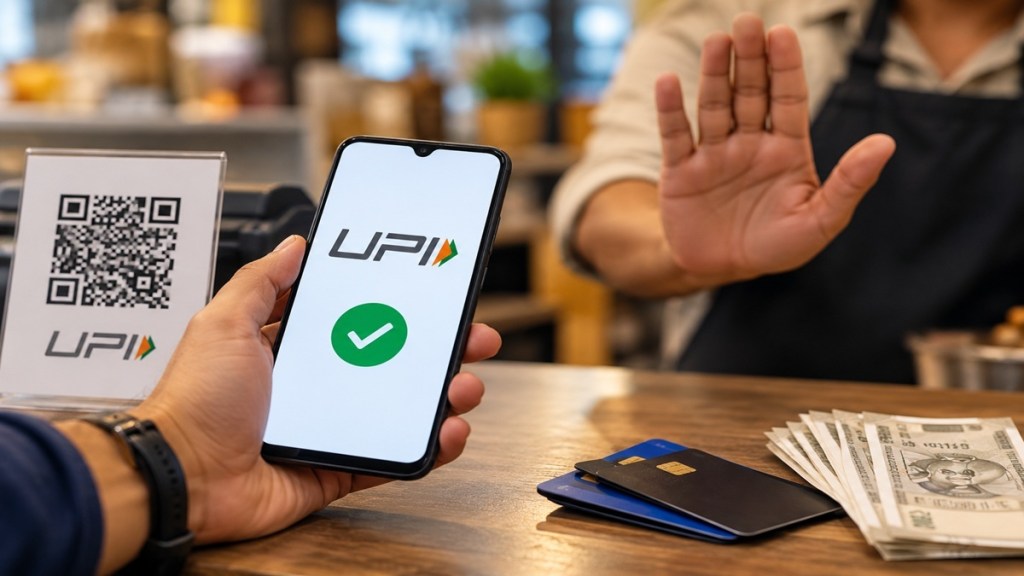

Person-to-merchant (P2M) UPI transactions exceeding Rs 2,000 will be subject to a Merchant Discount Rate (MDR) of 0.4% from October 15, 2026. Transactions worth Rs 75,000 and above will attract a flat MDR of Rs 300 per transaction – a ceiling on UPI MDR charges.
According to the National Payments Corporation of India (NPCI), this suggests that person-to-person (P2P) transactions and P2M payments up to Rs 2,000 would remain free from MDR charges.
However, if you have a Rs 20,000 merchant bill to pay, is it possible to avoid the MDR by simply splitting the transaction into 10 UPI payments of Rs 2,000 each?
Here’s what a UPI user needs to know before making a payment.
What happens when you split a Rs 20,000 UPI payment into 10 UPI payments to dodge the MDR?
If a Rs 20,000 UPI transaction attracts MDR of 0.4%, the fee would be Rs 80. If a customer splits the same payment into ten transactions of Rs 2,000 each, the total value paid remains Rs 20,000, and the aggregate MDR would still generally be Rs 80, unless the pricing framework specifically provides a per-transaction cap or exemption that creates an economic advantage for smaller transactions.
“While a customer can legally and technically split a Rs 20,000 purchase into multiple UPI transactions, the economic outcome will depend on how the MDR framework is designed and enforced,” said Ramkumar Subramanian, Partner, Grant Thornton Bharat.
“If transaction splitting becomes a route to arbitrage pricing rules, payment ecosystem participants are likely to deploy monitoring and aggregation controls. Ultimately, regulation typically seeks to align fees with the underlying transaction rather than the manner in which it is fragmented,” Subramanian further added.
One purchase, multiple UPI payments: Does it reduce MDR?
If MDR is applicable, splitting a single purchase into multiple UPI transactions does not change the underlying nature of the transaction.
Payment systems, acquirers, and merchants typically evaluate transactions based on the overall commercial activity rather than just the number of payment attempts.
While customers may technically make multiple payments against the same bill, any deliberate structuring of transactions solely to reduce or avoid MDR could attract closer scrutiny from payment ecosystem participants and regulators.
“The effectiveness of any MDR framework will ultimately depend on robust merchant classification, transaction monitoring and clear safeguards that prevent arbitrage while preserving a seamless customer payment experience,” according to Subramanian.
Splitting a Rs 20,000 UPI payment doesn’t change what a consumer pays. A normal UPI payment from your bank account doesn’t involve any MDR for you; that cost sits with the merchant, not the customer.
The Rs 2,000 figure that comes up in this context applies to certain prepaid-instrument-based UPI payments, not regular bank-account UPI.
“So breaking the payment into ten Rs 2,000 transactions doesn’t offer a cost advantage, but it can make things harder if you need a refund or want to track the payment later. The simpler approach is to pay it in one go, within your bank or app’s usual transaction limit,” according to Adhil Shetty, CEO, BankBazaar.
UPI MDR: Can multiple UPI payments bypass the MDR?
If transaction-level controls are absent, repeated splitting of a larger purchase into multiple sub-Rs 2,000 UPI payments could create an economic loophole in an MDR framework that exempts smaller-value transactions.
While such behaviour may be technically feasible, relying on bill-splitting at scale would run contrary to the policy intent of linking charges to the underlying transaction value.
“Over time, payment networks, acquirers and regulators are likely to monitor patterns such as multiple sequential payments to the same merchant and may introduce safeguards if the practice becomes widespread,” stated Subramanian.
The long-term effectiveness of the framework will depend not only on the MDR structure itself but also on the ability to detect and discourage artificial transaction fragmentation
If merchants actively encourage customers to split a large payment into multiple smaller UPI transactions to avoid MDR, the primary risk lies with the merchant.
While GST is linked to the value of the underlying sale and not the number of payment transactions, systematic payment splitting can create reconciliation complexities, increase audit scrutiny, and raise questions around compliance with the intent of the payment framework.
Any perceived short-term savings could be offset by higher operational, governance, and regulatory risks if adequate controls and documentation are not maintained.
Key takeaway
In a transaction-splitting scenario, the merchant is usually the main financial beneficiary because the objective is often to reduce payment acceptance costs.
Consumers do not gain materially unless savings are shared with them, while payment providers are unlikely to benefit from behaviour that seeks to bypass the intended MDR framework.
If such practices become widespread, additional safeguards and monitoring mechanisms may emerge to preserve the integrity of the payments ecosystem.
Consumers typically choose UPI for speed and convenience. Splitting a Rs 20,000 payment into multiple transactions undermines that convenience without creating a clear economic benefit, provided MDR remains a merchant-borne cost.
Disclaimer: This article is for informational purposes only and should not be construed as investment, financial, tax, or legal advice. Any illustrations, examples, or return projections used in this article are for explanatory purposes only and do not guarantee actual investment outcomes. The views and opinions expressed by experts quoted in this article are their own and should not be considered investment recommendations. Readers should consult a qualified professional before making any financial decisions.
Every financial journey has a turning point. What’s yours?
Financial Express is launching a new series highlighting real experiences with money, investments, and the taxman. Did a sudden tax rule catch you off guard? Did a piece of financial advice change your life? Your story could provide invaluable, practical lessons for thousands of fellow taxpayers. Share your experience with us. We respect your privacy: no stories will be featured without a direct conversation and your full consent. Thank you.