


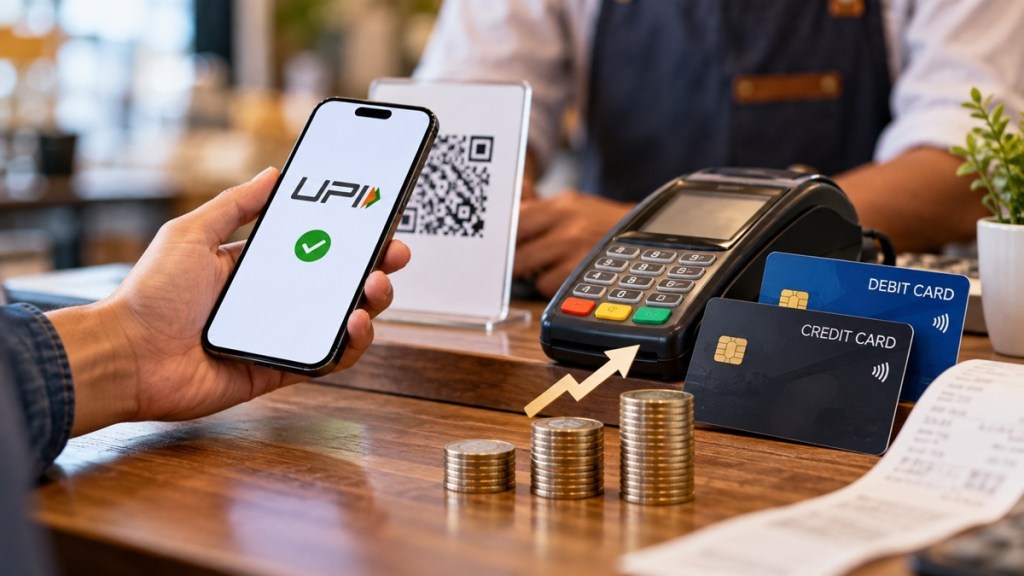

For merchants, UPI has long had one big advantage over cards: there was no Merchant Discount Rate on standard UPI transactions. That is set to change for certain high-value person-to-merchant payments. Under the proposed framework, a 0.4% MDR will apply to eligible UPI P2M transactions above Rs 2,000, bringing a cost to a payment mode that merchants have so far largely accepted without this charge.
At first glance, the new charge may appear significant because it will directly reduce the amount a merchant receives from an eligible transaction. But UPI will still remain cheaper than most debit and credit card payments. The difference becomes particularly visible as the transaction value rises.
For example, on a Rs 5,000 payment, the UPI MDR at 0.4% works out to Rs 20. On a Rs 10,000 transaction, it would be Rs 40, while a Rs 50,000 payment would attract Rs 200. By comparison, using a 0.9% debit card MDR and a 1.5% credit card MDR for illustration, the cost would be Rs 45 and Rs 75 respectively on Rs 5,000, rising to Rs 450 and Rs 750 on a Rs 50,000 transaction.
UPI still cheaper than cards despite MDR
The introduction of MDR changes the economics of UPI for merchants, but it does not necessarily make cards more attractive from a cost perspective.
Vaibhav Kakkar, Senior Partner at Saraf and Partners, said debit card MDR can be capped at 0.9%, while credit card charges generally range between 1.5% and 2.5%, depending on the card and other factors. He also pointed out that RuPay debit cards have a 0% MDR.
This means the proposed 0.4% UPI MDR would still be lower than the rates generally associated with debit and credit cards.
Thomas Stephen, Director and Head – Preferred at Anand Rathi Share and Stock Brokers, also said UPI MDR would remain significantly lower than card charges. According to him, debit card charges can go up to 0.9%, depending on the merchant category, while credit card transactions can range between 1.25% and 2.5%.
The actual cost for a merchant, however, can vary depending on the payment network, merchant category and the agreement with the acquiring bank or payment service provider.
Rs 5,000, Rs 10,000 and Rs 50,000: What will merchants pay?
The difference becomes easier to understand when the numbers are compared directly.
| Transaction value | UPI at 0.4% | Debit card at 0.9% | Credit card at 1.5% |
| Rs 5,000 | Rs 20 | Rs 45 | Rs 75 |
| Rs 10,000 | Rs 40 | Rs 90 | Rs 150 |
| Rs 50,000 | Rs 200 | Rs 450 | Rs 750 |
-Calculations based on NPCI’s UPI MDR framework and illustrative debit and credit card MDR rates.
These figures show why UPI could continue to remain the preferred digital payment option for many merchants even after MDR is introduced.
On a Rs 5,000 transaction, the merchant would pay Rs 25 more if the customer used a debit card instead of UPI, based on the assumed rates. The difference rises to Rs 50 on a Rs 10,000 transaction.
For a Rs 50,000 payment, the gap becomes much wider. The UPI charge would be Rs 200, compared with Rs 450 for a debit card and Rs 750 for a credit card.
Stephen said, “Across all transaction values, UPI MDR comes out cheaper versus debit and credit card transactions.”
The calculation also shows another important point. As the transaction size increases, the absolute MDR paid by the merchant rises under all three payment methods. But the percentage cost remains lower for UPI under the proposed 0.4% rate.
So, will merchants move away from UPI?
Not necessarily. For businesses, the shift from zero MDR to a 0.4% charge does make UPI less attractive than it was earlier. But the comparison changes when UPI is placed against cards.
Kakkar said the introduction of MDR makes UPI less attractive for businesses compared with the current zero-MDR structure. However, it is still cheaper than debit and credit cards in most cases.
This could be particularly relevant for merchants handling high-value payments. A merchant accepting a Rs 50,000 payment through UPI would pay Rs 200 under the proposed rate. A comparable debit card transaction at 0.9% would cost Rs 450, while a credit card transaction at 1.5% would cost Rs 750.
So, even though the merchant now has to pay for UPI, the cost advantage does not disappear.
Mukesh Pandey, Founder and MD of Rupyaapaisa.com, said UPI would remain competitive because of the relatively low 0.4% fee. However, merchants are likely to start comparing the cost of UPI with cards more closely as transaction values increase.
There is also a cap of Rs 300 for eligible transactions above Rs 75,000, according to the expert responses. This means the percentage-based MDR does not continue increasing indefinitely for very high-value transactions.
The biggest impact may be on high-volume, low-margin businesses
The cost may look small when seen on one transaction. The bigger issue for merchants could be the cumulative impact.
A business that handles hundreds or thousands of eligible UPI transactions above Rs 2,000 could see a meaningful amount going towards MDR every month.
This is where merchant margins become important.
Stephen said, “Merchants with already wafer-thin margins may feel the biggest pinch since the 0.4% MDR cost will eat directly into their already slim margins.”
Retail businesses and travel-related businesses could be among those that feel the impact more sharply, particularly if they process a large number of P2M transactions.
Pandey said merchants handling a high volume of P2M transactions are likely to be affected the most. He specifically pointed to businesses in areas such as retail and travel, where transaction volumes can be significant.
For a merchant operating with a comfortable margin, an MDR of 0.4% may be manageable. For a business where margins are already very thin, even a small payment-processing cost can become important when it is multiplied across a large number of transactions.
Could merchants start pushing customers towards other payment methods?
This is where the new MDR could influence merchant behaviour.
UPI has become deeply embedded in everyday payments because it is convenient for consumers and simple for merchants. But once a cost is attached to certain transactions, merchants may have a greater incentive to compare payment methods.
Kakkar said consumers may also have reasons to choose cards if merchants do not pass on the MDR to customers. Credit cards, for example, can offer reward points, discounts and other incentives that UPI may not provide in the same way.
However, merchants are unlikely to abandon UPI simply because of the new charge, particularly when card MDR remains higher.
“Unless card companies are offering more incentives, it will still not motivate merchants to move away from UPI because card transactions will still carry a higher MDR charge,” Kakkar said.
That means the new MDR may not result in a simple shift from UPI to cards. Instead, merchants could increasingly compare the economics of different payment methods based on transaction size, margins and incentives.
The Rs 2,000 threshold could become important
The proposed MDR applies to eligible UPI P2M transactions above Rs 2,000. That threshold could become an important factor in how merchants structure payments.
For transactions below the threshold, the MDR would not apply under the proposed framework described by the experts. This creates a clear difference between smaller and larger payments.
Pandey pointed out that small merchants could remain relatively unaffected, particularly those whose transactions fall within the applicable exemption criteria.
At the same time, Stephen raised another possible merchant response. He said some merchants could consider splitting a larger bill into smaller transactions below Rs 2,000 to avoid the MDR trigger.
“Since the MDR trigger is only on transactions above Rs. 2,000, the merchant may split the bill into smaller values, each less than Rs. 2,000, to circumvent the MDR charges,” he said.
Whether such practices are permitted under the final framework and how payment providers respond to them will be important. Merchants may also have to consider whether such a strategy is practical for their business and compliant with the applicable rules.
Small merchants may feel less pressure
The impact is unlikely to be uniform across the merchant ecosystem.
A small neighbourhood merchant with relatively low monthly transaction volumes may see a much smaller impact than a retailer, travel company or other business processing a large number of high-value P2M payments.
Pandey said some small merchants could continue to have a relatively problem-free experience with UPI. He noted that merchants with monthly transactions of no more than Rs 1 lakh may be exempt from the fee under the criteria he referred to.
For larger merchants, however, the calculation will be different. They will have to factor payment-processing costs into their overall business expenses.
This could also make merchants more conscious of the difference between payment methods. A customer paying Rs 5,000 through UPI may cost the merchant Rs 20 in MDR, while the same transaction through a credit card could cost Rs 75 based on the assumed 1.5% rate.
For a single transaction, the difference is only Rs 55. Across thousands of transactions, it can become a substantial cost.
UPI’s cost advantage is likely to remain
The introduction of MDR marks a significant change because UPI’s zero-MDR model has been one of its biggest advantages for merchants.
But the proposed 0.4% charge does not erase UPI’s cost advantage over cards.
At Rs 5,000, UPI costs Rs 20 compared with Rs 45 for debit cards and Rs 75 for credit cards under the rates used for this comparison. At Rs 50,000, the difference widens to Rs 200 for UPI against Rs 450 for debit cards and Rs 750 for credit cards.
So, the bigger change may not be that merchants suddenly stop accepting UPI. Instead, they may start looking more closely at the cost of each payment method.
For consumers, too, the payment choice could increasingly depend on the combination of convenience, rewards and merchant preference.
As Kakkar pointed out, “For businesses, this shift from 0% MDR to 0.4 MDR for UPI transactions makes it less attractive, but compared to other modes like credit cards or debit cards it’s still cheaper.”
That is perhaps the key takeaway from the proposed change. UPI will no longer be free for certain merchants and transactions, but it is still likely to remain cheaper than cards for most eligible high-value payments. The real impact will depend on transaction volumes, merchant margins, exemptions and how businesses respond to the new cost.
Disclaimer: The UPI MDR rates and transaction limits discussed in this story are based on the proposed framework and expert inputs available at the time of writing. Actual charges may vary depending on the merchant category, payment network, acquiring bank, transaction type and applicable exemptions. Debit and credit card charges used for comparison are illustrative and may differ across banks, card networks and merchants. Readers should check the applicable terms before making financial or business decisions.
Every financial journey has a turning point. What’s yours?
Financial Express is launching a new series highlighting real experiences with money, investments, and the taxman. Did a sudden tax rule catch you off guard? Did a piece of financial advice change your life? Your story could provide invaluable, practical lessons for thousands of fellow taxpayers. Share your experience with us. We respect your privacy: no stories will be featured without a direct conversation and your full consent. Thank you.