


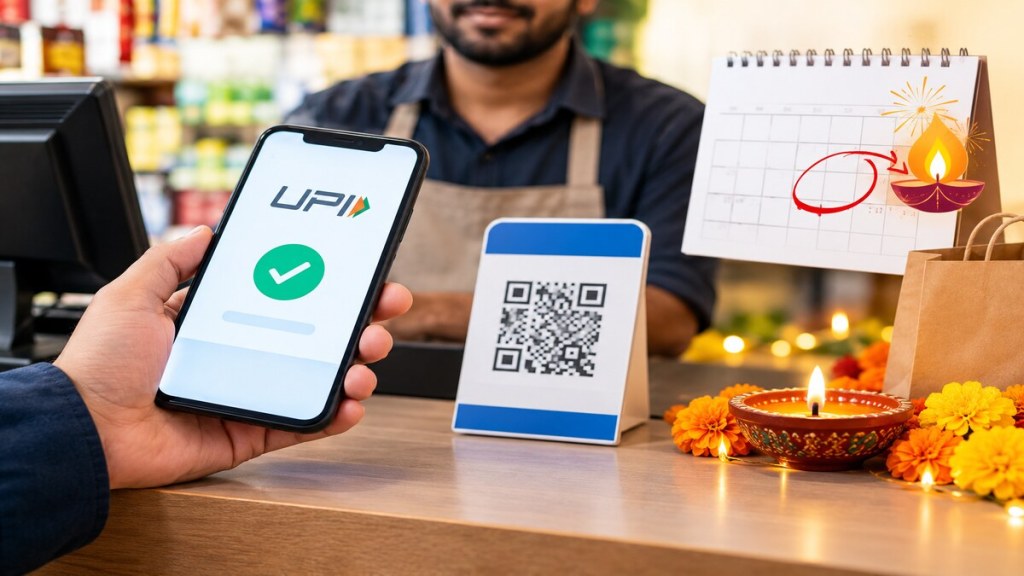

The implementation of Merchant Discount Rate (MDR) on select Unified Payments Interface (UPI) transactions has been deferred till after Diwali, giving merchants and payment companies more time before the new charges come into effect, according to a statement issued by the National Payments Corporation of India (NPCI).
The UPI and Services Steering Committee, in a meeting on October 13, decided that MDR on select person-to-merchant (P2M) transactions would be implemented immediately after Diwali. The exact date will be notified separately, according to a statement issued by the National Payments Corporation of India (NPCI).
The decision comes ahead of the festive season, when digital payments typically see a rise in activity. The new MDR framework was earlier scheduled to take effect from October 15, 2026.
Financial Express reported last week that the October 15 deadline was likely to be extended. NPCI has now confirmed that the implementation of UPI MDR charges on select merchant transactions will be deferred until after Diwali.
What is the new UPI MDR framework?
Under the framework announced in September, select UPI payments made to merchants above Rs 2,000 will attract an MDR of 0.4%. The charge will be capped at Rs 300 for transactions of Rs 75,000 and above.
MDR is a fee paid by merchants to the payment ecosystem for processing digital transactions. It is shared among participating entities, including banks, payment service providers and payment apps. The charge is not a tax collected by the government.
However, the new framework does not mean that customers will have to pay extra every time they use UPI.
Will UPI payments remain free for customers?
Yes. Person-to-person transfers will continue to remain free, irrespective of the amount transferred. Merchant payments of up to Rs 2,000 will also remain free of MDR.
Small merchants receiving up to Rs 1 lakh a month through UPI QR codes under the applicable small-merchant framework will continue to be exempt from MDR.
According to the government, around 96% of merchant UPI transactions will remain unaffected by the new framework.
The government has also clarified that merchants cannot pass on the MDR as a separate UPI charge to customers.
Why has the government introduced MDR now?
UPI has operated under a zero-MDR framework for years, helping drive the widespread adoption of digital payments across India. However, the rapid growth in transaction volumes has also raised questions about how banks, payment companies and other participants will fund the infrastructure needed to run the system.
In August, the government clarified that proposed changes to the Payment and Settlement Systems Act, 2007, were intended to create an enabling framework for introducing limited merchant charges while keeping UPI free for ordinary users.
Following the legislative changes, the UPI and Services Steering Committee announced the new MDR structure in September.
The latest decision delays its implementation until after Diwali, but does not scrap the proposed charges. Merchants and customers will have to wait for the revised implementation date to be formally announced by NPCI.
For consumers, everyday UPI payments are expected to remain unaffected. For merchants, the key question will be how the new charges affect the cost of accepting digital payments once the framework comes into force.